Comparing Fleet Dash Cam Providers: Three Questions That Narrow the Field
Fleets comparing Azuga, Surfsight, BlackVue, Samsara, Rhino Fleet Tracking, and SureCam can narrow the choice with three questions: does footage reach the portal over a cellular network within seconds, does the fleet own that footage, and does the price cover only the tools the fleet will use? A provider that answers all three clearly fits most non-ELD service, construction, and delivery fleets. A provider that hedges on any of them deserves a close read of its contract before signing.
| Question to Ask |
What the Answer Reveals |
Red Flag to Watch For |
| SD card or network-connected? |
How fast footage reaches your team after an incident |
SD-only systems need 12–24 hours for download and review |
| Who owns the footage? |
Whether your team can pull video without the vendor |
Vendor-controlled access during a live claim |
| Does pricing include ELD and routing tools? |
Whether the fleet pays for features it will never open |
Bundled compliance suites that raise cost and onboarding effort |
| What does the all-in monthly fee per vehicle cover? |
True total cost of ownership |
"Starting at" pricing that grows with storage, seats, or contract terms |
Does the Camera Upload Video Over a Cellular Network?
Network-connected cameras send footage to the cloud over the cellular network, so a collision or harsh-braking event reaches the fleet portal within seconds. SD-card systems depend on a person to remove the card, copy the footage, and reinstall it. According to SureCam's dash cam buying guide, incidents captured on SD systems must first be downloaded and reviewed, which can take 12–24 hours. For a driver parked three states from the home depot, the delay stretches further.
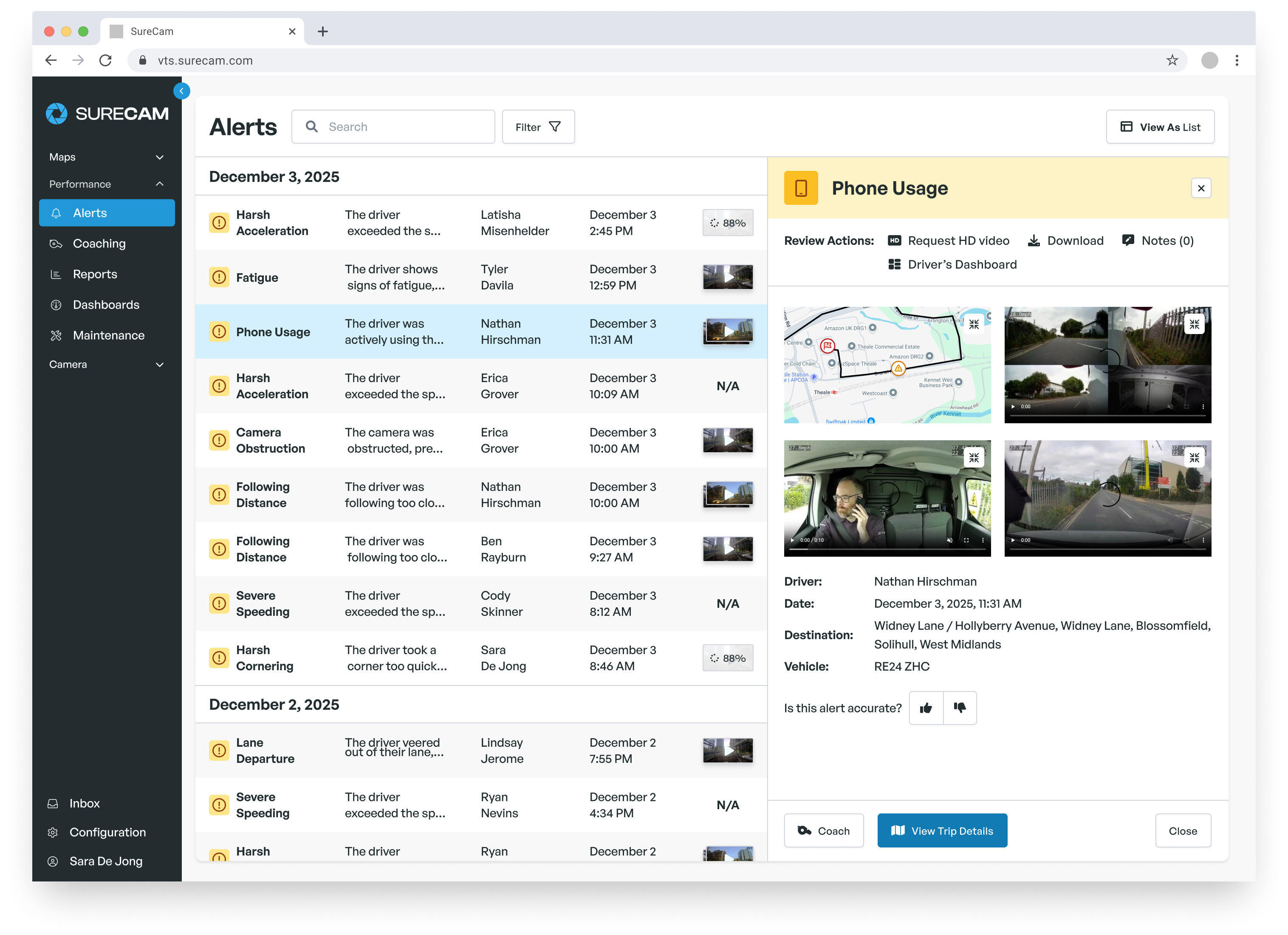
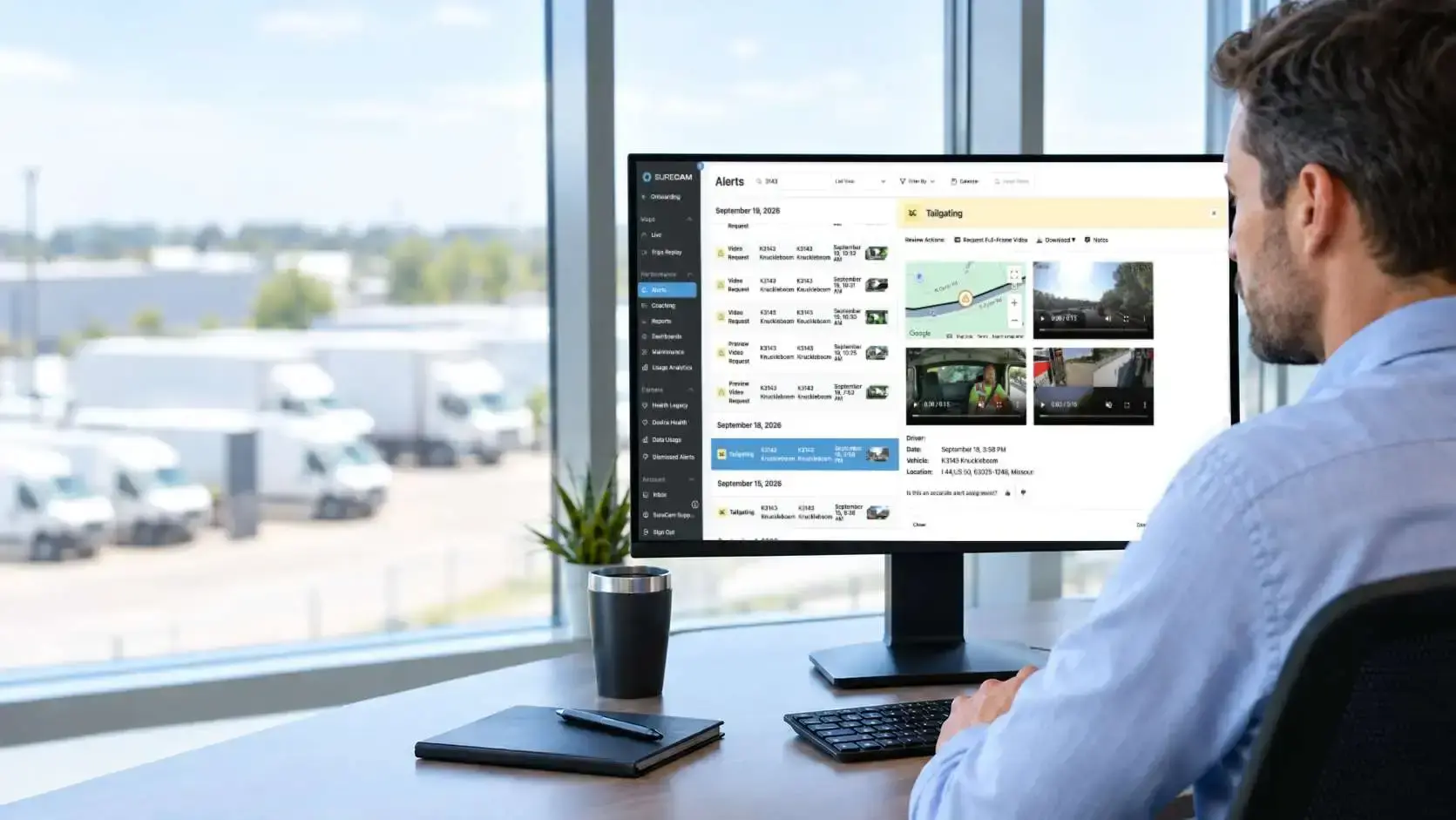
When evaluating Azuga, Surfsight, and BlackVue as alternatives, ask each vendor how incident footage reaches the fleet after a collision, and whether live event alerts and remote video pull are available in the base tier or require an upgrade. Also ask how AI-powered event detection works: which behaviors trigger it, whether GPS ships inside the camera or requires a separate device, and whether speed and g-force data attach to each clip. SureCam builds GPS into every camera, so each clip carries location and trip context without a second purchase.
Who Owns the Footage After It Records?
Some platforms retain administrative control of recorded video and route access requests through the vendor, including requests that arrive minutes after an incident with an adjuster waiting. Before signing, ask whether the fleet owns its footage, whether any authorized user can download additional clips that did not upload automatically as alerts, and what happens to stored video when the contract ends. A fleet should not need to file a support ticket to see its own recording.
Account structure matters here as well. Ask whether user licenses carry a cap, whether the account can mirror the fleet's regional or departmental structure, and whether camera settings change without an account manager. SureCam's fleet camera checklist lists each of these as a standard pressure test. Answers that depend on a service request signal friction that will surface at the worst moment: during a disputed claim.
Does Pricing Cover Only the Tools the Fleet Will Use?
Platform breadth shapes both price and complexity. According to SureCam's published provider comparison, Azuga targets small to midsize fleets that want bundled GPS and safety basics under contract-based plans, while Samsara targets larger, technology-forward fleets that want deep integrations and a full operational stack under tiered pricing. Neither approach misfits every buyer. The risk lies in paying for an ELD, routing, and maintenance stack when the fleet needs cameras and GPS.
Imagine a hypothetical 40-van HVAC fleet that already handles dispatch through a separate system and files no hours-of-service logs. Licensing a full operations suite would add onboarding time, extra dashboards, and monthly cost for modules that never launch. That fleet needs clear video, GPS, and coaching tools its safety lead can run in a few minutes a day.
Scalability deserves the same scrutiny. Ask what changes in the per-vehicle price, user seats, and storage terms at 25, 100, and 250 vehicles. For Rhino Fleet Tracking, confirm whether dash cams function as a core product line or as an add-on to GPS tracking, and whether they upload over cellular. Request a single quote that lists hardware, cloud storage, software, and support, so the comparison reflects total cost of ownership rather than an entry price.
SureCam Performance and Value: Verified Results for 100-Vehicle Fleets
SureCam gives mid-sized fleets AI-powered video telematics with GPS built into every camera. One transparent per-vehicle monthly price covers hardware, software, unlimited cloud storage and unlimited events, and fleets keep direct access to all of their footage. Fleets with 100 or more vehicles use SureCam to cut claims costs, settle disputes with video, and coach drivers, without paying for an ELD or routing platform they don't need.
Footage ownership was a deciding issue for SAV Express, a 100-vehicle dry goods trucking company in Coon Rapids, Minnesota. Its previous telematics provider bundled a camera but claimed the footage as its own and shared it only on the vendor's terms. Video quality was poor, and data costs were high. After switching to SureCam, SAV Express owns its data and gets sharper video. Matt "Jake" Jacobson, Director of Fleet Operations, said the cameras put "the truth of the matter" on record and keep "everyone honest." SAV Express reports more than $1 million saved in repair and claims costs since adopting SureCam. In one incident, a third-party truck backed into a parked SAV Express vehicle at a truck stop. The video documented more than $10,000 in damage the company would otherwise have paid for.
Fleets that already run a telematics or ELD platform don't have to replace it. SureCam integrates with third-party providers such as Geotab, so video adds onto the compliance tools a fleet already uses. UK utility services fleet euroloo pairs SureCam dash cams with Geotab GO9 devices. It reports a 22% drop in idling fuel consumption and a 100% success rate defending against false insurance claims.
SureCam holds a 4.7-star rating on G2. On Trustpilot, a reviewer who has been a customer for about five years wrote in December 2025 that they would refer SureCam to anyone.