What OBD-II Codes Tell a Fleet: Which System Faulted and Where to Look First
OBD-II codes tell a fleet which vehicle system logged a fault, whether the code follows an industry-standard definition, and where a technician should start looking. Each diagnostic trouble code (DTC) uses five characters, and a telematics device connected to the vehicle's OBD-II port can collect those codes and send them to a fleet management platform. SureCam Vehicle Health Diagnostics brings that capability into the SureCam Fleet Management Platform, so maintenance teams can review fault codes without waiting for a driver to return to the shop.
An on-board diagnostics (OBD) system monitors the engine, emissions controls, and related components through sensors that report to the vehicle's engine control unit (ECU). When a fault meets the vehicle's detection criteria, the ECU stores a DTC and, depending on the fault, lights the malfunction indicator lamp that drivers know as the check engine light. A technician then retrieves the stored code through the OBD port with a code reader or scan tool.
OBD-II systems have appeared on US light-duty vehicles since model year 1996, and EPA guidance on vehicle inspection and maintenance programs treats that model year as the starting point for OBD checks (EPA, Performing Onboard Diagnostic System Checks as Part of a Vehicle Inspection and Maintenance Program, EPA420-R-01-015, June 2001). That standardization matters to fleets because a technician or a telematics device can read emissions-related codes from most light-duty vehicles through the same connector and the same communication protocols, regardless of the manufacturer.
For a fleet, the business reason for caring about codes outweighs the technical one. A stored code often marks the earliest visible sign of a problem that otherwise surfaces as a roadside breakdown, a missed appointment, or a failed emissions inspection, and each of those outcomes tends to cost more than a planned repair.
How to Read a Diagnostic Trouble Code: Five Characters Point to the Fault
A DTC reads as one letter followed by four digits, and the first two characters give a manager the fastest read on the problem. The letter names the system: P for powertrain, B for body, C for chassis, and U for network communication between control modules. The second character shows whether the code carries a standard definition shared by every manufacturer (usually 0) or a definition set by the manufacturer (usually 1), with 2 and 3 covering additional ranges.
The final three characters narrow the fault to a subsystem and a specific condition. SAE J2012 defines the generic code descriptions, so a P0 code reads the same on every make. Manufacturer-specific codes behave differently: a P1 code means whatever the manufacturer's service information says it means, which gives fleets running several makes a reason to keep OEM reference material close.
Basic readers often return only the code itself, and the technician then looks up the definition in a code database or in manufacturer documentation. More capable tools also report pending codes (faults detected but not yet confirmed), freeze-frame data (a snapshot of vehicle conditions when the fault set), and live sensor readings. Those extra details help separate a one-time glitch from a recurring failure, which shapes how urgently a vehicle needs the shop.
Handheld Code Readers vs. Remote Diagnostics: Where Each One Fits
A handheld code reader gives one technician deep access to one vehicle at a time, while remote diagnostics give a maintenance team early visibility across the whole fleet. Neither replaces the other. The reader still suits troubleshooting at the shop, and remote collection closes the gap between the moment a vehicle stores a code and the moment someone notices.
| Dimension |
Handheld code reader |
Remote telematics diagnostics |
| How codes arrive |
A technician connects the reader to the OBD-II port |
A connected device sends codes to a platform |
| Timing |
After a driver reports a light or the vehicle reaches the shop |
While the vehicle works in the field |
| Scale |
One vehicle per scan |
The whole fleet in one view |
| Record keeping |
Manual notes unless the shop logs each reading |
Codes recorded against each vehicle in one place |
| Best fit |
Hands-on troubleshooting and repair confirmation |
Early warning and prioritization across many vehicles |
The gap matters because a handheld reader depends on someone physically connecting it. A driver may keep working for days with a light that came on Monday, or never mention an intermittent warning at all. A device that stays connected reports the code when the vehicle stores it, which gives a maintenance team the chance to act while the repair still fits a planned schedule.
A code points to a system, not a root cause, so a technician still confirms the repair. Remote diagnostics change when and how a fleet learns about a fault, and they leave the diagnostic work that follows in the hands of the shop.
What SureCam Vehicle Health Diagnostics Adds to the Fleet Management Platform
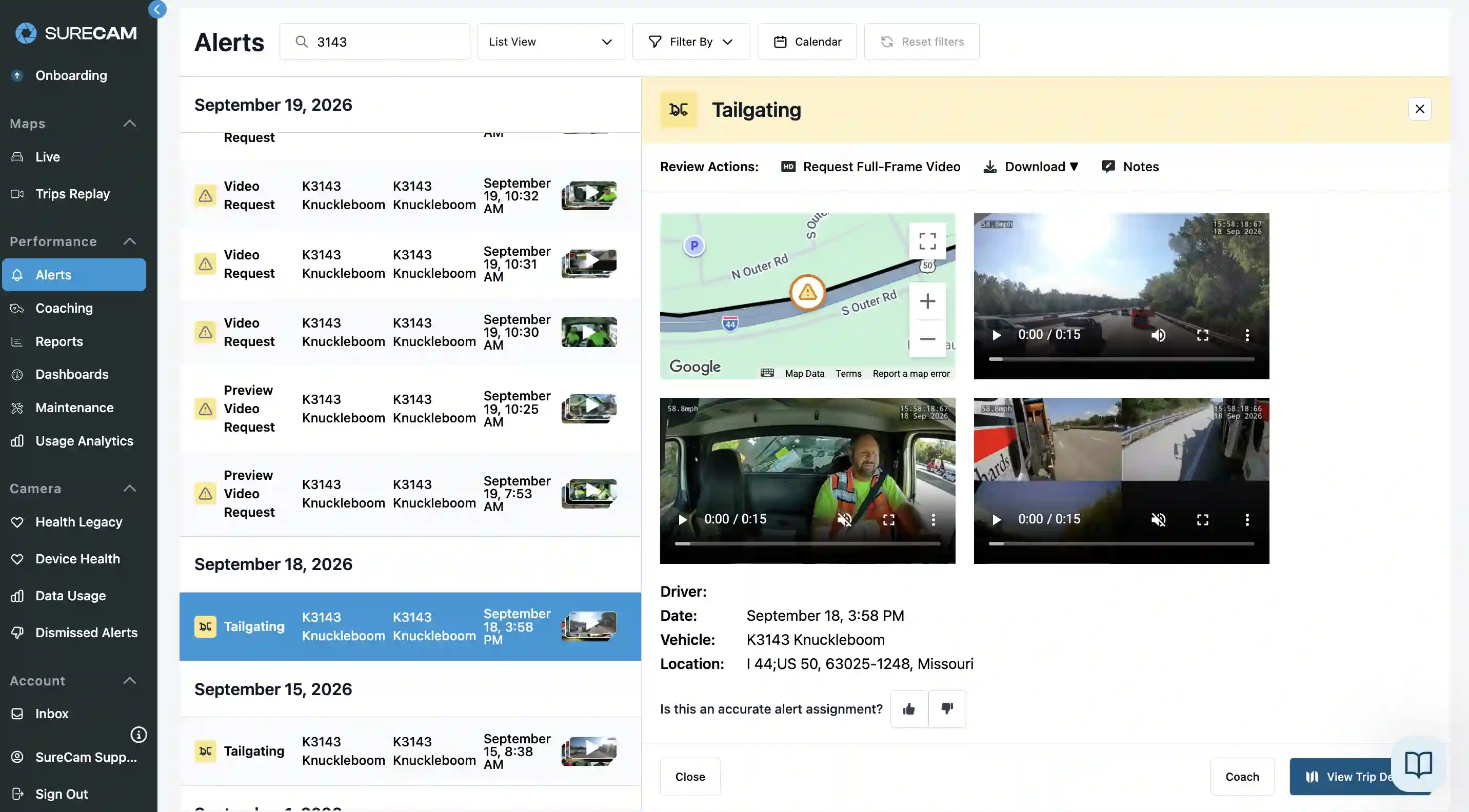
SureCam Vehicle Health Diagnostics adds OBD-II vehicle health data to the platform fleets already use for video, GPS tracking, and maintenance management. Maintenance and operations managers can review vehicle condition in the same place they review driver and location data, instead of switching between a diagnostics tool and a separate set of records.
SureCam's Maintenance Suite covers the scheduled side of upkeep. According to SureCam's Fleet Maintenance page, it flags vehicles due or overdue for service, logs each vehicle's service history with parts, vendors, and costs, sends reminders by odometer, engine hours, date, or custom interval, and tracks warranty expiration dates. Diagnostic data supplies the other half of the picture: reminders cover what a fleet can predict from mileage and time, and fault codes cover what the vehicle reports on its own.
SureCam also ties maintenance to its video and driver coaching tools, which places vehicle upkeep inside the same safety program that handles incident video and coaching. The Fleet Maintenance page describes an all-in-one monthly subscription that bundles hardware, software, and data, with unlimited user licenses included, so a shop supervisor, a dispatcher, and an owner can all view the same information.
From Reactive Code Response to Preventive Maintenance: A Hypothetical Service Fleet
A DTC reports a fault after the vehicle has already detected it, so code alerts work best as one input to a preventive maintenance program rather than a substitute for one. The goal reads simply: fewer codes, caught earlier, resolved on a schedule rather than on the shoulder of a highway. SureCam's Fleet Maintenance page states that preventive maintenance costs three to four times less than emergency roadside repair and that fleets following recommended schedules last 30–40% longer than neglected vehicles.
Imagine a 60-van HVAC service fleet running across two metro areas, with technicians dispatched to residential and light commercial calls every day. On a Tuesday morning, the maintenance coordinator sees a new powertrain code on a van booked for four afternoon calls. Rather than wait for the van to stall between jobs, the coordinator moves the first two calls to a spare vehicle, books a shop slot for that evening, and warns the technician before the shift starts. This illustration shows a workflow, not a measured outcome.
In areas that run inspection and maintenance programs, a stored emissions code or an illuminated check engine light can also stand between a vehicle and a passing result. Because EPA guidance directs those programs to check the OBD system on model year 1996 and newer vehicles (EPA420-R-01-015), fleets that see stored codes early can schedule repairs before an inspection date rather than after a failed test.
Where OBD-II Data Stops: Light-Duty Coverage and Heavy-Duty Trucks
OBD-II diagnostics suit light-duty vehicles such as vans and pickups, while heavy-duty trucks typically report faults through SAE J1939 messages that use a different code structure and a different connector. Where OBD-II codes follow the P, B, C, and U letter format, J1939 faults arrive as a Suspect Parameter Number (SPN) paired with a Failure Mode Identifier (FMI), and heavy trucks commonly use a 9-pin diagnostic connector rather than the 16-pin OBD-II port.
A mixed fleet therefore needs a clear answer to one question for every vehicle class: which protocol covers it. Some medium-duty trucks use a 16-pin connector that looks identical to an OBD-II port yet carries heavy-duty protocol data, and a device that physically connects does not guarantee the full set of diagnostic information.
SureCam's confirmed capability covers OBD-II vehicle health diagnostics. Fleets with Class 6 through 8 trucks in the mix should ask SureCam which vehicles will report diagnostic data before planning an install.
Five Questions to Ask Before Adding Remote Diagnostics
Before adding remote diagnostics, a fleet manager should confirm five things: vehicle coverage, alert routing, code translation, record keeping, and cost. Each question below separates a tool that surfaces codes from one that fits into daily maintenance work.
- Which vehicles in the fleet will report data, sorted by make, model year, and weight class?
- Who receives an alert when a code appears, and through which channel?
- Does the platform translate codes into plain language, and how does it treat manufacturer-specific codes?
- Do codes attach to each vehicle's service history so repeat faults stand out?
- What does the subscription cover, including hardware, software, and installation?
SureCam can walk through all five in a demo of Vehicle Health Diagnostics. Book a demo at surecam.com, or call or text 1-855-870-7205 to schedule time with a product specialist.