Most Stolen Equipment Stays Gone, and Portable Assets Fare Worst
Stolen equipment rarely comes back because owners discover thefts late, keep incomplete ownership records, hold machines that carry no vehicle-style title, and depend on agencies with little capacity for equipment cases. Odds improve when an owner reports fast, supplies an exact PIN, and builds the records before the theft happens.
In 2015, the National Equipment Register (NER) and the National Insurance Crime Bureau (NICB) counted 2,552 recoveries against 11,493 thefts reported to the National Crime Information Center (NCIC), about 22 percent. The 2016 report, the most recent annual NER and NICB edition located, put the figure near 21 percent on 11,574 reported thefts. That data now sits about ten years old, and it leaves out unreported thefts.
That headline rate likely flatters the odds for the equipment small and mid-sized fleets lose most. A 2019 study by Joseph Shrestha and Dustin Osborne of East Tennessee State University analyzed more than 15,000 construction-site thefts in the FBI's National Incident-Based Reporting System (NIBRS). It found recovery below 7 percent across all targets and average losses near $6,000 per incident. Trucks, which carry VINs and titles, came back 55 percent of the time. The datasets use different methods and do not compare directly, yet the NIBRS result shows how sharply recovery splits between titled vehicles and everything else.
Portable assets sit on the weak side of that split. Generators, compressors, welders, light towers, and attachments move easily, resell through the used-equipment market, and often lack an identifier that officers can check quickly. The 2016 NER and NICB report credits generators, compressors, and welders with about 1 percent of that year's recoveries and does not report trailers, light towers, or attachments as separate categories.
Four Structural Reasons Recovery Fails
NER and NICB annual reports list several factors behind low recovery, and four shape the outcome for portable equipment.
Delayed Discovery and Reporting
Equipment sits unattended on weekends, at remote sites, and in shared yards, so a theft can go unnoticed for days. NER and NICB name delays in discovery and reporting as factors, and each lost day gives thieves time to move, strip, or resell a machine.
Imagine a 40-vehicle landscaping fleet that leaves two enclosed trailers and six generators in a fenced, unstaffed yard over a weekend. Thieves load up Friday night. A crew lead notices Monday morning, then spends two hours checking whether a supervisor moved the gear. The police report arrives more than two days after the theft.
Inaccurate or Missing Owner Records
Officers can search only for identifiers they hold. NER and NICB cite inaccurate or nonexistent owner records as a factor. An NER newsletter describes a recovered forklift that produced no immediate theft match because the owner had filed the report with only a partial PIN. NER found the report after searching deeper into its data.
Small units invite loose records. A generator logged as "the yellow unit from the Elm Street job" gives police nothing to enter, and an attachment with no recorded serial number cannot get matched at all.
No Title or Registration for Equipment
Cars and trucks carry a 17-character VIN, a title, and a registration record, so an officer can match a vehicle to its owner from the roadside. Most equipment offers no equivalent. An FBI Law Enforcement Bulletin article pointed to missing registration and title requirements for off-road equipment as far back as 1981, and NER and NICB still cite ambiguous identification number formats.
California offers an exception: NER's 2015 report notes that its mandatory registration programs give law enforcement more opportunities to make recoveries. Elsewhere, an officer checking a machine at 1 a.m. can verify it quickly only if the owner or insurer already placed the PIN in NCIC or NER's database.
Limited Law Enforcement Capacity
NER and NICB cite limited law enforcement resources for equipment investigations, and the 2015 report describes much higher recovery in areas with funding, training, and dedicated heavy-equipment task forces. Errors also creep into reporting, searching, and NCIC entry.
Owners control one part of this problem: report quality. Under the NCIC Vehicle File rules, the agency holding the theft report makes the entry and keeps documentation that supports it, so a thin report produces a thin record. A complete package of exact PIN, photographs, proof of ownership, and location data lets the officer enter the record accurately without a second call to the owner.
The First 24 Hours: Five Steps in Order
Five steps cover the first 24 hours: confirm the theft, pull the PIN and ownership documents, file a police report that includes the PIN, notify the insurer, and register the theft with NER. Order matters because NER treats an item as stolen only when the submission carries a police report number.
- Confirm the theft. Check crew leads, yards, rental returns, and transfer logs for an authorized move. Call police as soon as the theft looks real, because a long internal search spends the hours that matter most.
- Locate the PIN or serial number and ownership documents. A PIN may also appear as a VIN or serial number. NER's theft form requires an accurate PIN and the correct model number, and a partial PIN has delayed matches before.
- File the police report with the PIN included. Give the officer the PIN, make, model, year, photographs, last known location, and any tracker location. Ask for the report number, and confirm the officer entered the PIN exactly as written. Agencies enter stolen equipment into NCIC, the FBI's national database, and the NER 2015 report documents entry errors, including equipment placed in the wrong file.
- Notify the insurer. Supply the police report number, the PIN, and the matching schedule line.
- Register the theft with NER. The NER theft report costs nothing, requires the police report number and an accurate PIN, and accepts up to five pieces per submission. NER works with NICB to make the information available to local law enforcement.
Every recovery step runs through law enforcement. An owner who learns where equipment sits passes that to the investigating officer and stays away.
What GPS Tracking Changes in That Sequence, and What It Does Not
GPS tracking changes steps one and three: it shortens the time to discovery, and it gives police a location in place of a description. It does not compel a police response, keep reporting on a drained battery, or replace ownership records.
What Tracking Changes
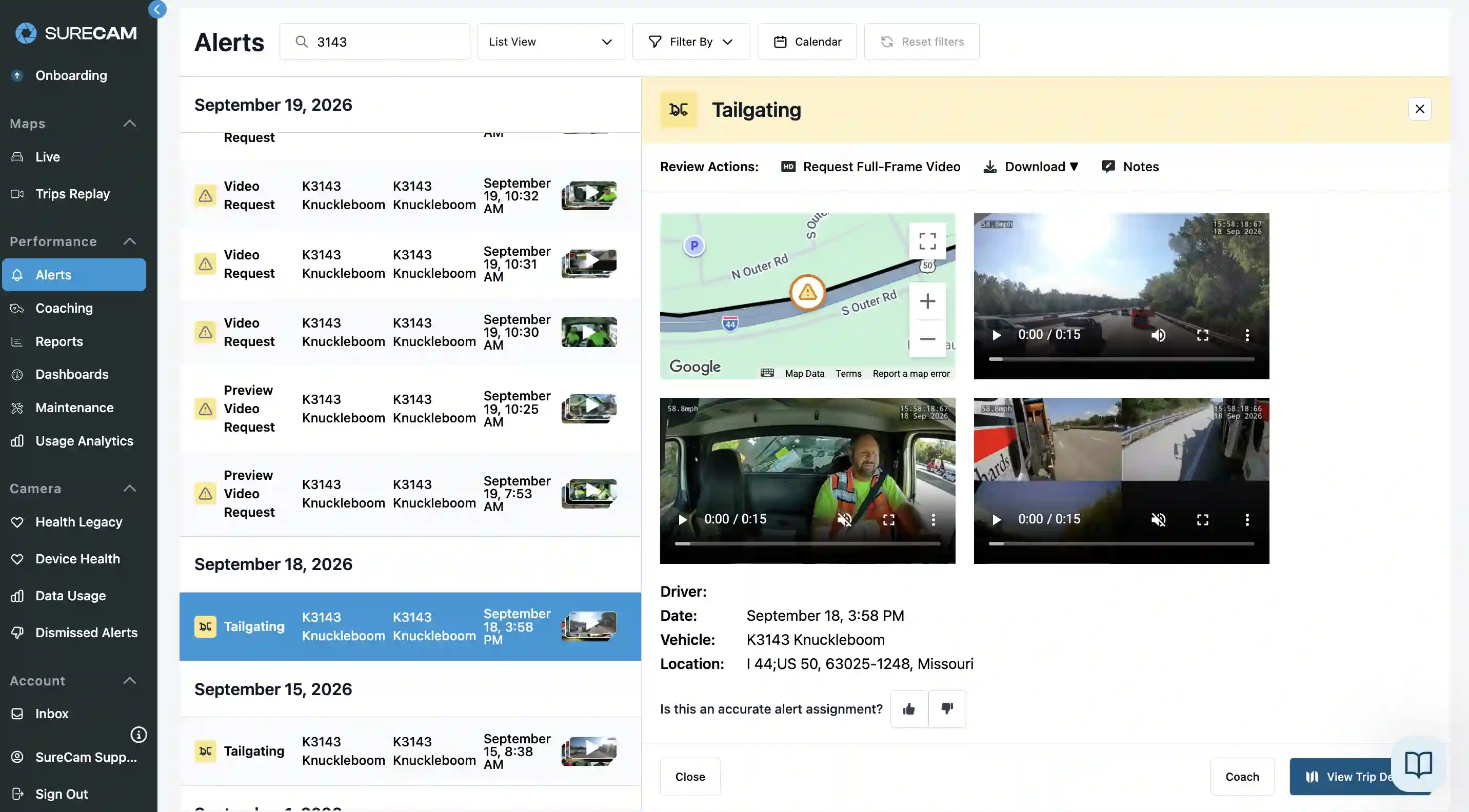
An empty yard makes a theft slow to confirm, and tracking narrows that gap. SureCam asset tracking brings equipment such as trailers, generators, pumps, and small bobcats into the same platform as SureCam vehicle cameras and GPS tracking, with live GPS tracking, geofencing, arrival and departure tracking, and trip history. A departure from a defined yard or site registers in the platform, so data, not phone calls, answers whether a supervisor moved the equipment.
The location and trip history then go into the police report from step three, giving an officer a current position and a movement record to act on. Device selection, including the Powered and Non-Powered options, sits in SureCam's guide to choosing asset tracking for equipment theft prevention.
What Tracking Does Not Change
A location gives officers something to act on, though no tracker obliges an agency to respond, and response varies with caseload and circumstances.
A battery-dependent device stops reporting when its battery drains, and no device supplies the PIN, proof of ownership, or report number that police and NER require. A tracked machine without records leaves the officer unable to confirm ownership at the scene.
Records to Assemble Before Anything Gets Stolen
Four records turn the first 24 hours into a short series of copy-and-paste steps: a PIN and serial inventory, photographs, purchase documentation, and the tracking configuration.
- PIN and serial inventory. Keep one row per asset: PIN, component and attachment serial numbers, make, model, year, and plate location. Check each entry against the plate once, because one transposed character defeats a match. NER recommends registering serial numbers at purchase so law enforcement can identify equipment at any hour.
- Photographs. Capture each machine from four sides, plus close-ups of the PIN plate and distinguishing marks. NER and NICB prevention guidance recommends a photo archive.
- Purchase documentation. Keep bills of sale, invoices, lien releases, and lease or rental agreements as off-site scans.
- Tracking configuration. Record which device sits on which asset and where each geofence boundary runs, so police get the right location data quickly.
What to Tell an Insurer and How Theft History Affects Renewal
Tell the insurer what police received: when and where the theft likely occurred, the PIN or serial number, the police report number, the NER submission, and any location data. Theft claims can influence renewal pricing, because insurers weigh claims history, so ask the broker how a claim will count before renewal talks begin.
Three questions help. First, whether the stolen item sits on the equipment schedule; second, whether the carrier offers a theft deductible waiver tied to tracking or registration; AXA XL describes one for equipment fitted with an operational GPS tracking device. Third, whether the policy sets a reporting deadline. A loss under the deductible still warrants a police report, because the NCIC record and the NER submission depend on the report, not the claim.
Brokers and risk managers can request the PIN and serial inventory at underwriting, so a theft claim starts with identifiers already in hand.
FAQ: Recovering Stolen Equipment
What should an owner do first when equipment gets stolen? Confirm the theft, find the PIN or serial number, and file a police report that includes the PIN. Then notify the insurer and submit an NER theft report.
How often do police recover stolen construction equipment? Rarely. NER and NICB counted recoveries on about 22 percent of NCIC-reported thefts in 2015 and about 21 percent in 2016, and a 2019 study of NIBRS construction-site thefts found recovery below 7 percent across all targets.
Why does a police report need the PIN? A PIN gives officers something to search and match. Agencies enter stolen equipment into NCIC from the report they hold, and NER's theft form requires an accurate PIN plus a police report number before it counts an item as stolen.
Does GPS help recover stolen equipment? GPS can shorten the time to discovery and give police a location to act on. It does not guarantee recovery or a police response, and it does not replace ownership records.
How should an owner report a stolen trailer, generator, or attachment? Report a trailer by its VIN and license plate. Report a generator or attachment by its serial number, make, and model, and add photographs and a description of any distinguishing marks.