The Short Answer
Lytx DriveCam excels at AI-powered driver coaching for large, safety-focused enterprises. But for mid-sized fleets running 50–300 vehicles (or fewer even), Lytx often feels overbuilt: expensive licensing, heavy compliance features you don't need, lengthy coaching cycles, and vendor lock-in on proprietary integrations. SureCam delivers video telematics without the bloat. Simple pricing, faster incident response, third-party integrations, and a web platform designed for operations teams to use daily, not annually. The result: fleets cut their video telematics costs by 30–40% while keeping the safety and claims benefits that matter.
What Lytx Does Well (and Where It Breaks for Mid-Sized Fleets)
Lytx's DriveCam platform earned its reputation in large enterprise fleets. In-vehicle AI coaching that watches driver behavior, sophisticated safety scoring tied to CSA metrics, and deep integrations with compliance workflows make sense for 500+ vehicle operations with dedicated safety teams, compliance officers, and budget room for premium pricing.
But mid-sized fleets operate differently. You likely have one or two people in safety and operations wearing multiple hats. Your drivers work local or regional routes, not interstate long-haul. You care about collisions and third-party claims, not HOS violations and CSA scorecard optimization. Lytx's strength becomes your cost burden. Coaching dashboards you rarely access. Compliance modules built for carriers worried about DOT penalties. Licensing that scales with vehicle count, pricing that assumes you'll use every feature.
One mid-sized construction fleet manager put it plainly: "Lytx is built for Schneider or Swift. We're running 80 trucks in three states. We needed video for insurance and safety. We didn't need to pay enterprise pricing for compliance coaching; no one was reviewing."
Head-to-Head: Lytx vs. SureCam
| Dimension |
Lytx DriveCam |
SureCam |
| Primary Use Case |
Large enterprise fleets, CSA/compliance optimization |
Mid-sized service, construction, and delivery fleets |
| Core Strength |
AI driver coaching, safety scoring, compliance workflow integration |
Video + GPS + simple incident response, AI alerts, and low operational overhead |
| Typical Fleet Size Sweet Spot |
200+ vehicles |
50–300 vehicles |
| Pricing Model |
Per-vehicle monthly, scales with fleet size; enterprise contracts |
Flat hardware lease or purchase + monthly software; scales linearly |
| Coaching Approach |
Centralized video review, manual coaching workflows |
Self-managed (AI alert filtering) or fully-managed (optional) |
| Integration Story |
Proprietary integrations with Geotab and Samsara (some limitations) |
Native Geotab integration; open API for third-party connections |
| Web Interface |
Dashboard-heavy, requires training; features for compliance teams |
Streamlined, designed for daily operations use; instant video access |
| Video Retrieval |
Coaching workflow, ticket-based system |
Instant web access, no ticket required |
| Real-Time Visibility |
Available, but secondary to coaching focus |
Built-in: live map, incident alerts, remote job site monitoring |
| Cost for 80-Vehicle Fleet (Est.) |
$5,000–$8,000/month |
$3,500–$5,000/month |
| Contract Lock-In |
Typically 3+ years |
Flexible: 1–3 year options; free trial available with vehicle minimums |
| Setup & Implementation |
8–12 weeks, dedicated implementation team |
2–4 weeks, self-install or professional install |
Why the Pricing Gap Matters
A 50–80 truck fleet switching from Lytx to SureCam typically saves $500–$1,000 per month in software and licensing. Over two years, that's $12,000–$24,000 in freed cash flow. For fleets with single-digit profit margins, that money funds driver raises, vehicle maintenance, or technology upgrades elsewhere.
Lytx's per-vehicle pricing and compliance-heavy feature set assumes you'll use coaching modules, CSA alignment tools, and HOS integrations. Many mid-sized fleets don't. They need cameras for three things: accident defense, driver exoneration, and third-party claims resolution. SureCam's pricing reflects that simpler mission.
The Coaching Difference: Real-Time Alerts vs. Centralized Review
Lytx's coaching model centers on human review and structured feedback. A coach (often a Lytx vendor or your internal team member) watches highlighted events, creates coaching tickets, and schedules driver feedback. This works well at scale: a 500-vehicle fleet might have a dedicated safety team working on coaching full-time. A 60-vehicle fleet? Coaching becomes another burden on your operations manager.
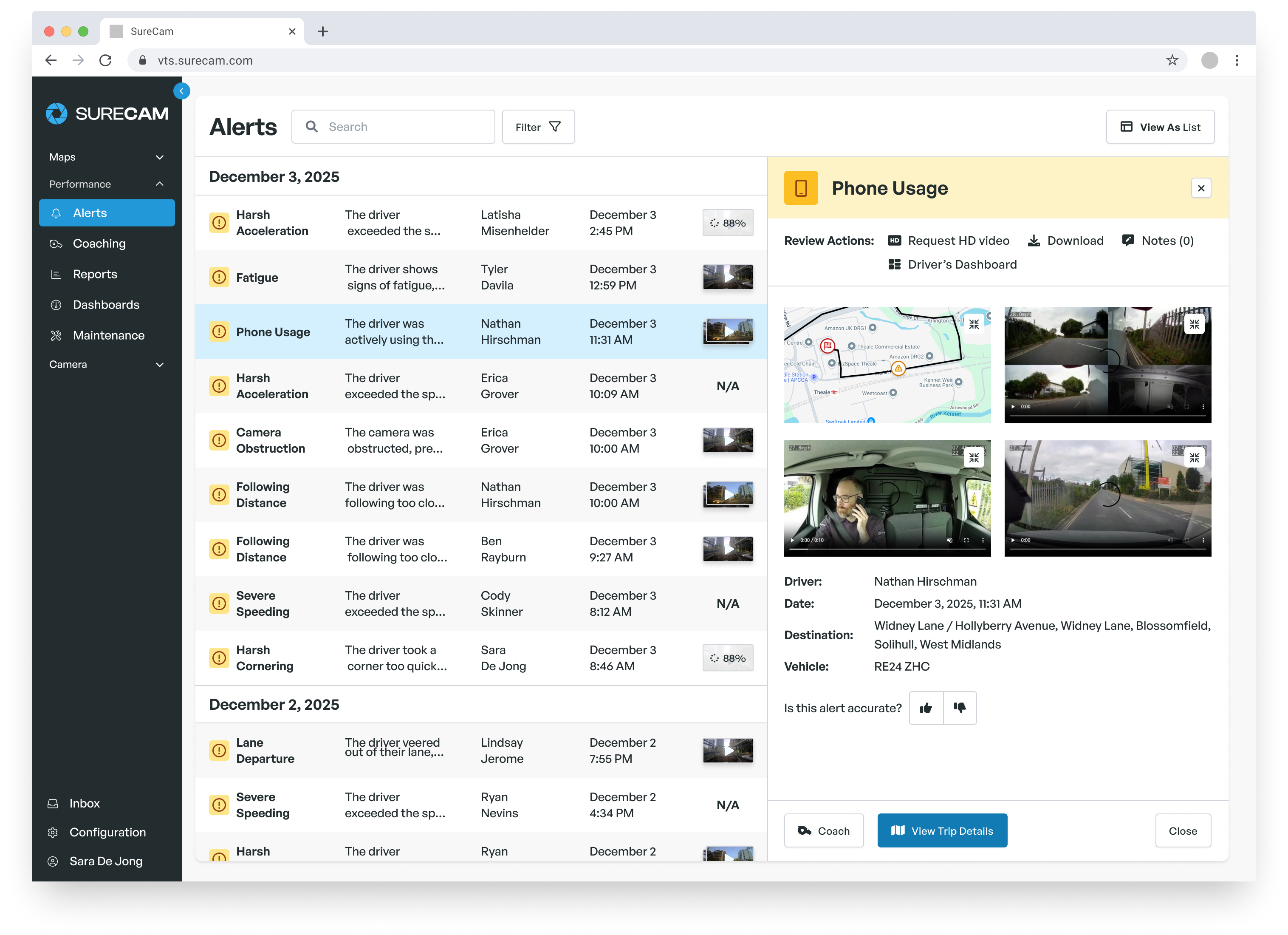
SureCam's coaching approach flips the script. The platform uses AI to filter harsh braking, speeding, and collision events, sending real-time alerts to dispatch or the driver's manager. Coaches decide which events warrant conversation. No tickets, no queues, no workflow bottleneck. For mid-sized operations, this responsiveness matters: a driver gets a text about harsh braking this afternoon, not a coaching ticket three days later.
This is not "better" or "worse" than Lytx. It's a different operational model. Lytx suits large fleets with professional coaching teams. SureCam suits fleet managers who want immediate visibility and real-time response without creating a new full-time job.
Integration and Flexibility: Lock-In vs. Open Architecture
Lytx's integrations are getting better, but the platform still pushes fleets toward proprietary ecosystems. If you already run Geotab or another telematics system, Lytx integration exists, but often with limitations on data flow or manual workarounds. Moving off Lytx later means re-integrating with your telematics stack all over again.
SureCam's architecture assumes you'll keep your existing telematics. Built-in Geotab integration lets you layer SureCam video on top of your current GPS and ELD system without rip-and-replace. Want to switch telematics later? Your SureCam data and videos stay portable. This flexibility costs less upfront and protects your investment if vendor relationships change.
For mid-sized fleets without a dedicated IT person, this matters. Integration shouldn't require vendor calls and implementation projects.
The Real-World Case: How Lansberry Trucking Framed the Investment
Lansberry Trucking, an 80-truck family business running short- and long-haul routes across the US and Canada, faced a choice between two platforms after a $550,000 uninsured claim forced them to adopt cameras. They evaluated DriveCam but chose SureCam after realizing Lytx's coaching workflows and CSA-focused features would require hiring a dedicated safety person.
Within one year, Lansberry cut claims losses by 80% with SureCam. Their safety director reviews all fleet footage in 15–20 minutes per day using instant video access and simple event filtering. Sam Lansberry II, the founder, reframes the investment in business language fleet owners understand: "I don't view our investment in SureCam as a cost, it's a profit center. Last year alone, our claims losses reduced by over 80%."
Lansberry operates where most mid-sized fleets live: between small local operations and large enterprise carriers. Their experience reflects a common pattern: when claims savings and operational simplicity are the goals, SureCam's focused toolset wins over Lytx's broader (and costlier) platform.
When Lytx Still Makes Sense
This comparison favors SureCam for mid-sized, non-ELD fleets. But Lytx remains the right choice for certain operations:
You're an interstate long-haul carrier. If your fleet runs HOS-sensitive routes and CSA scoring affects your insurance premiums, Lytx's compliance integrations and coaching workflows justify the cost.
You have 300+ vehicles and dedicated safety staff. Enterprise fleets benefit from Lytx's coaching scale and compliance depth. If you employ a safety director, compliance manager, or insurance risk coordinator, Lytx's features will be used.
You need customized coaching workflows. Lytx's professional services team can build custom coaching logic and integrations. Mid-sized fleets rarely need this level of customization.
You're already locked in. If your insurance partner, broker, or parent company mandates Lytx, switching costs (contract penalties, retraining, data migration) may outweigh savings.
How to Migrate from Lytx to SureCam Without Disruption
If you've decided to switch, the migration path is straightforward.
Phase 1: Parallel Operation (Weeks 1–2). Install SureCam cameras on a pilot fleet of 10–15 vehicles while keeping Lytx running on the rest. Use this to validate video quality, familiarize your team with the SureCam web portal, and confirm incident response workflows match your expectations. Lytx remains your source of truth during this phase.
Phase 2: Ramp to Full Deployment (Weeks 3–6). Once pilots confirm the platform works for your operation, schedule SureCam installation on remaining vehicles. Timing matters: avoid installation during peak operational windows. SureCam's self-install option lets you control the schedule and avoid downtime costs.
Phase 3: Historical Data Handoff (Week 7+). Export your key metrics from Lytx (incident counts, claims data, safety scores) and document them before you cancel service. SureCam's reporting tools will track results going forward. This creates a clean baseline for measuring post-switch ROI.
Contract End. Check your Lytx agreement for early termination penalties. Some contracts allow 30–60 day exit windows annually. Timing your migration to align with renewal dates can eliminate or reduce penalties.
One note: if you run a Geotab system, coordinate with your Geotab partner on the integration handoff. SureCam's Geotab integration is plug-and-play, but your telematics vendor should confirm the data flow is clean before you shut down Lytx.
The Numbers: What Mid-Sized Fleets Expect to Save
A 60–80 vehicle fleet moving from Lytx to SureCam typically sees:
- Monthly software savings: $4,000–$6,000 (Lytx ~$8,500/month for 70 vehicles; SureCam ~$3,200/month for the same)
- Implementation cost reduction: Lytx deployment averages 8–12 weeks and $15,000–$25,000 in vendor services; SureCam self-install or professional install costs $500–$2,000 total
- Claims cost reduction: Most mid-sized fleets reduce claims by 30–50% in year one after deploying video. This reduction applies equally to Lytx or SureCam, but you'll pocket the margin faster with SureCam
- Operational labor: SureCam's simpler interface cuts time spent in the platform by 20–30% compared to Lytx coaching workflows
- Year-one net savings: $48,000–$84,000 after factoring in hardware, installation, and software
For mid-sized fleets, this savings is material. It often funds a driver retention program, vehicle maintenance improvements, or technology upgrades elsewhere in the operation.
Making the Case to Your Leadership Team
If you're evaluating this switch, frame it in language your CFO and operations leadership understand:
Total Cost of Ownership. Compare all-in costs: hardware, software, implementation, training, and integration support over three years. Lytx averages $300,000–$450,000 for a 70-vehicle fleet; SureCam averages $150,000–$220,000.
Return on Claims Reduction. Video reduces claims by 30–50% in year one regardless of vendor. But your cost-per-claim-prevented is 40–50% lower with SureCam. This is material for mid-sized fleets where claim costs run $15,000–$40,000 per incident.
Operational Bandwidth. Estimate your team's time in the platform weekly. Lytx coaching workflows often demand 5–8 hours per week for someone to create tickets, assign coaching, and track compliance. SureCam requires 1–2 hours per week for incident review and flag management. That's 200 hours per year your team gets back.
Scalability. If you plan to grow your fleet, Lytx's per-vehicle pricing scales up painfully. SureCam's flat-rate plus hardware keeps marginal costs low for additional vehicles.
Final Word: Right-Sizing Your Technology to Your Operation
The best camera system is the one your team will actually use. Lytx excels for large enterprises with dedicated safety functions and compliance pressure tied to their business model. Mid-sized fleets, though, operate with tighter margins and leaner teams. They need cameras that deliver claims defense, driver exoneration, and safety visibility without creating new operational overhead or bloated pricing.
SureCam fills that gap. It's not flashier than Lytx. It doesn't promise coaching AI that will transform your culture. It promises something simpler and more valuable for mid-sized operations: video evidence when you need it, integration with your existing systems, and pricing that lets you compete without bleeding cash on features you'll never use.
If you're evaluating cameras for a 50–250 vehicle fleet and feeling stuck between Lytx's enterprise pricing and cheaper retail dash cams, SureCam is worth a closer look.



.png)