The Fleet Hidden in Plain Sight
Every safety director has a version of this problem. The fleet list in the telematics portal shows 45 vehicles. The actual number of vehicles driving on company time, on company business, at the company's legal exposure: closer to 80. The rest belong to employees who get a mileage check and a handshake.
Grey fleet vehicles (privately owned cars used for work journeys, typically reimbursed at a per-mile rate) represent one of the most undermanaged risk categories in commercial transportation. They sit outside standard fleet procurement, outside telematics contracts, and often outside the safety programs that cover employer-owned vehicles. The driver's personal insurance policy handles the vehicle. The organization handles the liability when something goes wrong at work.
That gap creates real exposure. And as duty-of-care regulation continues to tighten on both sides of the Atlantic, fleet managers and HR/compliance officers can no longer treat grey-fleet vehicles as someone else's problem.
What Grey Fleet Actually Means for Risk Managers
Older Vehicles, Weaker Standards, Less Oversight
Employee-owned vehicles used for work tend to be older than employer-managed fleet vehicles. They may lack the advanced driver assistance systems (ADAS) that newer commercial vehicles carry as standard: lane-keep assist, automatic emergency braking, blind-spot monitoring. They go through MOT or state inspections on the employee's schedule, not a fleet maintenance protocol. When a tyre wears below safe limits or a brake pad thins out, no fleet dashboard throws an alert.
The oversight gap compounds the mechanical one. A company vehicle typically carries GPS tracking, a dash cam, and a manager who can pull footage after an incident. A grey-fleet vehicle gets reimbursed miles and, in most programs, nothing else. The organization pays for the miles but has no visibility into how those miles happened: the speed, the following distance, the phone in the hand.
The Duty-of-Care Reality
In both the United States and the United Kingdom, the duty of care extends to employees driving their own vehicles for work purposes. UK Health and Safety at Work Act obligations and the Corporate Manslaughter and Corporate Homicide Act apply regardless of who owns the vehicle. U.S. employers face vicarious liability under the respondeat superior doctrine when employees cause accidents while acting within the scope of employment, and "scope of employment" routinely covers personal-vehicle business trips.
That legal exposure does not disappear because the vehicle title sits in the employee's name. Courts and regulators look at who directed the journey, who benefited from it, and whether the employer took reasonable steps to manage the risk. An organization that tracked driver behavior in company-owned vehicles but did nothing for grey-fleet drivers often finds that contrast used against it in litigation.
Insurance costs reflect this reality. Fleet underwriters increasingly request declarations about the percentage of business mileage driven in non-fleet vehicles. Organizations that cannot demonstrate any oversight program for those miles frequently pay higher premiums or face coverage gaps.
The Legal Patchwork: What Fleet Managers Need to Know
Dash Cam Law Varies by Jurisdiction
Deploying dash cams across grey-fleet vehicles requires navigating a patchwork of rules that differ meaningfully by country, state, and use case.
In the United States, windshield mounting restrictions vary by state. California, New Jersey, and a handful of others restrict the placement area and size of devices mounted on windshields. Most states permit dash cams provided they do not obstruct the driver's forward view, but "obstruct" receives no uniform definition. Audio recording rules present a second layer of complexity: all-party (two-party) consent states, including California, Florida, and Illinois, require all parties in the vehicle to consent to audio recording. For employer-deployed cameras in employee-owned vehicles, this typically means written consent as part of the dash-cam policy agreement.
Driver-facing cameras add another consideration. In-cab cameras that record the driver's face and behavior generally require disclosure and consent. Several U.S. states have introduced or actively considered legislation targeting the use of driver-monitoring systems, with requirements ranging from notice to opt-out rights. Staying current requires legal review at deployment, not just at purchase.
In the United Kingdom, the Information Commissioner's Office (ICO) publishes guidance on dash cam use in employment contexts under the UK GDPR framework. Employers must document a lawful basis for recording, typically legitimate interests for road-facing cameras and explicit employee consent or contractual necessity for driver-facing systems. Data retention periods, access controls, and subject access rights must all appear in a written policy. Deploying cameras in employee-owned vehicles without this documentation risks ICO enforcement action.
Practical Compliance Steps Before Deployment
Organizations planning a grey-fleet dash cam program should complete four baseline steps before any camera touches a windshield. First, obtain a legal review of audio recording requirements in every state or country where grey-fleet drivers operate. Second, draft a written camera use policy that specifies what gets recorded, how long footage stores, who accesses it, and under what circumstances. Third, build explicit written consent into the grey-fleet reimbursement agreement or a standalone camera program addendum. Fourth, confirm the vehicle insurance picture: some personal auto policies exclude employer-installed equipment, and the organization may need to indemnify employees for hardware installed at the organization's direction.
These steps protect the organization and the driver. A program built on clear consent and transparent policy also removes the primary objection most employees raise when cameras enter personal vehicles.
How Dash Cams Address the Duty-of-Care Gap
Visibility Replaces Assumption
The fundamental problem with grey-fleet safety programs that rely on mileage reimbursement alone is that the organization assumes the driver behaved safely and the vehicle performed properly. Assumptions cost money when they turn out to be wrong.
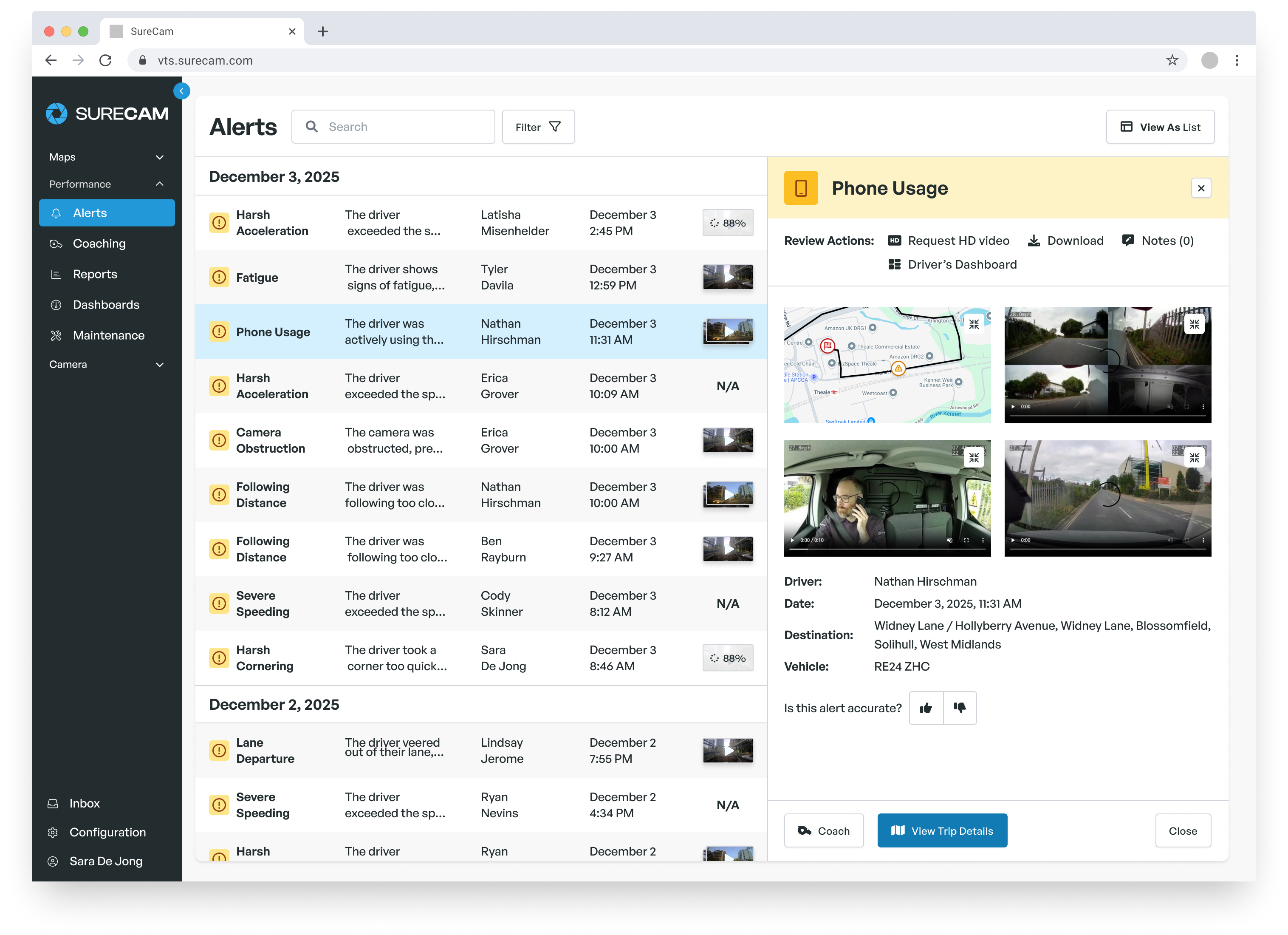
Network-connected dash cams replace assumption with evidence. When a harsh braking event triggers an automatic upload, the safety manager does not need to call the driver, pull a police report, or wait for an insurance adjuster's summary. The footage arrives within seconds. Speed, G-force data, and GPS position accompany it. The incident either happened as described, or it did not, and the video makes that clear before the conversation starts.
For grey-fleet programs specifically, this visibility serves two functions. It gives the organization the oversight information it needs to demonstrate reasonable duty-of-care compliance. And it gives the driver something valuable in return for accepting a camera in a personal vehicle: protection against false or exaggerated claims. That reciprocity matters for program adoption.
What a Responsible Grey-Fleet Dash Cam Program Looks Like
Ringway Jacobs, a UK highway services contractor that manages road networks for local government, deployed SureCam cameras across a fleet of 250 trucks and 350 vans. Before cameras, the organization carried a high accident rate and poor driver behavior scores. Two years after deployment, accident rates and unsafe driving behavior had dropped 54%. Head of Fleet Operations Dave Bonehill noted that drivers initially resisted the cameras, then shifted to active advocates once the footage began exonerating them in incidents not of their making: "It was only when we had a number of incidents that we had to prove our drivers were not at fault. It was then that the cameras started to become respected and approved by drivers."
The lesson applies directly to grey-fleet programs. Drivers who fear being watched without recourse become advocates when they experience footage working for them, not just against them. A well-constructed policy that explains how footage defends drivers in disputed incidents addresses the resistance before it starts.
Building a Grey-Fleet Dash Cam Policy That Works
What the Policy Must Cover
A grey-fleet camera policy needs to answer six questions with no ambiguity. Who qualifies (minimum vehicle age, insurance requirements, annual licence and MVR check)? What gets recorded and stored (event-triggered only versus continuous, retention period)? Who can access footage and when (manager-level access, legal hold provisions)? What triggers a review (event threshold, incident report, insurance claim)? How does the organization handle coaching conversations arising from footage (process, timeline, tone)? What happens when a driver leaves the organization or the vehicle no longer meets standards?
The clearest policies treat the camera as a safety tool for the driver and a liability management tool for the organization simultaneously. Both framings belong in the document, not one or the other.
Technology Standards for a Mixed Fleet
Grey-fleet cameras should meet the same technical standards as cameras on employer-owned vehicles. Network-connected cameras, not SD-card devices, remove the friction of manual footage retrieval and eliminate the risk of footage being lost, damaged, or overwritten before anyone extracts it. Cloud storage with defined retention periods simplifies legal hold management when claims arise months after an incident.
AI event detection matters especially in grey-fleet deployments because no fleet manager can watch grey-fleet drivers in real time. The camera needs to identify and upload the events that require attention without generating so many alerts that safety managers stop reviewing them. Configurable sensitivity, triggered by G-force thresholds and AI-identified behaviors (hard braking, rapid acceleration, phone interaction), keeps the alert volume manageable.
SureCam's platform supports mixed-fleet deployment, where company-owned and employee-owned vehicles appear in the same portal under the same reporting structure. Safety managers get a unified view rather than one dashboard for fleet vehicles and a separate spreadsheet for grey-fleet trips. Privacy controls, including location privacy zones that disable recording in defined geographic areas (near an employee's home, for example) and time-of-day privacy settings that disable recording outside business hours, address the most common employee objections to cameras in personal vehicles.
The Business Case for Acting Now
Grey-fleet risk will not shrink. The proportion of business miles driven in personal vehicles continues to grow in service-heavy industries as hybrid work patterns shift commuting and travel habits. Litigation environments in both the U.S. and UK have grown less forgiving of organizations that documented robust safety programs for company vehicles but left grey-fleet drivers without any oversight.
The argument for deploying cameras on employer-owned vehicles and ignoring grey-fleet risk amounts to this: the organization took the easy vehicles and accepted the hard ones as unmanageable. Plaintiffs' counsel and underwriters see it the same way.
A grey-fleet dash cam program that starts with a clear legal review, a written policy built on consent, and network-connected cameras with AI event detection closes that gap. It gives drivers something that makes a personal vehicle feel less exposed. And it gives safety directors the evidence they need when incidents happen on business miles driven in a car the organization never owned. Contact a fleet safety consultant today to see how SureCam can help you manage your company car fleet while protecting your drivers' privacy.



.png)