What You Actually Pay For (And What Pays You Back)
A $550,000 claim lands on your desk. Your driver swears it was the other driver's fault. You have no footage, no data, no leverage. That number gets paid, at least in part, and your insurance renewal becomes a very uncomfortable conversation.
That scenario pushed Sam Lansberry II, founder of Lansberry Trucking, to install network-connected cameras across his 80-truck fleet. One year later, claims losses dropped 80%. "I don't view our investment in SureCam as a cost," he said. "It's a profit center."
That reframe matters when budgeting for video telematics. The question isn't only what the cameras cost. The question is what not having them costs. For most commercial fleets, the math tilts hard toward investment, and it starts with understanding the actual numbers on both sides of the ledger.
Breaking Down Fleet Dash Cam Costs
Hardware: Forward-Facing, Dual-Facing, and Multi-Camera Systems
Hardware costs vary by configuration, and most fleets will see two or three tiers depending on their vehicle mix and coverage goals. Below are some typical ranges you will find while shopping for class-leading commercial dash camera systems for your fleet.
Forward-facing cameras represent the entry point. A single road-facing connected dash cam with cellular upload, GPS, and g-force data typically falls in the range of $200–$400 per unit at purchase, or folds into a monthly subscription that eliminates upfront outlay entirely. These cover the most common claim scenario: a front-end collision or liability dispute about what happened on the road ahead.
Dual-facing cameras (forward plus in-cab) run higher on hardware, typically $250–$450 per unit, but add the driver-facing view that supports coaching programs, seatbelt compliance, and distracted driving documentation.
Multi-camera systems, such as side-view or rear-road-facing setups for larger vehicles, step up again. Full multi-view configurations on trucks and vans can reach $500–$1000 per vehicle in hardware alone, depending on the number of camera channels and whether AI processing runs on-device.
The right configuration depends on what you actually need documented. A concrete mixer fleet battling flying debris claims needs front coverage first. A steel hauler worried about unloading liability needs rear-facing. A fleet building a driver coaching program benefits from in-cab. Buy what solves the problem rather than the most expensive system available.
Monthly Subscription and SaaS Fees
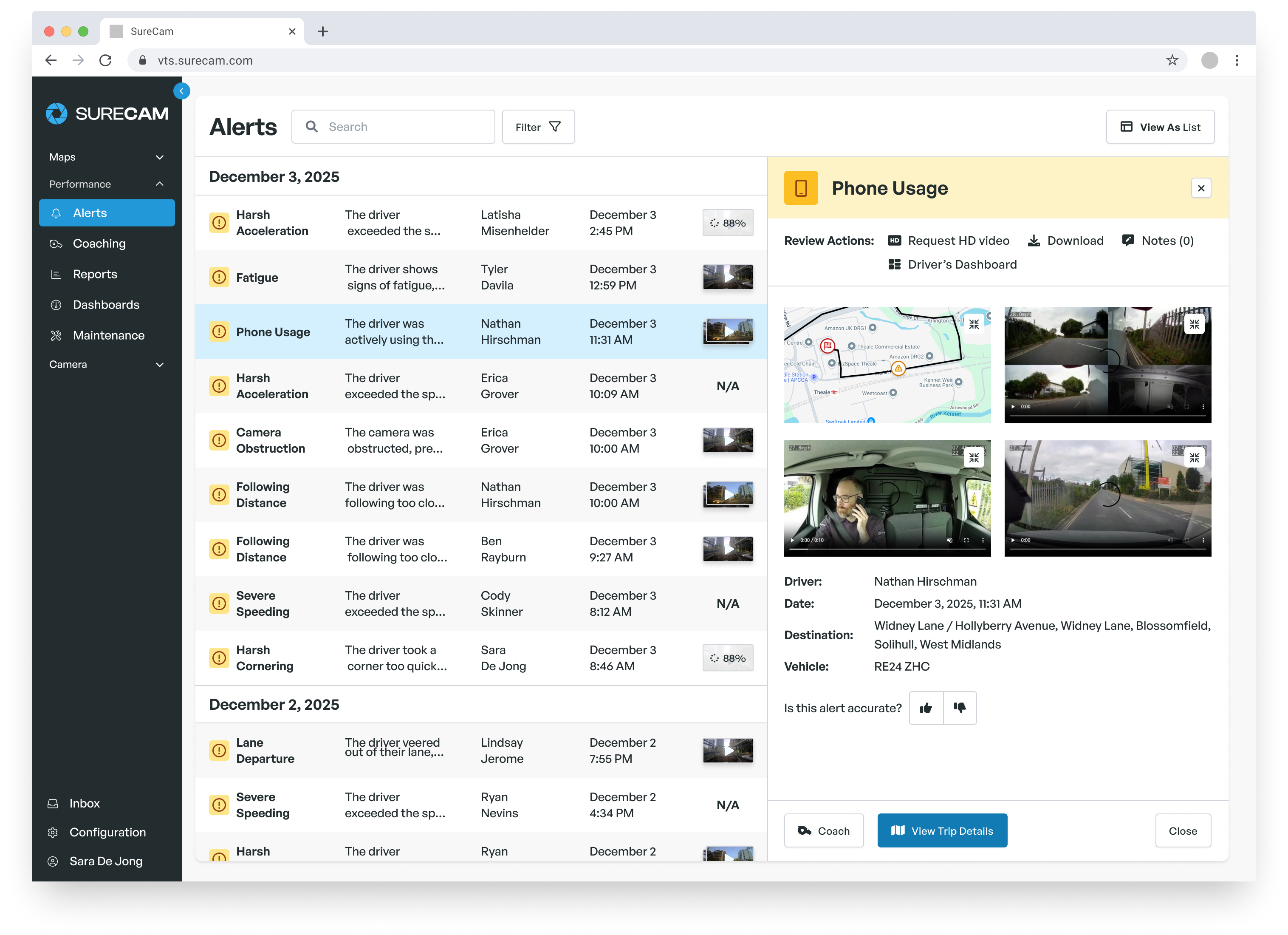
Hardware gets cameras on the glass. Software is what makes them useful. Every network-connected dash cam system includes a recurring subscription covering cellular data transmission, cloud video storage, the web portal, alert delivery, and ongoing support.
Monthly subscription fees range from $25–$100 per vehicle, per month, depending on the provider, the feature tier, and the contract length. Some vendors separate the data plan from the platform license; others bundle them into a single per-camera line. Understand what the monthly fee actually includes: How many days of video storage? Does live streaming cost extra? What about additional user seats?
SureCam's model folds hardware, software, and data into a single all-in monthly subscription with no large upfront hardware cost and unlimited user licenses. That structure matters operationally: safety directors don't need to share logins, and finance teams can model a clean per-vehicle monthly line rather than a depreciation schedule.
Installation Costs and Considerations
Installation often gets underestimated. A self-install takes 30–90 minutes per vehicle and requires only basic tools. A hardwire installation (preferred for always-on parking mode or secondary trigger inputs) adds time and may require a technician if your team lacks the capability.
Professional installation runs $100–$300 per vehicle in most markets. For a 50-truck fleet, that adds $5000–$15,00 to the launch cost. Factor that into the total commitment, and ask vendors whether their cameras support self-installation. SureCam's SC145 and SC245 hardware supports self-install with a straightforward guide, which lets fleets with mechanically capable staff avoid installation fees entirely.
Vehicles taken off the road during installation represent the other cost: lost productivity. Stagger installations during off-peak hours, weekends, or during scheduled maintenance windows to minimize that impact.
Total Cost of Ownership: A 3-Year View
Budgeting on purchase price alone misses the picture. A 3-year total cost of ownership model gives a more accurate read.
Take a 30-vehicle service fleet with forward-facing connected cameras at a $35/camera/month all-in subscription rate (hardware, data, software bundled). Over 36 months, that amounts to $37,800 in subscription costs for the fleet. Add a one-time self-install, and the total outlay sits around $38,000–$40,000 over three years.
Now model the offset. If the fleet carries one at-fault claim per year at a $15,000 average payout, cameras that exonerate even one driver per year deliver $45,000 in avoided costs over that same window. Add reduced insurance premiums from a cleaner claims history (insurers routinely offer discounts for documented camera programs), reduced claims administration time, and fuel savings from monitoring idling behavior.
The math does not demand perfection. A system that pays for itself by stopping one false claim, cutting one rear-end collision, or reducing one contested liability dispute crosses into positive ROI territory without dramatic assumptions.
Hidden Costs to Watch Before You Sign
Data Overage and Contract Lock-In
Some providers advertise a low per-camera monthly rate and then layer data overage charges on top when footage uploads exceed a monthly cap. Event-triggered uploads stay low in quiet fleets, but a fleet with active alerts, live stream usage, or high harsh-event frequency can generate significant data volume. Ask specifically: Is cellular data capped? What triggers overage charges? What does overage cost per GB?
Contract lock-in creates a different risk. A three-year term with a vendor whose product fails to deliver, whose customer support disappears, or whose platform doesn't integrate with your telematics stack means paying for a problem rather than a solution. Negotiate exit provisions, understand auto-renewal clauses, and ask for reference calls with existing customers before committing.
Data Ownership
One verified cautionary example: Matt "Jake" Jacobson, Director of Fleet Operations at SAV Express, specifically rejected a prior telematics provider because that vendor claimed ownership of the footage and only shared clips with the fleet. The provider controlled the evidence. When a third-party truck backed into a parked SAV Express vehicle at a truck stop, that kind of arrangement means asking permission to access your own footage.
Confirm in writing that footage belongs to your fleet, that you can download any clip at any time, and that footage access does not require going through the vendor's review queue.
How to Calculate ROI Before You Buy
A simple pre-purchase ROI model uses four inputs: current annual claims costs, estimated claims reduction percentage based on comparable fleets, current claims administration labor hours, and any insurance premium changes expected from a camera program.
Estimate conservatively. A 30% reduction in claims costs for a fleet spending $80,000 per year on claims delivers $24,000 annually. A system costing $15,000 per year to operate pays back in under eight months on claims savings alone. Most vendors offer ROI calculators that can run these numbers with your actual inputs; use them, and stress-test the assumptions.
The insurance premium impact deserves its own conversation with your broker before purchasing. Some carriers actively reward documented camera programs with lower premiums on renewal. Others offer discounts only after 12 months of a clean claims history. Either way, the camera program changes the conversation you have at renewal time, and that conversation has real dollar value. Speak with one of our fleet safety and telematics experts today to see how much SureCam can help you save.
Evaluating Vendors: A Price Comparison Framework
Price comparison across vendors requires a normalized unit: total annual cost per vehicle, including hardware amortization or monthly hardware fee, software subscription, data plan, and support. A vendor with a $20/month base rate, and $10/month data plan, and $5/month for live streaming costs $35/month per camera, matching a competitor that bundles all three at $35/month with less paperwork.
Beyond the number, ask five clarifying questions of any vendor:
-
Who owns the footage, and can you download any clip at any time without a managed-service intermediary?
-
What is the storage window for event video versus continuous video, and what happens to footage after that window closes?
-
Does the platform integrate with your existing telematics or ELD provider, or does switching require a full platform change?
-
What does customer support actually look like, including response time, dedicated contacts, and training?
-
And finally, what happens at the end of the contract term?
SureCam's positioning for mid-sized commercial fleets sits at the practical, focused end of the market. The platform avoids charging for compliance, dispatch, and routing modules that service fleets and field operations teams do not need. The trade-off: it does not offer a native ELD, which suits fleets that already run a preferred compliance stack and want cameras plus GPS without renegotiating their entire telematics ecosystem.
The Number That Reframes the Budget Conversation
When presenting fleet camera investment to a CFO or ownership group, the hardest framing to shake is "cost center." The camera line on a budget looks like an expense until someone connects it to a claim number, an insurance renewal quote, or a liability settlement that sat uncontested because there was no footage.
Lansberry Trucking's founding generation watched a $550,000 claim get paid for an accident their driver did not cause. The next generation of installed cameras and cut claims losses 80% in a single year. The camera subscription did not appear as a cost savings on a spreadsheet. It appeared as a claim that did not happen, a renewal that did not spike, and a safety director who reviewed the entire fleet's footage in 15–20 minutes per day instead of spending weeks reconstructing incidents from memory and police reports.
That is the honest case for budgeting fleet video telematics in 2026: not the monthly fee, but the cost of operating without it. Speak with one of our fleet safety and telematics experts today to see how much SureCam can help you save.