The Core Comparison
Both forward-only and dual-facing dash cam systems produce road-view footage that resolves the large majority of commercial fleet insurance claims. The difference surfaces where it matters most: disputed liability, high-severity cases, and nuclear verdict defense. Dual-facing systems add an in-cab camera that captures driver state at the moment of an incident, including phone handling, drowsiness, and other distraction indicators. Forward-only footage documents what happened on the road. In-cab footage documents whether the driver caused it. For commercial fleets with litigation exposure, significant cargo value, or prior loss history, that distinction carries measurable dollar consequences at renewal time.
What Each Camera Type Captures
Forward-Only: Road Evidence Without the Driver
A forward-facing camera records everything in front of the vehicle: traffic behavior, pedestrian movement, posted speed limits, weather conditions, and the seconds before and after a collision or near-miss event. That evidence base handles the most common liability scenario in commercial fleet claims. A third party who misrepresents what their vehicle did meets a factual record that cannot be disputed. Road-view footage establishes following distance, documents hazardous conditions, and resolves false third-party claims with speed and precision.
The gap appears when litigation asks a different question: what was the driver doing? Forward footage answers nothing on that front. When plaintiff counsel argues driver distraction, forward-only footage cannot rebut or confirm the allegation. The claim becomes a credibility contest between the driver's testimony, phone records, hours-of-service logs, and whatever narrative opposing counsel constructs. Fleets relying solely on forward footage accept that vulnerability as a standing feature of their liability posture.
In-Cab Footage: The Behavioral Record That Changes Litigation
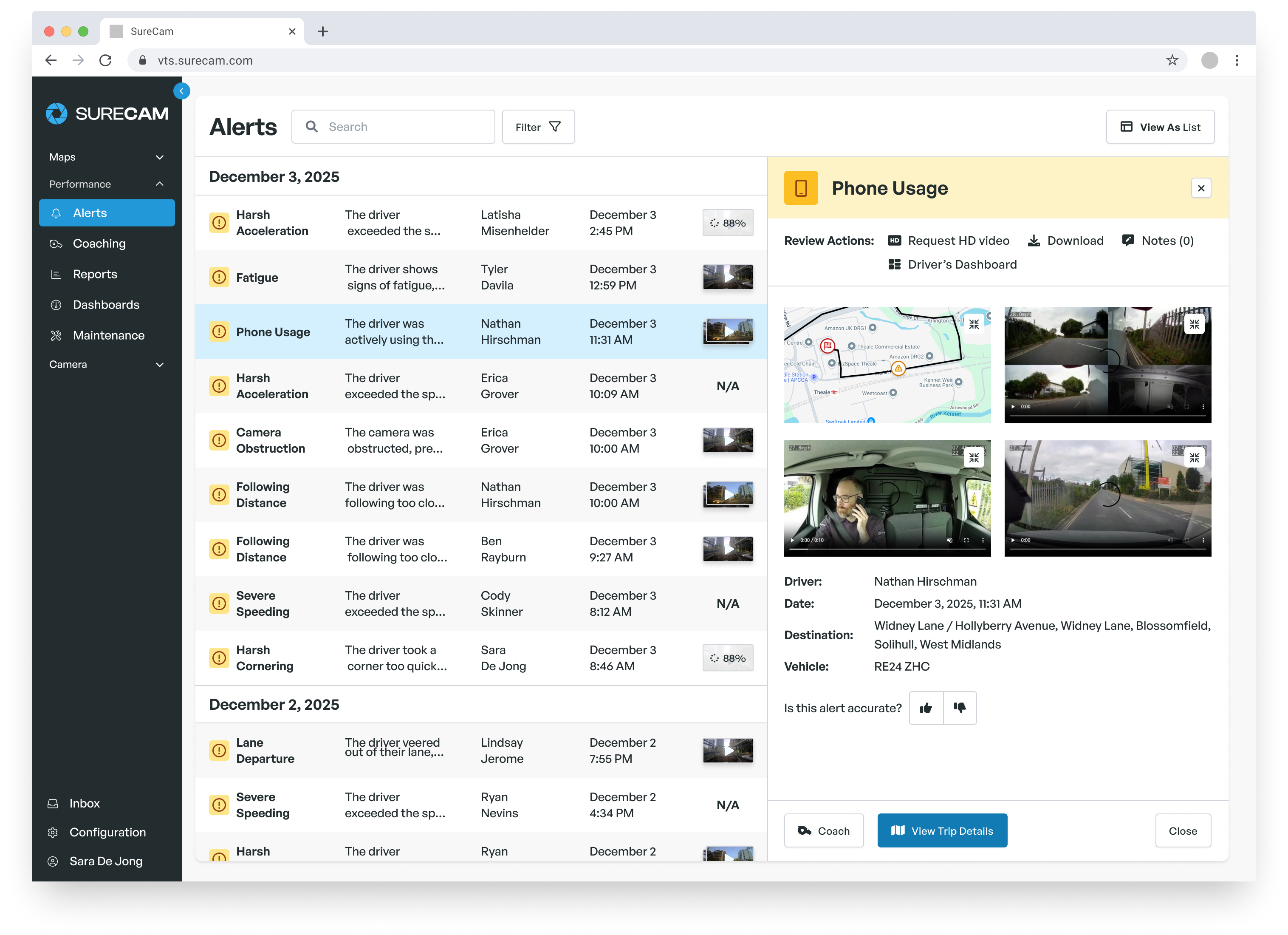
Driver-facing cameras record the cab interior during triggered and continuous recording windows, capturing driver attention, phone handling, seat belt status, and physiological signs of fatigue. The footage functions in two directions. When it shows a driver with both hands on the wheel, eyes forward, and clear alertness, it constitutes affirmative exoneration evidence. That distinction matters in court. The footage does not merely fail to prove distraction; it actively disproves the allegation with documentation.
The second function is early risk assessment. When in-cab footage captures a genuine distraction event, the fleet and its insurer obtain an accurate liability picture before the case reaches trial. Fleets that surface this through internal review can assess settlement exposure early and avoid defense costs on cases they are unlikely to win. That outcome differs from exoneration, but it still represents a liability management advantage that forward-only footage cannot provide.
Where In-Cab Footage Shifts Liability Outcomes
Disputed Claims and the Distraction Problem
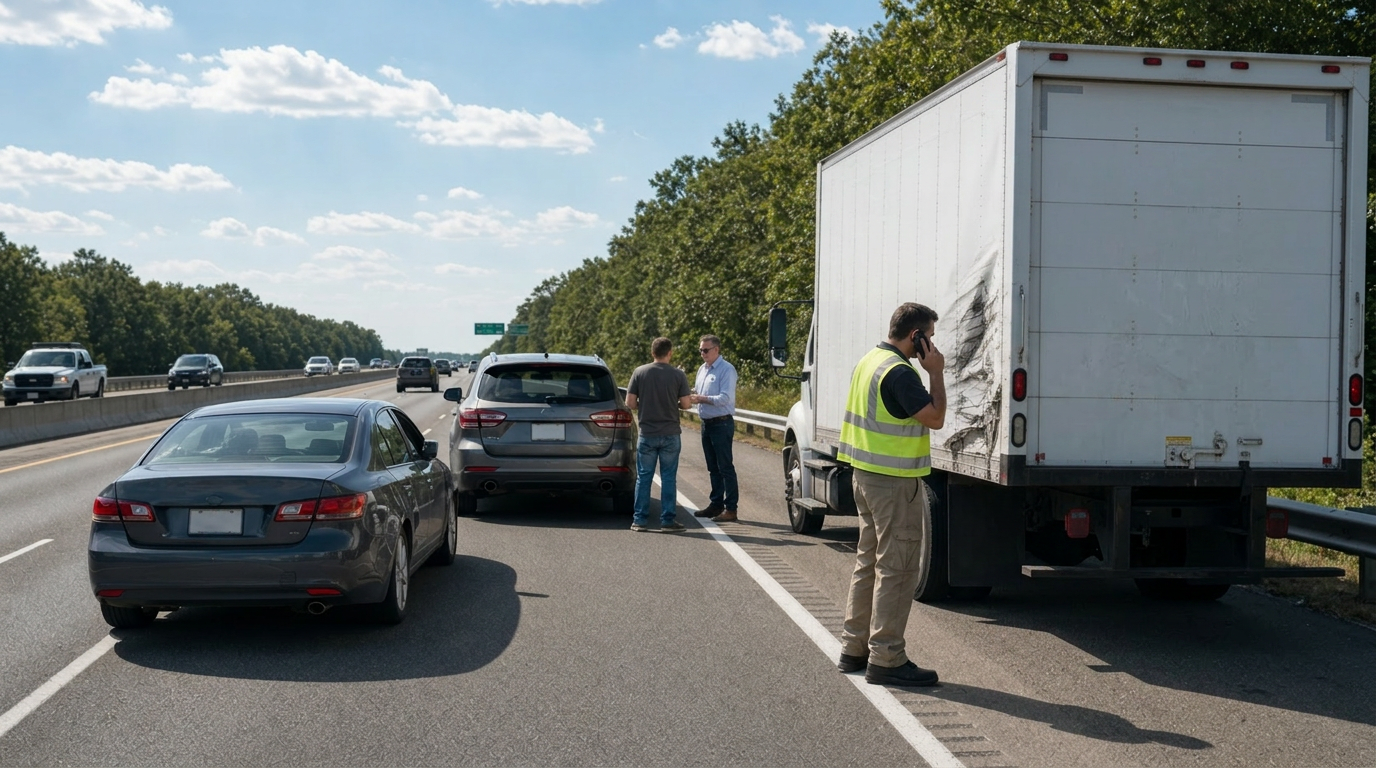
Most commercial fleet liability claims settle through standard FNOL processes without litigation. In straightforward at-fault scenarios, road-view footage supports efficient resolution. The dual-facing advantage surfaces in the subset of claims where fault percentage sits in dispute, injury severity creates significant financial exposure, or opposing counsel sees a recoverable case worth pursuing to trial.
Driver distraction has become one of the most targeted theories in commercial vehicle litigation. Phone records, electronic logging device data, and in-vehicle system inspection all fall within discovery. When a fleet has no in-cab footage, that absence creates a gap opposing counsel can fill with inference. When in-cab footage exists and shows no distraction, it closes that gap preemptively. A plaintiff pursuing a distraction theory faces a documentary record that contradicts the allegation. For safety directors and risk managers responsible for litigation cost control, that evidentiary closure has direct dollar value.
Nuclear Verdict Risk and Duty-of-Care Documentation
Nuclear verdicts in commercial trucking, defined as jury awards exceeding $10 million, have increased sharply over the past decade. These outcomes typically depend on establishing one of two narratives: that the driver behaved negligently, or that the company failed to monitor and correct known unsafe behavior. In-cab footage addresses both.
Behavioral footage combined with documented coaching response supports a duty-of-care argument that proves difficult to attack. A fleet that runs in-cab cameras, reviews behavioral alerts, conducts documented coaching sessions, and can show improvement over time presents a fundamentally different legal posture than one relying on road footage alone. Excess liability carriers have begun factoring this posture into their evaluation of large fleet accounts, treating systematic behavioral management as a risk reduction signal rather than a safety program checkbox.
How Insurers Evaluate the Difference
Carrier Appetite for Behavioral Evidence
Commercial auto underwriters price fleet risk across several variables: claims frequency, claims severity, fleet size, driver tenure, and technology adoption. In-cab cameras have moved from novelty to expected technology in most mid-sized fleet underwriting conversations. Carriers that historically focused only on forward footage now ask whether fleets run behavioral monitoring capability and whether that capability connects to a documented coaching program.
The reason is practical. Behavioral data gives underwriters better predictive signal on future loss exposure. A fleet that monitors in-cab events and responds with documented coaching demonstrates real-time risk management. That signal outperforms historical claims data alone, which is backward-looking by design. For fleets with prior loss activity or high-severity claims history, implementing dual-facing cameras alongside a structured coaching program can factor meaningfully into renewal conversations with commercial auto and excess liability carriers.
Claims History, Reserve Costs, and the Renewal Conversation
The most direct financial impact of dual-facing footage on fleet insurance comes through claims resolution speed and accuracy rather than formal premium discounts. When both road and in-cab footage are available immediately after an incident, adjusters work with a complete factual record. Liability determination moves faster. Reserve requirements get set more accurately from the outset. Defense costs on disputed claims decrease. Fleets with self-insured retentions or experience-rated policies see these dynamics directly in their loss runs.
Sam Lansberry II, founder of Lansberry Trucking, articulated the economic logic clearly. After his 80-truck fleet absorbed a $550,000 claim for an incident that was not their fault, with no footage to establish what actually happened, Lansberry invested in network-connected cameras and framed the decision as a profit center rather than a safety cost. Claims losses dropped 80 percent in a single year. The core mechanism applies directly to dual-facing configurations: footage that resolves liability faster means lower defense costs, more accurate reserves, and a claims trajectory that supports better terms at renewal.
Privacy Compliance and Driver Consent
State Audio Consent Requirements
In-cab cameras that record audio operate under state wiretapping and consent laws. The United States divides into one-party and two-party (all-party) consent jurisdictions. In one-party consent states, one party to a conversation may lawfully consent to recording, which in a commercial fleet context typically means employer policy plus driver acknowledgment covers the requirement. Two-party consent states, with California as the most significant example for fleet operators, require all parties to a recorded conversation to consent before recording begins.
Fleets operating across multiple states should build consent compliance into driver onboarding documentation. A clear, written camera policy acknowledging that company vehicles record both road and cab views provides the foundational consent structure for most jurisdictions. Many commercial fleets choose to disable audio recording entirely, removing consent complexity while retaining the full video evidentiary benefit. In-cab video without audio captures the behavioral evidence that matters most for liability purposes while eliminating the legal administration burden of multi-state audio compliance.
Building a Camera Policy That Earns Driver Trust
Driver resistance to in-cab cameras presents a real operational challenge. Drivers understand that in-cab footage can capture distraction events, and that understanding shapes their initial reaction to the technology. Fleets that frame camera policy primarily around monitoring and accountability tend to encounter the strongest pushback. Fleets that lead with driver protection as the central value proposition see faster adoption.
Ringway Jacobs, a UK highway services company running 250 trucks and 350 vans, experienced this adoption arc directly. Dave Bonehill, Head of Fleet Operations, noted that drivers initially resisted cameras. The dynamic shifted when footage was used to exonerate drivers against false claims. Cameras became a resource drivers valued because they provided protection rather than just surveillance. For dual-facing deployments, that framing carries practical weight: introduce in-cab coverage as protection against false distraction allegations and as the evidence that keeps a driver's record clean when a third party misrepresents what happened.
Forward-Only vs. Dual-Facing: A Side-by-Side Comparison
The table below summarizes key differences across the dimensions most relevant to fleet insurance liability decisions.
| Dimension |
Forward-Only Camera |
Dual-Facing Camera |
| Road incident documentation |
Complete |
Complete |
| Driver behavior at time of incident |
Not captured |
Captured |
| Distraction allegation defense |
Limited to inference |
Documentary evidence available |
| Nuclear verdict risk mitigation |
Partial |
Stronger |
| In-cab coaching capability |
Road events only |
Road and behavioral events |
| Audio consent complexity |
Minimal |
Requires state compliance or audio disable |
| Driver adoption effort |
Low |
Moderate; requires policy introduction |
| Insurance carrier behavioral signal |
Road safety data |
Road and behavioral data combined |
Forward-only cameras handle the majority of commercial fleet liability scenarios with good effectiveness. The gap surfaces when litigation targets driver behavior, when injury severity pushes a claim toward trial, or when an underwriter evaluates a fleet's behavioral management posture at renewal. Dual-facing systems close those gaps at the cost of a more deliberate rollout process and an ongoing privacy compliance posture.
The Coaching Layer: Prevention Before Claims Happen
Dual-facing cameras generate behavioral data that forward-only systems cannot produce. Hard braking events with visible driver distraction, phone handling during high-speed operation, and fatigue indicators near the end of long shifts all become coaching inputs rather than undocumented risks. Safety directors can build incident prevention programs on actual in-cab event data rather than inference from road-view events alone.
This prevention dimension matters for insurance outcomes in a second-order way. A fleet that actively reduces distraction events generates a claims frequency and severity profile that trends favorably over time. Carriers pricing renewal terms examine loss runs across multiple years. A fleet that shows declining frequency alongside a documented coaching program presents a risk trajectory that can support better pricing, not just a strong one-year snapshot. The coaching layer turns in-cab footage from a reactive claims defense tool into a proactive risk management asset with compounding value.
SureCam's Dual-Facing Options and FNOL Integration
SureCam offers road-facing and dual-facing configurations, giving fleets the choice based on their safety programs, industry requirements, and driver population characteristics. Dual-facing configurations include privacy controls designed to address driver concerns at the policy level: in-cab privacy mode disables inward video and reactivates only on triggered events, facial blurring pixelates driver and passenger faces, and time-of-day privacy settings disable recording outside defined business hours. These controls allow fleets to implement dual-facing capability in a way that reflects their specific consent framework and workforce dynamics.
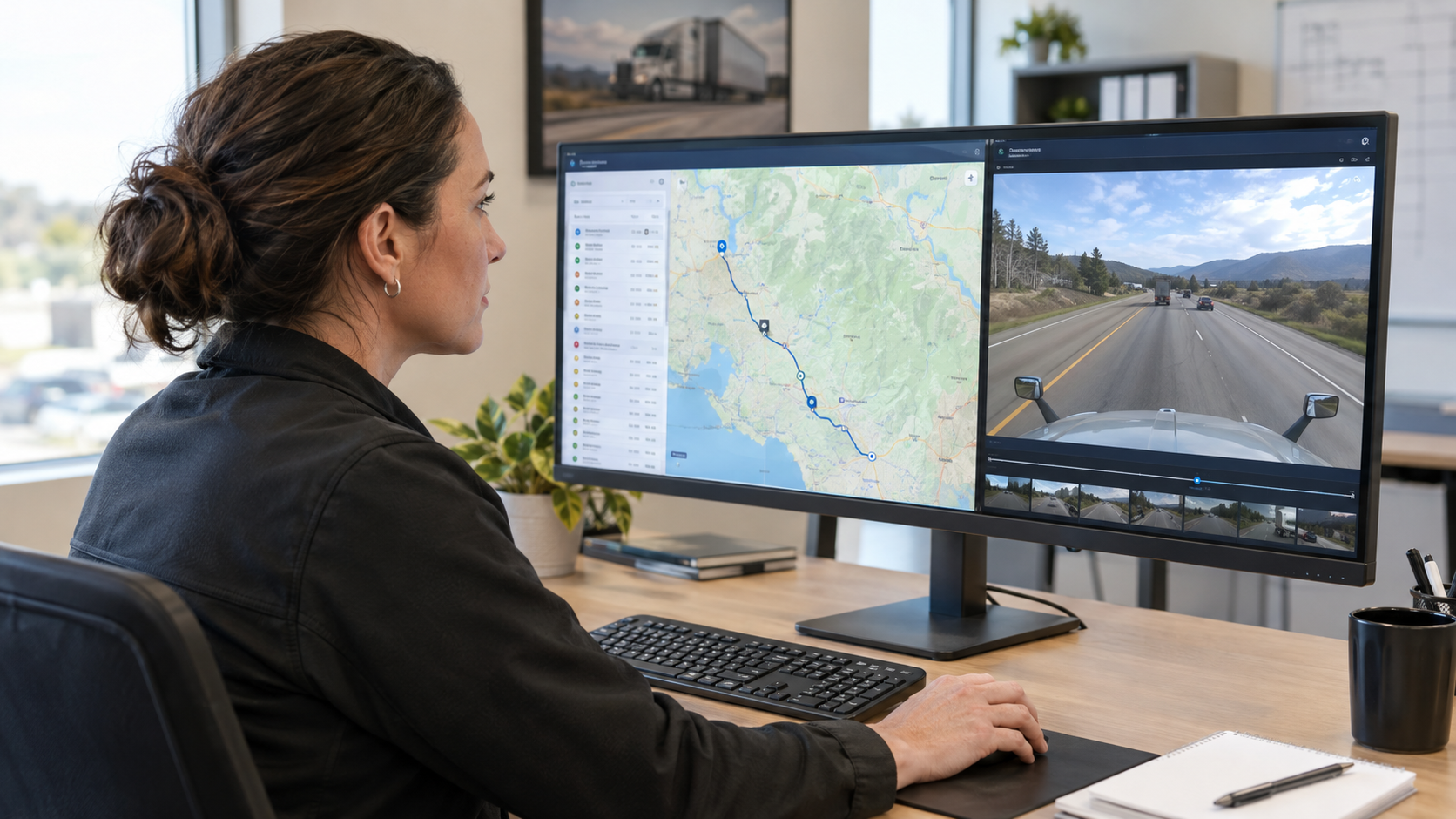
On the claims side, SureCam's connected camera system delivers footage automatically on triggered events, making both road and in-cab video available within seconds of an incident for FNOL purposes. Safety managers and insurance partners access footage through the web portal without waiting for drivers to retrieve SD cards or return to a depot. For fleets managing multi-vehicle incidents or high-value cargo claims, that immediacy separates a fleet that controls the claims narrative from one that reacts to it.