One Tired Driver Can Erase Years of Safety Progress
April marks National Distracted Driving Month, and on April 6, Drowsy Driver Awareness Day pulls attention toward one of commercial fleets' most underestimated hazards. Fatigue doesn't announce itself with a dashboard warning light. A driver running on too little sleep doesn't feel dangerous. They feel more or less normal, right up until the moment they don't.
For fleet safety managers running 20 to several hundred vehicles, driver fatigue represents a silent liability hiding in plain sight. Unlike speeding or hard braking, fatigue leaves no obvious telemetry signature unless the fleet has the right detection tools in place. A hard-braking event shows up immediately in a telematics dashboard. A driver fighting microsleep on a straight stretch of highway at 6 a.m. does not, unless an AI-enabled in-cab camera catches it.
This article breaks down what drowsy driving really costs commercial fleets, how to spot and prevent it, and why AI dash cams and video telematics now give mid-sized fleets the same fatigue detection capabilities once reserved for the largest national trucking operations.
The Real Cost of Driver Fatigue in Commercial Fleets
The NHTSA estimates drowsy driving contributes to tens of thousands of crashes annually. The AAA Foundation for Traffic Safety puts the true toll far higher, estimating drowsy driving plays a role in roughly 9.5% of all crashes—many of which never get coded as fatigue-related at the scene.
For commercial fleets, the financial exposure runs deep:
- A single fatigue-related accident can trigger a nuclear verdict, especially when plaintiff attorneys argue the fleet ignored documented warning signs and failed to act on available detection technology.
- Insurance carriers now scrutinize fatigue management programs during underwriting and policy renewal conversations.
- FMCSA guidance on driver fatigue holds motor carriers responsible for hours-of-service compliance, but HOS logs alone don't capture actual driver alertness or impairment level.
The drowsy driving vs. drunk driving comparison deserves a moment here. Harvard University Sleep Research shows that a driver operating on fewer than six hours of sleep demonstrates reaction time and decision-making degradation comparable to a blood alcohol concentration of 0.05%. That comparison lands differently when a fleet safety manager says it to their insurance broker or COO than when it sits in a regulatory summary. It shifts the conversation from compliance to liability, and from liability to urgency.
Why Commercial Fleets Face Higher Driver Fatigue Risk
Causes of Drowsy Driving in Commercial Fleets
Long-haul trucking captures most of the public attention around commercial driver fatigue and truck drivers. But field service, construction, utilities, and last-mile delivery fleets carry significant fatigue exposure of their own, often without the same regulatory attention.
Early start times. Technicians and delivery drivers often begin routes before 6 a.m., cutting into sleep cycles regardless of hours-of-service rules.
Route monotony. Highway driving and repetitive suburban routes suppress alertness faster than varied urban driving, particularly during long stretches without stops.
Seasonal schedule compression. Construction and field service fleets push longer days during peak seasons, stacking cumulative fatigue across weeks rather than a single shift.
Split shifts and on-call schedules. Municipal and utility fleets frequently run night shifts and emergency rotations that fragment restorative sleep in ways that show up days later on the road.
Undiagnosed sleep disorders. FMCSA research suggests a significant percentage of commercial drivers have undiagnosed sleep apnea—a condition that disrupts sleep quality regardless of hours logged in a bunk or the number of off-duty hours recorded in an HOS log.
Signs of Drowsy Driving That In-Cab Cameras Reveal
Fatigue shows up in specific, observable behaviors that both trained safety managers and AI systems can identify on video:
- Lane drift and micro-corrections at highway speed
- Heavy eyelid closure and repeated head bobbing
- Unusually slow response to traffic changes ahead
- Following distances that collapse without apparent cause
- Erratic vehicle speed with no traffic explanation
Before AI-powered in-cab cameras, fleet managers could only review this footage after an incident. Real-time fatigue detection changes that calculus entirely.
What Hours-of-Service Compliance Misses
FMCSA hours-of-service regulations create a floor for commercial driver fatigue management. They do not create a ceiling.
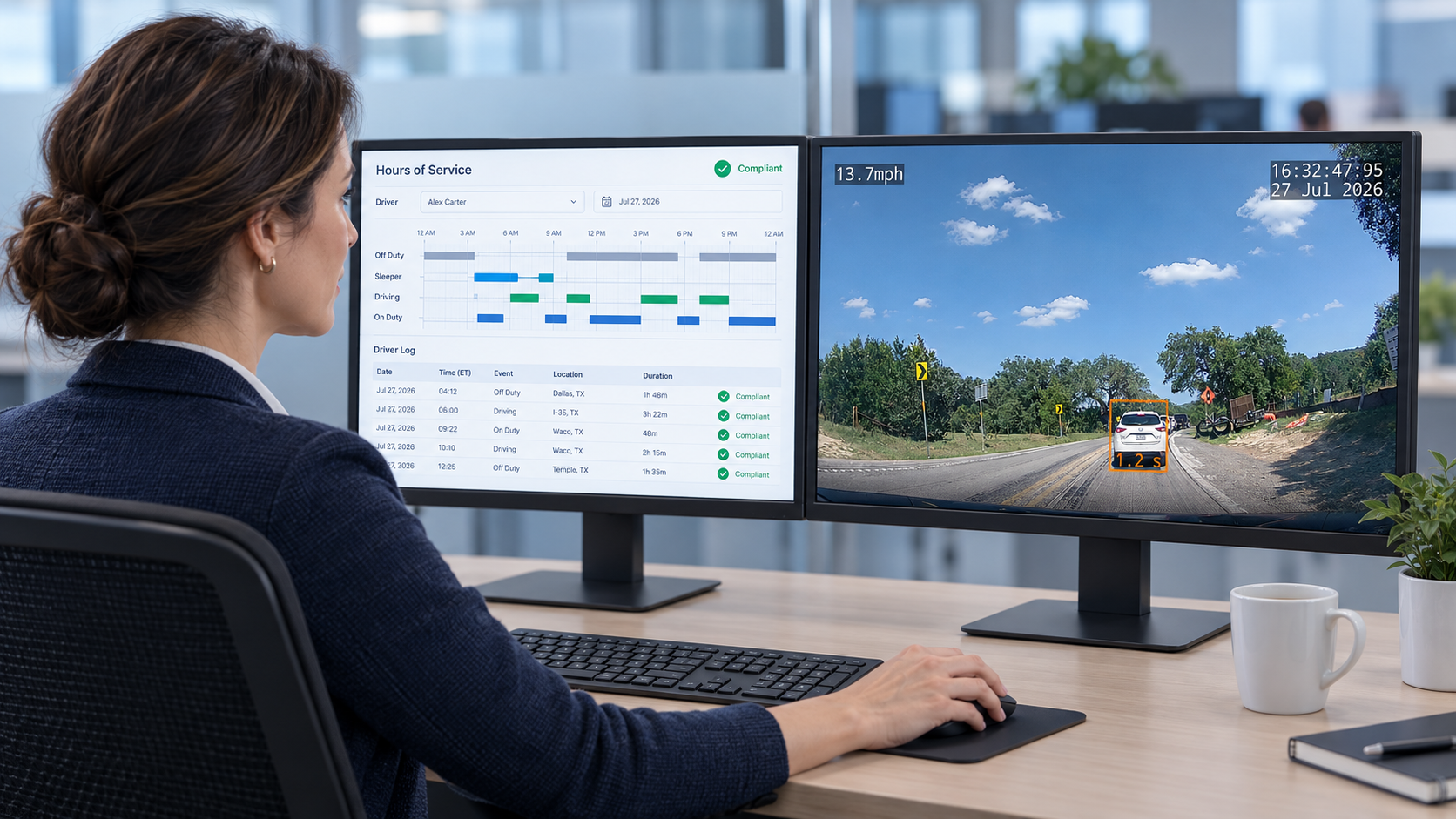
A driver can complete a legal 10-hour off-duty period and still climb behind the wheel exhausted. HOS logs record time. They don't record sleep quality, stress load, or whether those off-duty hours produced actual rest. A driver who spends four of those hours dealing with a personal crisis, a noisy environment, or a medical issue arrives at the vehicle legally compliant and genuinely impaired.
For mid-sized fleets without dedicated safety directors, compliance often gets reduced to "HOS logs look current." That mindset leaves a gap that video telematics can close.
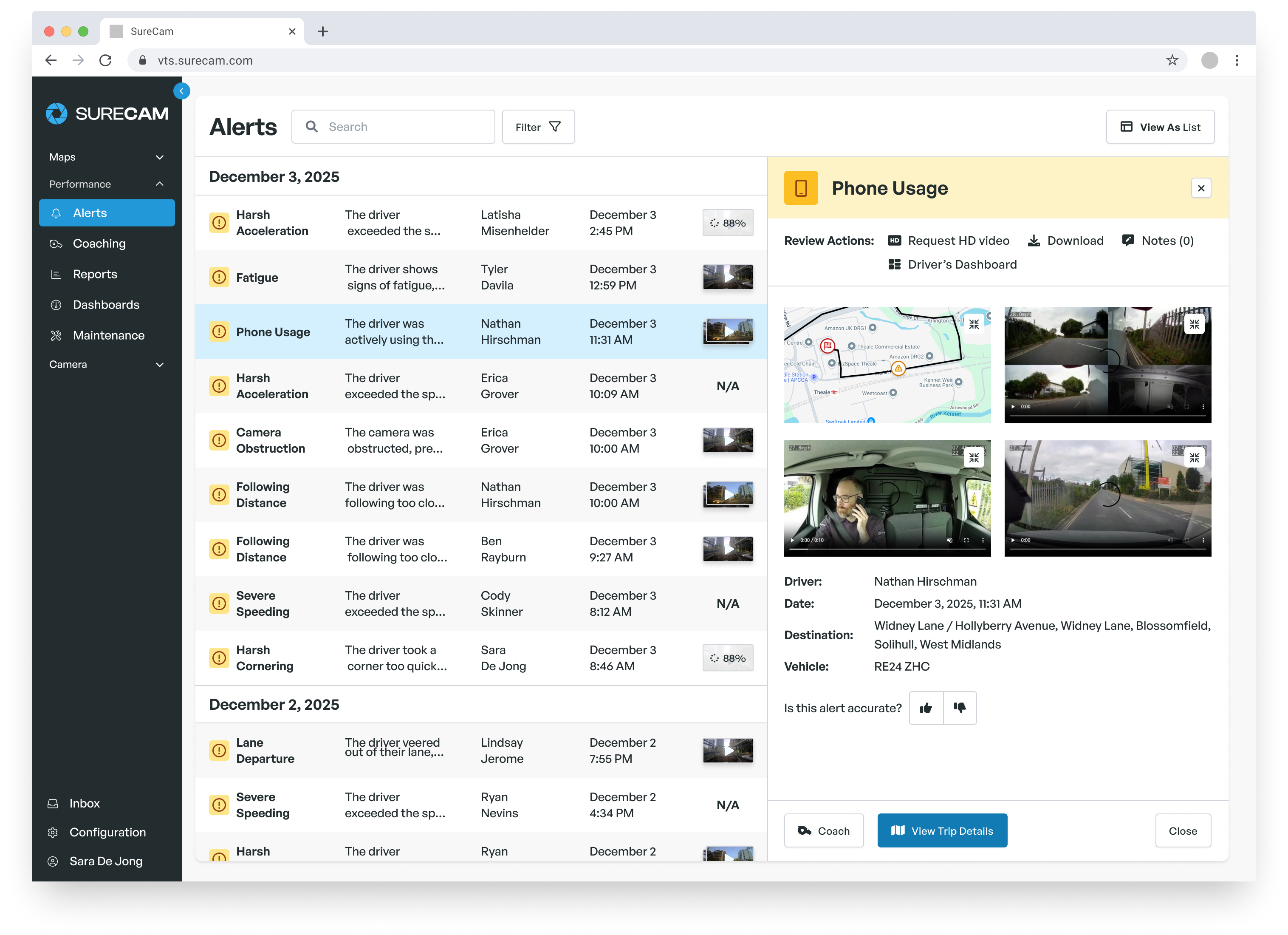
SureCam's connected dash cams generate event-triggered footage tied to real driver behavior, not just time records. When a vehicle drifts, the system captures and flags it. When in-cab behavior matches established fatigue indicators, the platform surfaces that event for review with video evidence attached.
That data transforms driver fatigue from an abstract compliance topic into a concrete, coachable behavior with a paper trail that holds up in a claims conversation or a renewal meeting with an underwriter.
How AI Dash Cams and Video Telematics Address Driver Fatigue
Real-Time In-Cab Fatigue Monitoring with SureCam
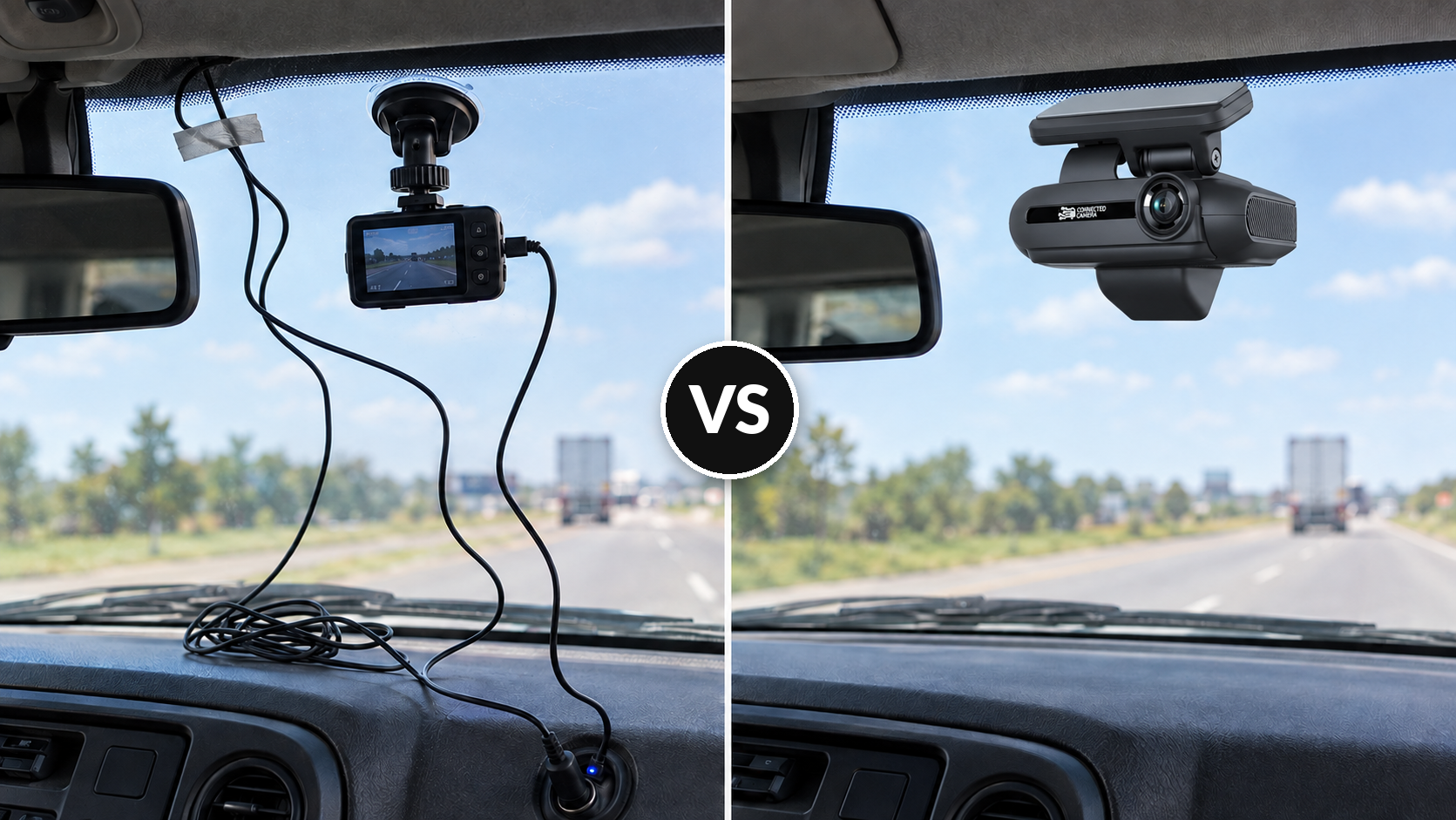
Modern AI dash cams with driver-facing cameras don't simply record. They analyze.
SureCam's AI-enabled in-cab cameras use computer vision to detect distraction and fatigue indicators in real time. The system monitors eye closure patterns, head position, and attention lapses, then triggers an alert before the situation escalates into a near-miss or a crash.
The process follows a three-step detection and response cycle:
- Event Detection: The AI identifies a fatigue or distraction indicator based on driver behavior and camera analytics.
- Instant Upload: Video and telematics data upload via cellular connection to the SureCam platform.
- Immediate Notification: Fleet managers receive an alert via email or the SureCam dashboard, with footage ready for review.
This real-time loop shifts fatigue management from reactive (reviewing footage after an incident) to proactive (intervening before a crash occurs). That shift defines the difference between a fleet safety program that documents problems and one that prevents them. For insurance purposes, it also defines the difference between a fleet that responded to known risk and one that let it accumulate.
From Alert to Action: The Driver Coaching Loop
Detection without follow-through accomplishes nothing. The value of AI dash cams for driver fatigue comes from what the fleet does after the alert fires.
Effective fleets treat fatigue-related events as structured coaching opportunities rather than disciplinary triggers. A safety manager who calls a driver after a flagged fatigue event, reviews the footage together, and asks about sleep and schedule builds a safety culture rather than a surveillance culture.
That coaching conversation might sound like:
"Your camera picked up some lane drift on Route 9 this morning. Everything okay? How did you sleep last night?"
"We saw three fatigue alerts this week. Let's look at your schedule and see if we can adjust your start time before the end of the month."
Video evidence grounds that discussion in observable behavior rather than subjective judgment. Drivers respond better to specifics. So do fleet safety programs when it comes time to present data to an insurance carrier at renewal.
Drowsy Driving Prevention Checklist for Fleet Managers
Use this at the next safety meeting or internal review conversation.
Schedule and Dispatch
- Review start times for routes that push before 5:30 a.m.
- Identify drivers with split shifts or back-to-back long days
- Build schedule buffer to reduce pressure-driven fatigue
Driver Wellness
- Add sleep hygiene as a standing topic in regular safety meetings
- Include sleep disorder screening in CDL medical exam conversations
- Establish a clear "pull over and rest" policy, and enforce it without penalty
Technology and Detection
- Deploy dual-facing AI dash cams with in-cab fatigue detection capability
- Configure real-time alerts for drowsy driving indicators
- Set a weekly review cadence for fatigue-flagged events
Coaching and Documentation
- Create a written fatigue coaching workflow for safety managers
- Log coaching conversations as part of each driver's safety record
- Track fatigue event trends over time to identify high-risk routes and schedules
Insurance and Compliance
- Pull current fatigue-related event data before carrier renewal conversations
- Document your fatigue detection technology as part of your fleet safety program presentation to insurers
- Review FMCSA guidance on driver fatigue and update policy documentation accordingly
What Drowsy Driver Awareness Day Means for Mid-Sized Fleets in 2026
Drowsy Driver Awareness Day on April 6 doesn't carry the regulatory weight of an FMCSA mandate. But the attention it draws from insurance carriers, safety advocates, and fleet industry media creates a real opening for fleet safety managers to take a harder look at what their current program actually catches.
National Distracted Driving Month sets the broader context: distraction and fatigue share overlapping causes and consequences. A fleet safety program that addresses distracted driving but ignores fatigue misses half of the risk picture.
Mid-sized fleets now access the same AI dash cam and video telematics technology that large national carriers deploy. The gap in fatigue detection between a 50-vehicle field service fleet and a 5,000-truck carrier comes down to deployment and process, not platform availability.
SureCam closes that gap. The platform delivers AI-powered in-cab monitoring, real-time fatigue alerts, and a video coaching workflow built for fleet managers who wear multiple hats and don't have a 20-person safety department to delegate to.
Preventing fatigue-related crashes doesn't require a massive telematics overhaul. It requires the right camera, pointed in the right direction, connected to a workflow that turns footage into action before an accident turns into a claim.
That standard sits within reach for every fleet. April 6 marks a good day to commit to it.



.png)