What a Driver Monitoring System Does
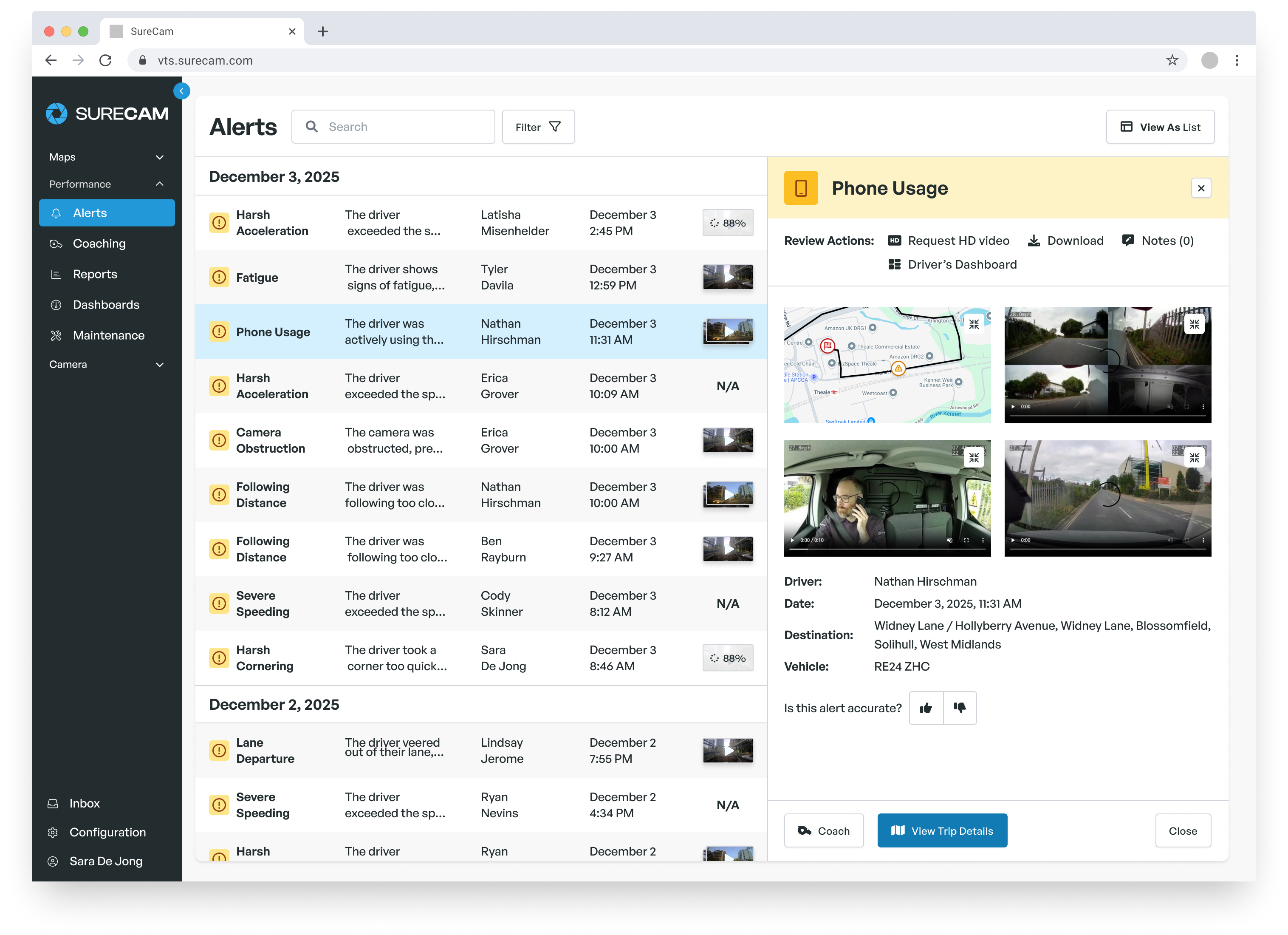
A driver monitoring system (DMS) is an in-cab AI camera that analyzes driver behavior continuously, detecting distraction events such as phone use, eyes-off-road, and hands-off-wheel before those behaviors contribute to a collision. Each flagged event triggers an in-cab alert, generates a timestamped video clip, and creates a coaching record that safety managers can act on within hours of the event.
Distracted driving appears in commercial crash data with more consistency than most fleet managers want to admit. Federal estimates attribute driver inattention to a meaningful share of preventable commercial vehicle accidents each year. A DMS gives fleet managers the ability to interrupt that chain before a glance at a phone becomes a lane departure or worse. The system runs continuously without requiring any action from the driver. No card to pull. No footage to retrieve manually. Just a cellular upload that puts event video in the platform within seconds of detection.
For fleet managers, that speed matters for two distinct reasons. Real-time alerts change driver behavior at the point of risk. After-the-fact clip review drives the coaching program that changes behavior over time. A DMS delivers both, and the coaching library it builds doubles as documented evidence when a third party files a claim based on driver distraction.
How AI Detects Distracted Driving in Real Time
Modern driver monitoring systems apply computer vision and machine learning models trained on millions of driving scenarios. The in-cab camera points at the driver, not the road ahead. Frame by frame, the AI reads facial geometry, hand position, and head angle, building a continuous attention picture and firing alerts when behavior crosses a defined safety threshold.
Phone Use and Hand Position
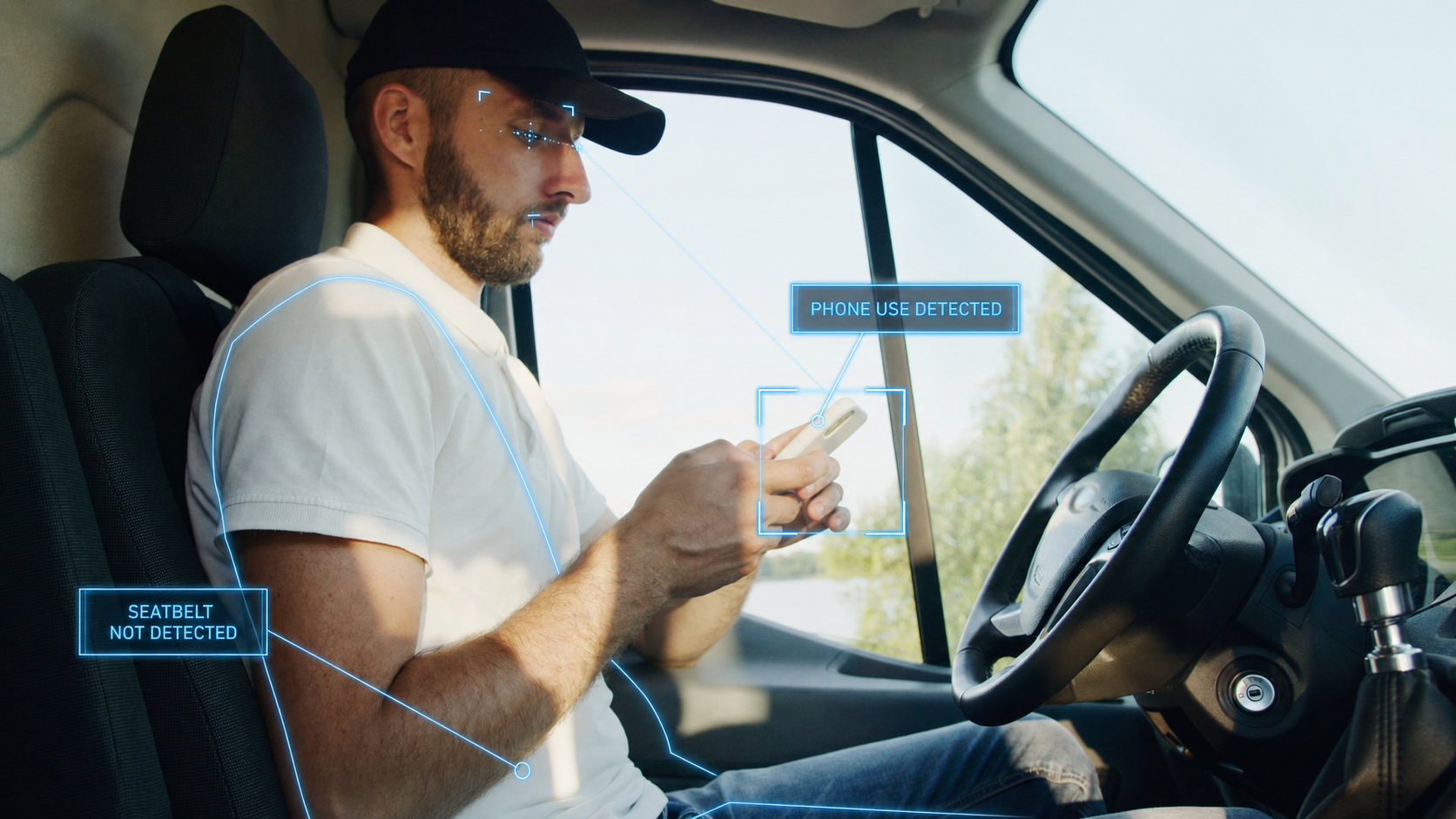
Phone detection works on behavioral signature rather than device recognition. The AI identifies the posture pattern associated with phone use: arm elevation, device angle, and the characteristic head tilt that accompanies holding or looking at a screen. Detection fires even when a driver holds the phone low or at an angle, because the model reads the movement pattern rather than the device itself. Concealing the phone below window level does not defeat the detection; it changes the visual input without changing the behavioral signal.
Hands-off-wheel detection monitors hand position relative to the steering wheel and triggers an alert when both hands leave the wheel beyond a configured threshold, typically in the range of two to four seconds depending on speed and system configuration. The threshold is not arbitrary. At 65 mph, two seconds of hands-off-wheel means a vehicle covers more than 190 feet without correction. The alert interrupts that window before it becomes a liability.
Eyes Off Road and Gaze Analysis
Eye-tracking models measure the direction and duration of driver gaze. When a driver looks away from the forward road plane for longer than a calibrated interval, the system registers a distraction event and fires an in-cab alert. Most platforms set tighter gaze thresholds at highway speeds than in low-speed urban environments, because the consequences of inattention scale directly with velocity and the distance a vehicle travels per second.
Gaze analysis catches distraction events that hand-tracking alone misses. A driver can keep both hands on the steering wheel while staring at a phone in the cupholder, watching a roadside sign, or reading a delivery address on a GPS mount. The eye-tracking layer closes that gap. Some DMS platforms cross-reference gaze direction with the forward-facing road camera, allowing the AI to distinguish between a driver checking a legitimate hazard and one fixating on a non-road object, which reduces false positives without relaxing the monitoring threshold.
Drowsiness and Head Position Signals
Drowsiness detection uses micro-expression analysis to identify fatigue markers: slow blinks, prolonged eye closure, head drooping, and repeated yawning cycles. The AI differentiates between a natural blink, roughly 150 to 200 milliseconds in duration, and the extended eye closure that signals impairment. Fatigued driving shares measurable behavioral overlap with distracted driving. Many DMS platforms flag both under a unified driver attention score, giving safety managers a single event feed for two overlapping risk categories.
Head position tracking expands detection further. Forward head slump, sustained lateral gaze, and repetitive head-shake patterns all register as attention flags. Combining head-position data with eye tracking reduces false positives: a driver briefly scanning a mirror reads differently in the model than one turned toward a passenger for an extended conversation.
In-Cab Alerts vs. After-the-Fact Review
In-cab alerts and after-the-fact review serve different functions in a driver monitoring program. Strong safety programs treat both as essential, rather than treating one as optional backup for the other.
The in-cab alert fires at the moment of detection. Most systems combine an audio tone, a visual LED indicator, and a voice prompt to redirect driver attention before the distraction extends. Alert intensity scales with severity. A brief glance at a phone triggers a gentle tone; a sustained eyes-off-road event triggers a more insistent prompt. The design logic matters here. An alert system calibrated too aggressively produces alert fatigue, where drivers tune out notifications entirely. One set too loosely misses the events that count. Well-configured systems apply the prompt proportionally, redirecting attention without creating a new distraction in the process.
After-the-fact review happens in the fleet management platform. Every flagged event generates a timestamped video clip that managers can access within seconds of the alert firing. The clip covers five to ten seconds of pre-event context, the distraction event itself, and the aftermath. That context window separates DMS footage from a snapshot: it shows what the driver was doing before the event occurred, which is what a coaching conversation needs and what a claims defense may require.
The practical lesson: fleets that rely on after-the-fact review as the primary function of a DMS leave the system's most direct safety benefit untapped. In-cab alerts change behavior in the moment. After-the-fact review builds the coaching record and the evidentiary trail. Both functions run off the same footage. Neither substitutes for the other.
Building a Coaching Workflow Around Distraction Events
Building an effective coaching workflow around distraction events starts with a filter layer, not a clip library. A DMS generates more event data than any safety manager can systematically review, and a program built on raw volume alone produces administrative burden rather than behavioral change.
Most platforms allow managers to configure which events generate a coaching flag versus which auto-dismiss after a single occurrence. A first-time, low-severity event may close without action; the same behavior repeated within a rolling seven-day window escalates to a required coaching conversation. This keeps the review queue at a level managers actually work through, rather than a backlog that creates the appearance of oversight without delivering it.
The coaching conversation is where DMS data earns its return. A safety manager who can show a driver their own distraction event on video, with time-on-road and speed context attached, shifts a defensive exchange into a productive one. Both parties see the same footage. That shared frame of reference shortens the conversation, removes ambiguity about what happened, and produces behavioral commitments more durable than a verbal warning without supporting evidence.
Concrete Strategies, a national concrete fleet with 136 vehicles, demonstrates the principle in practice. Lisa Lamons, the company's Safety Training and DOT Compliance Manager, describes how camera-triggered harsh event alerts for braking and cornering now feed same-day or next-day coaching reviews rather than queuing for weekly report cycles. Claims handling that previously consumed approximately one week of labor per month dropped to under 10 hours. The same-day review model applies directly to distraction events: footage reviewed while the driving context remains fresh produces stronger driver engagement and better recall than a week-old clip surfaced in a quarterly session.
Documenting the outcome closes the loop. A written log noting the event timestamp, the footage reviewed, and the agreed corrective action creates a defensible record if the behavior continues and progressive discipline becomes necessary. It also gives safety teams a dataset for tracking improvement rates by driver, event type, and route, which informs future training decisions with evidence rather than assumption.
Frequently Asked Questions
Fleet managers researching driver monitoring systems consistently encounter the same set of questions about how the technology works in daily operations. The answers below address the most common.
How does a driver monitoring system differ from a standard forward-facing dash cam?
A forward-facing dash cam records the road ahead but does not analyze driver behavior or generate coaching data. A driver monitoring system adds a driver-facing camera and an AI model that reads facial geometry, hand position, and gaze direction in real time, firing in-cab alerts for distraction events. Many commercial fleet cameras now integrate both functions into a single unit, providing road documentation and driver attention monitoring from one device.
How does AI detect phone use without reading the driver's screen?
The model does not need to read the screen. It identifies phone-use posture: the arm elevation, device angle, and head-tilt pattern associated with holding or looking at a phone. Detection fires on behavioral signature rather than device recognition, which makes it effective regardless of phone orientation, screen brightness, or whether the driver attempts to hold the device below window level.
Can a driver monitoring system operate without a driver-facing camera?
No. Eye tracking, drowsiness detection, and hands-off-wheel analysis all require a driver-facing camera with adequate cabin illumination. A forward-facing-only camera captures road events but cannot support DMS capabilities. A dual-channel system covering the road ahead and the driver's cab serves as the baseline configuration for any fleet running a full distracted-driving monitoring program.
How quickly can fleet managers access distraction event footage?
On a network-connected system, event video uploads within seconds of the alert firing and appears in the fleet management platform before the vehicle has cleared the next intersection. This separates network-connected DMS cameras from SD-card-based systems, where retrieval requires physically removing and reading the card, a process that typically runs 12 to 24 hours after the event.
What behaviors does a driver monitoring system typically flag?
Core detection categories include phone use, eyes-off-road, hands-off-wheel, drowsiness and microsleep events, and seatbelt non-compliance. Some platforms also detect eating or smoking while driving. The specific event library varies by platform and hardware configuration. Most fleets configure alerts to match their safety policy priorities rather than activating every available detection category simultaneously, which keeps alert volume at a level drivers respond to rather than tune out.