All-in-One Fleet Management Software: 2026 Buyer's Guide
12 Oct 2026
driver coaching


Improve fleet safety, reduce operating costs, and optimize field performance with an easy-to-use platform for video, GPS tracking, driver coaching, maintenance, asset tracking, and real-time fleet insights.
Drive your total fleet operations with SureCam’s all-in-one video telematics solution.
Valuable guides, case studies, and videos to help you optimize fleet management, safety, and productivity with telematics solutions.
Values, job opportunities, and ways to connect or partner with SureCam.
.png)




A single collision can cost a commercial fleet far more than a repair estimate. Legal fees, medical claims, third-party settlements, driver downtime, and rising insurance premiums compound quickly. For fleets without a proactive risk management strategy, these costs arrive without warning and escalate past any reasonable early projection.
The rise of nuclear verdicts (jury awards exceeding $10 million against commercial vehicle operators) has redefined the liability stakes for fleet operators of every size. Mid-sized fleets now face the same catastrophic exposure that once seemed reserved for national carriers. A single poorly-documented incident, narrated by aggressive opposing counsel and presented to a sympathetic jury, can threaten the financial stability of a business that took decades to build.
Fleet risk management provides a systematic alternative. Rather than absorbing costs after events occur, structured programs prevent incidents upstream, capture evidence in real time, and compress the time and cost of claims resolution downstream.
Fleet risk management encompasses the full range of practices, data systems, and processes a fleet uses to identify, measure, and reduce the likelihood and cost of adverse events: road incidents, fraudulent claims, driver behavior violations, compliance gaps, and operational liability.
Effective programs address risk at three distinct levels. Prevention works upstream through driver coaching and monitoring before incidents occur. Response operates in real time, capturing events as they happen and triggering immediate action. Defense works downstream, using footage and data to resolve claims quickly and on favorable terms. Video telematics serves as the connective layer across all three levels, making each stage more systematic and documentable than any paper-based or reactive process can achieve.
Collision frequency represents the most direct and visible fleet risk. Every at-fault accident generates repair costs, insurance claims, potential litigation, and driver downtime. For fleets operating 50 or more vehicles, even modest reductions in collision frequency produce significant annual savings across insurance, maintenance, and operations.
Third-party liability amplifies the financial stakes considerably. When a commercial vehicle collides with a passenger car, the commercial operator typically carries the burden of proof regarding driver behavior, speed, and road conditions at the moment of impact. Without video evidence, liability determinations depend on conflicting witness accounts and opposing counsel's reconstruction of events, a reconstruction often built to favor the highest possible settlement.
Fraudulent claims targeting commercial fleets range from staged collisions to exaggerated injury claims filed after minor incidents. Staged accident schemes (where third parties deliberately cause collisions to collect insurance payouts) disproportionately target fleet vehicles because commercial operators carry higher liability limits and typically settle out of court rather than absorb the full cost of litigation.
Even exaggerated (rather than outright fraudulent) claims cause significant damage. A minor rear-end incident producing a dubious soft-tissue injury claim can generate costs far exceeding the actual damage to either vehicle. Without video evidence documenting the true severity of impact, fleets frequently find settling cheaper than fighting, a dynamic that invites further targeting.
Nuclear verdicts have become a meaningful risk category for commercial fleets, not a headline risk reserved for major national carriers. Trial attorneys have refined strategies for targeting commercial operators, often using driver behavior records, maintenance logs, and prior incident history to argue systemic negligence rather than a single driver mistake.
This exposure changes the risk calculus for fleet documentation. Fleets with clean, consistent behavior records, reliable maintenance documentation, and video evidence of reasonable driver conduct carry a fundamentally different litigation profile than those without. The difference shows up not just in verdict outcomes, but in whether opposing counsel pursues a case aggressively in the first place.
Harsh braking, aggressive acceleration, speeding, and distracted driving function as leading indicators of collision risk. Fleets that monitor these behaviors and intervene before incidents occur consistently outperform those that manage outcomes only after events happen.
Driver behavior data also shapes insurance pricing conversations. Carriers increasingly price commercial fleet policies based on demonstrated safety performance rather than historical loss ratios alone. A fleet with documented behavior improvement trends holds a measurably stronger position at renewal than one presenting claim counts without behavioral context behind them.
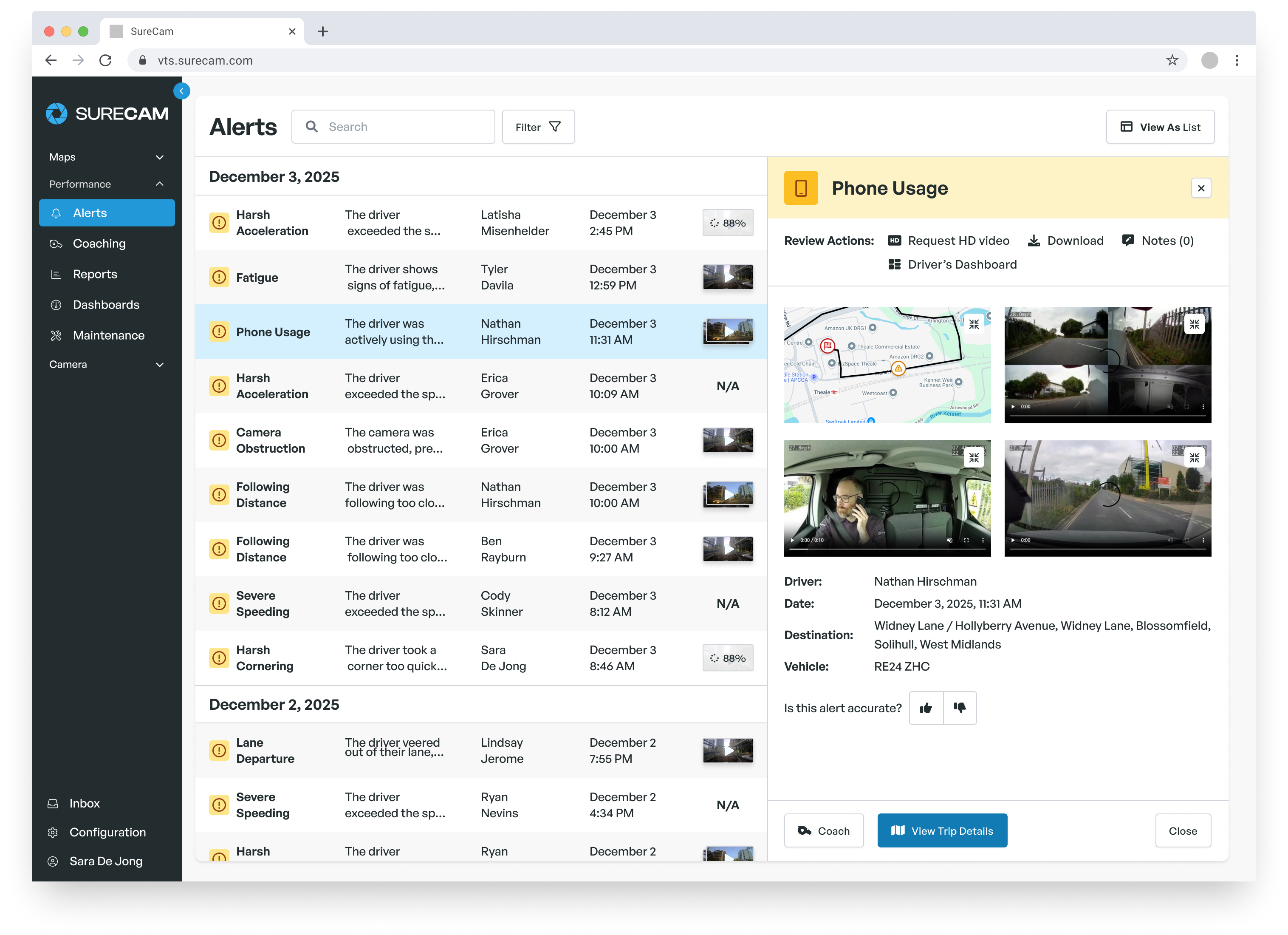
AI-powered driver monitoring detects high-risk behaviors in real time: forward collision warnings, lane departure alerts, distraction detection, and following-distance thresholds. Deployed consistently across a fleet, these systems redirect driver attention before a dangerous situation becomes an incident on the record.
The behavioral effect compounds over time. Drivers who receive consistent, coaching-oriented feedback modify their habits measurably across a full season of operation. [VERIFY before publish: confirm a citable industry benchmark for behavior improvement timelines with AI monitoring deployment; if unavailable, retain as a general directional claim.] The forward-looking value: fewer incidents to defend against, fewer claims to process, and a safety trend line that carries real weight at insurance renewal.
AI monitoring also delivers coaching specificity that generalized safety briefings cannot match. Rather than advising a driver to "improve following distance," a fleet manager can pull the exact clip, examine the specific road conditions, and set measurable improvement targets. That specificity accelerates behavior change and produces a documented coaching record that demonstrates program rigor to insurers and, if necessary, to courts.
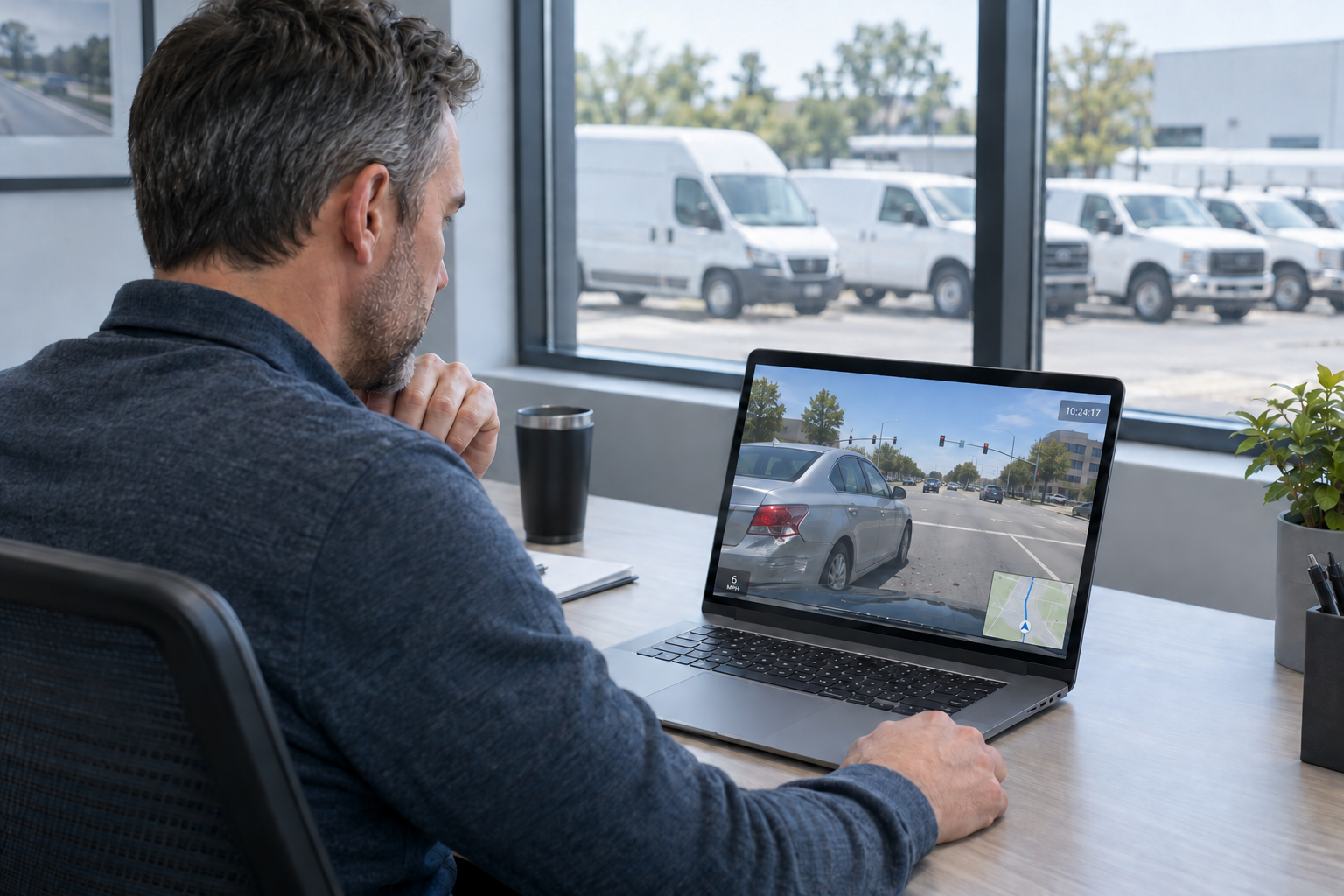
When an incident occurs, the first question in any claims process becomes: what actually happened? Without video, the answer depends on witness statements, police reports, and each party's reconstruction of events. With video, the answer arrives within minutes, and it does not shift with the interests of whoever tells the story.
Lansberry Trucking learned this lesson before deploying cameras. A $550,000 claim filed against one of their trucks (for an accident their driver did not cause) exposed the full cost of operating without documented evidence. The company responded by deploying network-connected cameras across their 80-truck fleet and reframing the investment not as a safety expense but as a financial defense mechanism. The result: an 80% reduction in claims losses in a single year. Sam Lansberry II, the company's founder, summarized the outcome directly: "I don't view our investment in SureCam as a cost, it's a profit-center. Last year alone, our claims losses reduced by over 80%."
The mechanics behind that result reflect what consistent video evidence does to claims economics. False and inflated claims fail because the footage exists. Legitimate claims resolve faster because liability determinations no longer require months of contested investigation. Subrogation recovery accelerates because the evidence chain is clean from the first notification.
First Notification of Loss (FNOL) workflows represent the operational bridge between incident capture and claims resolution. When a camera system generates an immediate alert at the moment of an event, complete with footage, GPS location, and g-force data, fleet managers and insurance partners can begin the claims process within minutes rather than waiting days for police reports and driver recollections.
Faster FNOL produces multiple downstream benefits: faster subrogation recovery on incidents where the fleet's driver was not at fault, faster resolution of third-party claims before medical bills and legal fees accumulate, and a documented incident timeline that resists subsequent reframing by opposing counsel. Fleets that build FNOL workflows into their camera program turn every incident into a managed process rather than an open liability.
A technology deployment without a clear risk baseline rarely produces measurable improvement. Before selecting cameras or software, fleet managers and safety directors should document their current incident rate, claims costs, and the behavioral metrics (harsh events, speeding frequency, distraction events) that predict future incidents.
This baseline serves two purposes. First, it identifies the highest-priority risk categories for the fleet: some operations face disproportionate fraud exposure while others carry collision-frequency problems driven by specific driver populations or route types. Second, it creates the comparison point against which future improvement gets measured, giving fleet leaders a defensible story for insurance conversations, internal budget reviews, and vendor accountability assessments.
Camera deployment without driver communication generates resistance and reduces adoption quality. Drivers who understand the purpose of cameras (mutual protection, faster claims resolution, fair accountability) accept the technology more consistently and maintain it more reliably than those who receive no context before launch.
The most durable programs present cameras as a benefit to drivers as much as to the business. In incidents where a driver was not at fault, video evidence exonerates them just as effectively as it documents genuine errors. That dual-purpose framing shifts driver attitudes from surveillance anxiety toward safety advocacy, and it shows up in data: fleets that invest in driver communication during rollout reach steady-state behavior improvement faster than those that do not.
Cameras generate data. Coaching converts that data into behavior change. A fleet that deploys cameras and reviews footage only after incidents captures the downstream defense value of video but misses the upstream prevention value, which is where the largest long-term savings accumulate.
Effective coaching cadences dedicate regular time to proactive review: examining harsh event alerts, identifying patterns in specific drivers or routes, and delivering feedback consistently rather than reactively. Lansberry Trucking's safety director reviews all fleet footage in 15-20 minutes per day, a manageable daily investment that sustains the behavior and claims performance the company's results demonstrate. Efficient review tools matter as much as the cameras themselves: a system that demands hours of footage scrubbing per driver will not sustain regular use.
Insurance partners and brokers respond to demonstrated, documented safety improvement. Fleets that bring structured risk data to renewal conversations (behavior trend reports, incident frequency comparisons, claims resolution timelines) give underwriters the evidence needed to justify favorable pricing rather than placing the fleet in a standard risk pool.
The risk data generated by a video telematics program functions as an asset beyond compliance and safety management. It quantifies the program's value in the language insurance professionals use: frequency, severity, and trend direction. Fleets with documented downward trends in collision frequency and claims costs command better renewal terms than those presenting historical loss runs without any behavioral context behind the numbers.
Fleet risk management, executed well, generates measurable savings at every level of the profit-and-loss statement. Lower claims costs reduce insurance expenditures. Faster claims resolution protects cash flow. Fewer collisions reduce repair bills and vehicle downtime. Driver coaching programs reduce turnover by replacing arbitrary discipline with a fair, evidence-based accountability system that drivers can trust.
The fleets that treat risk management as a strategic function rather than a reactive cost center build durable operational advantages: lower total cost of ownership, stronger insurance positions, and the kind of documented safety performance that attracts commercial customers, municipal contracts, and insurance partners who offer premium stability over multi-year terms.
Video telematics provides the infrastructure for that strategic function. Not because it replaces driver accountability, but because it makes accountability precise, fair, and documentable at every stage of the risk management cycle. The fleets that act on that infrastructure today hold a compounding advantage over those still managing risk from the rear-view mirror. If you own or manage a fleet of any size, contact us today to learn how SureCam can be the backbone of your safety culture.