Why Contract Terms Deserve as Much Attention as Camera Specs
Fleet managers spend weeks evaluating camera resolution, cellular coverage, and software interfaces. They run demos, check references, and negotiate pricing. Then they skim the contract.
That sequence costs money. The specs tell you what the system can do. The contract tells you what happens when you want to change course, when the provider changes pricing, when a dispute arises over data access, or when the relationship simply stops working. For SMB and mid-sized fleets without dedicated legal teams, contract terms that seem minor at signing have a habit of becoming major friction points 18 months later.
This guide breaks down the seven contract clauses that matter most in a fleet dash cam or video telematics agreement, what to watch for in each, and the questions worth asking before you sign.
The Seven Clauses That Matter Most
Auto-Renewal and Notice Windows
Most video telematics contracts include automatic renewal provisions. The renewal fires on the anniversary date unless the customer provides a written cancellation notice within a defined window. A 30-day notice window sounds reasonable. A 60-day or 90-day window, which some vendors require, means a fleet manager who misses the deadline stays locked in for another full contract term.
Ask the vendor to show you the exact cancellation notice requirement and confirm whether the notice period runs from the contract anniversary or from some other trigger date. Some agreements specify that notice must arrive via certified mail or email to a specific address, making informal cancellations ineffective even when the intent was clear. Calendar the deadline the day you sign.
Minimum Terms and Early Termination Fees
A 24-month or 36-month initial term is standard in the connected dash cam space; the hardware subsidy justifies it. The question is what the exit cost looks like if a fleet needs to leave early. Early termination fees often equal the remaining months of subscription multiplied by the monthly rate, which means exiting a 36-month contract at month 13 could mean paying 23 months of fees in a lump sum.
Some contracts include a proportional buydown: the termination fee decreases by a fixed percentage each month. Others do not. Before signing, calculate the worst-case exit cost at six, twelve, and eighteen months and verify whether a change-of-control event (acquisition, merger) triggers a termination right or carries over the existing obligation.
Hardware Ownership and Lock-In
Who Owns the Equipment
Connected dash cam vendors structure hardware in two primary ways: equipment purchase (the fleet owns the cameras outright, pays a separate software subscription) and equipment leasing (the vendor retains ownership; the fleet pays a bundled monthly fee). Neither structure is inherently problematic, but the contract should state ownership clearly.
Leased hardware means the vendor controls the equipment and can reclaim it upon termination. This becomes relevant when a fleet terminates early or switches providers. If the cameras belong to the vendor, they leave with the vendor. Confirm whether the contract grants the fleet an option to purchase leased hardware at end of term, and at what price.
Interoperability and Switching Costs
Hardware lock-in extends beyond physical ownership. Some vendors use proprietary mounting systems, wiring harnesses, or SIM configurations that make switching to another provider expensive even after the cameras themselves have been paid off. Ask whether the cameras support standard OBD connections or hardwire installations compatible with other hardware.
Software switching costs can exceed hardware switching costs. If the platform uses a proprietary data format or does not export trip history, event records, and video archives in a standard format, leaving means losing data you paid to generate. The switching cost extends well beyond the new vendor's installation fee. Lost operational history, in the form of trip records, event data, and footage archives that cannot be exported, carries its own price.
Data Ownership and Portability
Who Controls the Footage
Data ownership language in video telematics contracts varies more than most fleets expect. Some vendors explicitly state that the fleet owns all video footage and supporting data. Others use language that grants the vendor a broad license to use, aggregate, or anonymize fleet data for product improvement, benchmarking, or other purposes.
Matt Jacobson, Director of Fleet Operations at SAV Express, switched providers specifically because his previous vendor claimed ownership of the footage. The prior platform would only share video with SAV Express rather than treating it as the fleet's own asset. His point: "It suddenly puts in the truth of the matter rather than the way that the other party wants to shed light on the situation." Data that belongs to the vendor is data the vendor controls, and that distinction matters when a claim dispute arises and the fleet needs footage quickly.
Export and Portability Rights
Even when a contract grants fleet ownership, it may not guarantee portability. Read the clause covering data export: can the fleet download its own historical video in a standard format? Does the platform impose per-download fees or bandwidth caps that make bulk export impractical? What happens to footage stored on the platform after contract termination?
Some vendors retain footage for 30 days post-termination. Others delete it within 72 hours. If litigation is pending when a contract ends, this gap can become a liability exposure. Confirm the retention policy in writing before signing, and ask whether post-termination access to footage carries a separate fee.
Pricing Escalators and Fee Structures
Base Rate Escalation Clauses
Fixed-rate contracts for the full term exist but are not universal. Many agreements include a price escalation clause that allows the vendor to increase the monthly subscription rate at each renewal, often tied to a CPI index or a fixed percentage (3% to 5% is common). A 5% annual increase on a 100-vehicle fleet compounds meaningfully over a three-year term.
Request the historical escalation record for the vendor's existing customer base. If the contract permits increases up to 10% annually with no cap on cumulative increases, the year-three cost may look substantially different from the year-one rate that drove the purchase decision. Negotiate a cap on annual increases or a fixed rate for the full initial term.
Overage Fees and Tiered Billing
Some video telematics pricing tiers on cellular data consumption, number of events uploaded, or number of user seats. A fleet that expands during the contract term, adds driver-facing cameras, or increases event recording sensitivity may generate more data than the base plan covers. Overage fees for cellular data can arrive as line items on monthly invoices that do not surface until the bill arrives.
Ask the vendor to model the expected monthly data consumption for the planned configuration, then confirm the overage rate if that baseline is exceeded. If the contract permits the vendor to change the plan structure mid-term, understand what notice the fleet receives before a billing change takes effect.
Service-Level Agreements and Uptime
What the SLA Actually Covers
A service-level agreement (SLA) specifies what the vendor promises about platform availability and what remedy the fleet receives when the vendor falls short. The important detail: most SLAs cover the software platform, not cellular connectivity. A fleet that cannot access footage because cellular coverage in a particular geography is limited typically has no SLA recourse.
Read the SLA exclusions carefully. "Force majeure" clauses, maintenance windows, and third-party infrastructure dependencies can account for a significant portion of downtime without triggering any remedy. Ask for the vendor's historical uptime data, not just the contractual promise.
Remedies for Downtime and Support Failures
When a vendor fails to meet the SLA threshold, the standard remedy is a service credit, not a refund or right to terminate. Service credits typically equal a fraction of the monthly fee proportional to the downtime period. For a fleet that depends on real-time incident notification, a service credit does not replace the business impact of a missed event during a period of platform unavailability.
Ask whether persistent SLA failures above a defined frequency or duration trigger a termination right without penalty. This clause gives the fleet meaningful leverage if reliability problems become chronic. Without it, the fleet must continue paying for a service that repeatedly underperforms while accumulating small credits that never add up to an exit option.
How SureCam's Contract Approach Serves Fleets
SureCam structures agreements to match how smaller and mid-sized fleets actually operate. Hardware financing, flexible terms, and a single bundled monthly subscription covering hardware, software, and data eliminate the itemized fee surprises that complicate billing at larger platforms. Video footage belongs to the fleet. SureCam does not claim ownership of or a broad commercial license to customer footage.
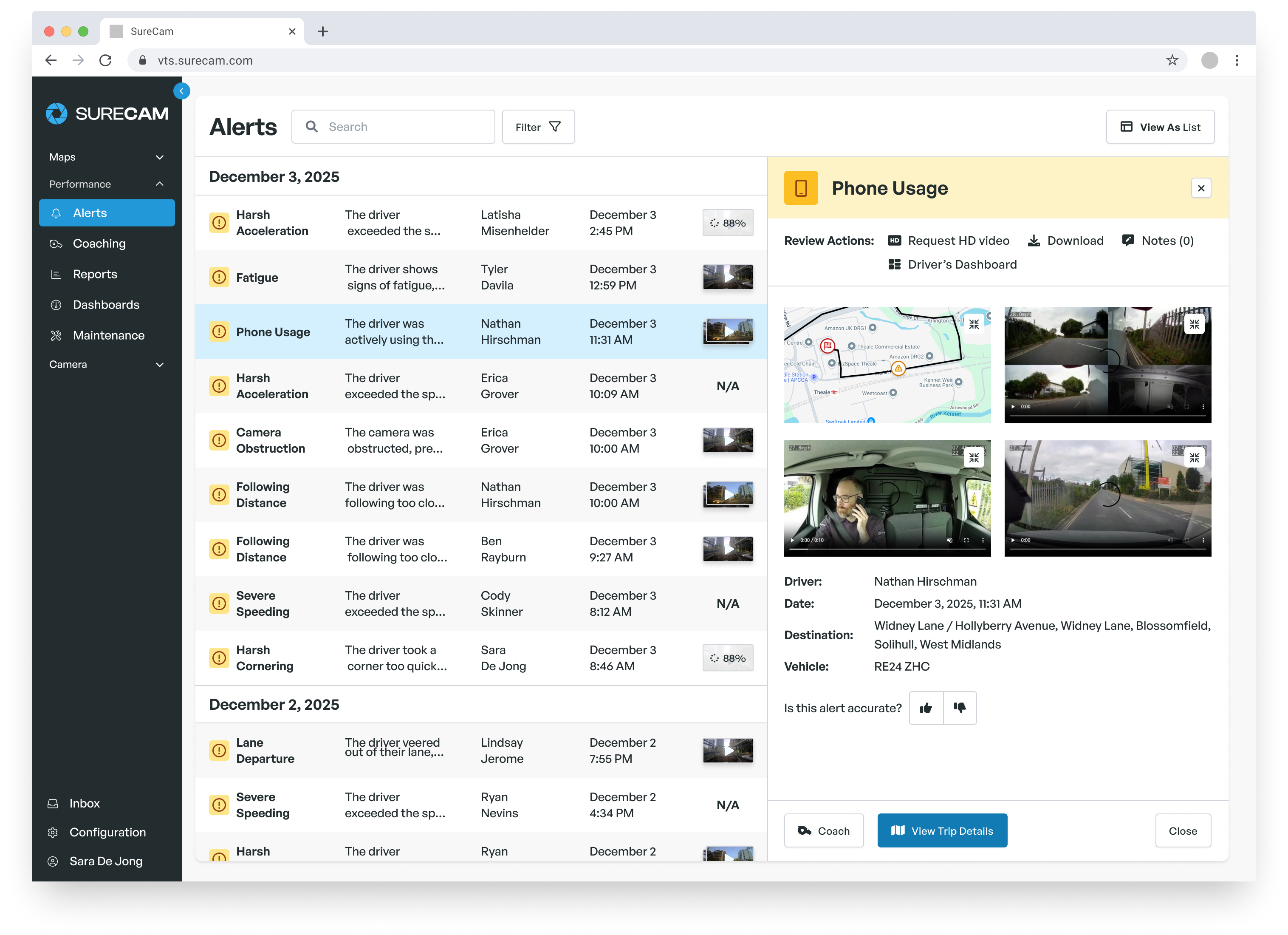
The platform operates on a self-managed model, which means fleet managers access their own footage directly without routing requests through a support team. The data access that most matters in a claim situation (getting footage to an insurance partner within minutes, not hours) does not depend on vendor intermediation.
For fleets evaluating contract terms alongside product capabilities, the right vendor conversation starts with these questions: Who owns the footage? What does it cost to leave? What happens to the data if the relationship ends? A vendor that answers these questions directly, in writing, before the contract reaches legal review, signals a relationship built around the fleet's interests rather than the vendor's retention strategy.
A Contract Review Checklist Before You Sign
The following questions translate the contract clauses above into a practical pre-signature review:
Auto-renewal and cancellation: What is the exact notice period? How must notice be delivered? What is the anniversary date?
Minimum term and exit costs: What does early termination cost at month 6, month 12, and month 18? Does a proportional buydown apply?
Hardware ownership: Does the fleet own the cameras, or does the vendor retain title? What is the end-of-term purchase option?
Switching costs: Do cameras use standard mounting and wiring? Does the platform export data in a portable format?
Data ownership: Does the contract explicitly state the fleet owns its footage? What commercial license, if any, does the vendor claim over fleet data?
Data portability: Can historical footage be exported in full after termination? How long does the vendor retain footage post-termination?
Pricing escalators: Does the contract cap annual rate increases? Are there overage fees for data consumption, events, or user seats?
SLA coverage: What does the SLA cover, and what does it exclude? What remedy does the fleet receive for downtime? Does persistent failure trigger a termination right?
Signing a vendor contract without answers to these questions means accepting terms the fleet has not negotiated. Most vendors will address reasonable questions in writing. Those that will not, have given you an answer already. Give us a call or schedule a short conversation to learn more about how SureCam compares.



.png)