Why Most Driver Coaching Programs Stall Before They Start
Coaching conversations happen after the fact. That's the first problem. A driver gets flagged for a harsh braking event three days ago, receives a brief talking-to with no video to reference, and walks away, uncertain what the concern actually was. The manager walks away, hoping the conversation landed. Neither party has anything concrete to hold on to.
That cycle repeats until someone loses patience or something expensive happens. And it explains why so many fleets report that their coaching programs never gain traction: the inputs arrive too late, the evidence sits too far from the conversation, and the feedback loop closes long after the moment has passed.
The second problem: coaching without data becomes a guessing game between managers and drivers. Accusations feel arbitrary. Defenses feel reflexive. The result is exactly the friction you cannot afford when driver retention already demands careful handling.
The Shift from Reactive Review to Proactive Intervention
A proactive coaching program starts before the next incident. It works from a continuous stream of driving behavior data: harsh braking, harsh acceleration, hard cornering, speeding thresholds, following distance, and in-cab distractions captured through dual-facing cameras. Each event populates a safety score that gives managers a running picture of where each driver sits relative to the fleet baseline.
That picture matters because it changes the coaching conversation entirely. Instead of reacting to a collision report, a safety director can sit down with a driver who has accumulated twelve harsh braking events over the last thirty days and show them the pattern before an incident occurs. The conversation shifts from blame assignment to behavior awareness, and that shift makes drivers more receptive.
Proactive coaching also catches the drivers who are quietly developing bad habits. The ones who look fine until they aren't. Regular review of event frequency by driver, combined with video clips tied to specific events, surfaces those patterns early.
How AI Dash Cams Generate the Event Data Coaching Programs Need
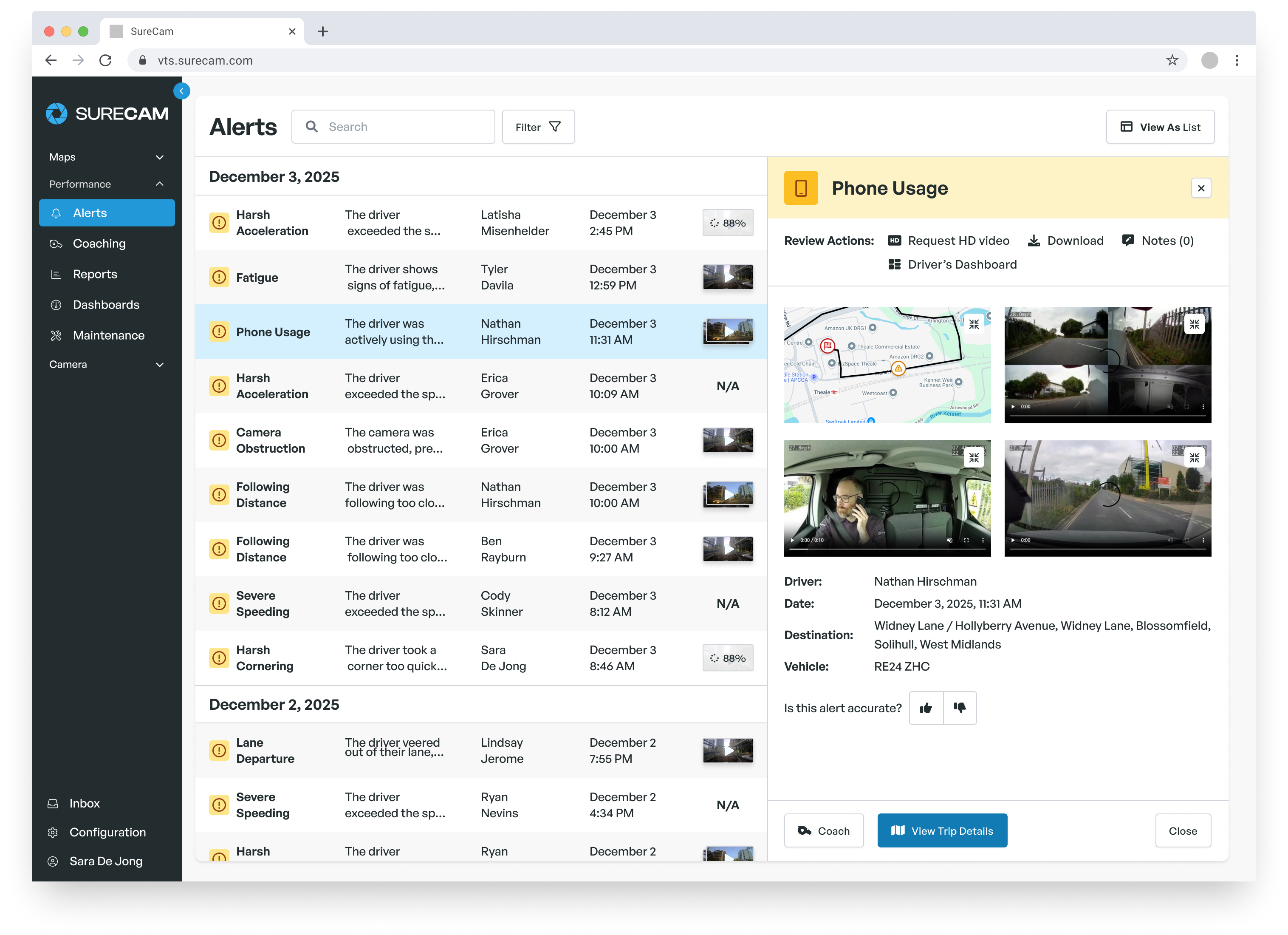
Video telematics systems detect driving events through a combination of G-force sensors, GPS data, and AI-powered video analysis. The camera's accelerometer registers the physical signature of a hard stop or aggressive lane change. AI processing identifies in-cab distractions: phone use, failure to wear a seatbelt, or fatigue-related head drops. The system logs the event, timestamps it, geotags it, and uploads the clip to the fleet portal automatically.
The result: a manager logging into SureCam's platform at 7 a.m. sees every flagged event from the previous day, each one paired with video. No manual card pulls. No waiting on drivers to report. No missing footage because a camera ran out of storage.
Why Video Context Changes Everything in a Coaching Conversation
Data without context produces arguments. A driver told their score dropped because of three harsh braking events can reasonably push back: traffic was unpredictable, someone cut them off, road conditions changed fast. Those explanations may well be accurate.
Video resolves the argument in seconds. Play the clip and both parties see exactly what happened. If external conditions genuinely caused the event, the video confirms it and the driver receives credit for handling the situation correctly. If the event reflected a habit worth addressing, the driver can see it themselves rather than taking someone's word for it.
That distinction matters enormously for the quality of the coaching conversation. Defensiveness drops when the evidence comes from the road, not from a manager's interpretation of a data point. Drivers who can watch their own footage often identify the issue before the manager says a word.
Building a Tiered Coaching Workflow
Not every harsh event warrants a one-on-one meeting. A tiered approach keeps the program from overwhelming both managers and drivers while ensuring the most serious behaviors receive appropriate attention.
Tier One: Automated In-the-Moment Feedback
The first tier handles low-severity, isolated events automatically. A driver receives an in-cab alert the moment a threshold gets crossed. This immediate feedback connects the behavior to the consequence in real time, when the driver can actually adjust. SureCam's connected cameras support these real-time nudges, which reduces the number of events that require human follow-up.
The in-cab alert does not replace a coaching conversation for repeat behaviors. Its job is to interrupt the pattern before it becomes a habit. A driver who receives an alert after a hard brake in a construction zone may simply have reacted to something unexpected. One who receives the same alert four times in a week needs a conversation.
Tier Two: Pattern-Based Coaching Conversations
The second tier activates when a driver's event frequency exceeds a defined threshold over a rolling time window. The threshold varies by event type: a single distracted-driving detection warrants faster escalation than a single harsh cornering event. Safety directors set these thresholds based on fleet priorities and risk tolerance.
When a driver reaches tier two, the coaching conversation uses video clips, not just score summaries. Pull two or three representative clips from the period in question. Watch them together. Ask the driver to explain what they saw happening and what they might do differently. This format keeps the conversation collaborative rather than adversarial, and it produces better retention of the feedback.
Tier Three: Formal Performance Review and Escalation
Tier three covers persistent patterns that have not responded to tier-two coaching, plus any single event severe enough to require immediate formal review: a near-miss, a collision, a documented seatbelt violation. This tier involves documented performance expectations, a clear improvement timeline, and scheduled follow-up reviews with video evidence at each check-in.
The escalation path matters because it protects the fleet legally and keeps the program credible. Drivers who receive only informal conversations without documented follow-up rarely take the program seriously. Those who see that the process has structure and consequence understand that the fleet's commitment to safety runs through behavior, not just policy statements.
Driving Buy-In: Getting Drivers to Embrace Coaching, Not Resist It
Driver resistance to cameras and coaching programs follows a predictable pattern. Skepticism runs high at rollout. Drivers worry about surveillance, about being watched unfairly, about footage used against them rather than for them. That concern deserves a direct answer.
The best answer comes from the track record. When drivers understand that video evidence exonerates them from false claims, defends them against fraudulent accusations, and protects their record when an incident was not their fault, the camera transforms from a surveillance device into a professional asset.
Ringway Jacobs, a UK highway services company managing road network contracts for local government, experienced exactly this shift. At rollout, their drivers pushed back on cameras. The resistance faded over time as incidents arose and footage proved drivers were not at fault. Dave Bonehill, Head of Fleet Operations, described the turning point: "It was only when we had a number of incidents that we had to prove our drivers were not at fault. It was then that the cameras started to become respected and approved by drivers." Over two years, Ringway Jacobs achieved a 54% reduction in accident rate and unsafe driving behavior. (surecam.com/case-studies/ringway-jacobs/)
That arc from resistance to advocacy accelerates when fleets communicate the dual purpose of the program clearly at launch: the cameras protect drivers as much as they hold them accountable. Pair that message with privacy controls that reinforce the point.
Privacy Settings as a Trust-Building Tool
SureCam's privacy features give fleet operators concrete tools to demonstrate that the program respects driver boundaries. In-cab privacy mode disables inward video except during button-push events. Facial blurring pixelates driver and passenger faces for fleets operating in jurisdictions with stricter personal data requirements. Location privacy zones disable recording automatically within designated private areas. Time-of-day privacy shuts off recording outside defined business hours.
Rolling out these controls visibly and explaining how each one works tells drivers that the program does not seek to monitor their personal lives. That message lands differently than a policy memo. It shows rather than tells.
Measuring Whether the Program Actually Works
A coaching program without measurement degrades quickly. Managers lose motivation to review footage when they see no feedback on whether the effort translates to outcomes. Drivers lose motivation when no one tracks or recognizes improvement.
Three measurement areas matter most. First, event frequency trends by driver and by fleet: are harsh event counts declining over the rolling thirty-day window? Which drivers show the steepest improvement? Which show persistent elevation despite coaching? Second, safety score trajectories: individual scores should improve over a coaching cycle if the conversations and tier-two interventions are working. A score that stays flat or declines after formal coaching may indicate the approach needs adjustment or the escalation path needs activation.
Third, and most consequential for leadership conversations: claims frequency and cost. A well-run coaching program reduces the number of incidents that become insurance claims. It also produces better outcomes on the claims that do occur, because documented coaching conversations and consistent event data strengthen the fleet's position with adjusters and attorneys. That connection between driver behavior data and claims outcomes gives safety directors the business-case evidence to sustain the program budget through budget cycles when safety competes with other priorities.
Putting the Program in Motion with SureCam
The mechanics of a SureCam-based coaching workflow start with event alerts arriving the morning after an incident. Safety directors review flagged clips directly in the portal, tag events by type and severity, and queue the ones requiring follow-up. The platform's safety scoring assigns each driver a running score based on event frequency and severity, giving managers a prioritized list rather than a pile of undifferentiated footage.
The tiered workflow described in this article maps cleanly onto those tools: in-cab alerts for tier one, portal-based clip review for tier-two conversations, and documented score tracking for tier-three escalation. SureCam's dual-facing camera options capture both road events and in-cab behavior without requiring separate hardware, and privacy controls give fleet operators flexibility to match program configuration to workforce agreements and regional requirements.
A coaching program built on this foundation does not require a full-time video review team. With the right platform, a safety director can review an entire fleet's flagged footage in 15–20 minutes per day. The system surfaces what needs attention; the manager applies judgment and context.
That combination: consistent data, video evidence, tiered response, and a privacy-forward rollout, produces the behavior change that reactive programs cannot. The drivers who improve stay in the cab longer, cost less to insure, and understand that the fleet's investment in safety runs in both directions.


-1.png)