The Short Answer on Value
For small delivery fleets evaluating SureCam, Verizon Connect, Azuga, and Lytx on total value, SureCam delivers the clearest ROI path: simple per-vehicle pricing, available with no upfront hardware costs, real-time live video, and a focused platform that does not charge for compliance tools most small delivery operators will never use. Azuga competes well on pricing transparency and self-install convenience. Verizon Connect suits enterprise fleets already inside the Verizon ecosystem but adds platform complexity and a 36-month commitment that can become costly for fleets under 50 vehicles. Lytx offers industry-leading AI coaching, but its premium pricing and enterprise-first posture make it a harder case to justify for fleets running fewer than 100 vehicles.
| Dimension |
SureCam |
Verizon Connect |
Azuga |
Lytx |
| Pricing model |
Per-vehicle subscription; GPS, Maintenance tracking, and reporting included |
Quote-required; not published |
~$25/mo GPS + ~$30/mo dashcam add-on |
Quote-required; premium tier |
| Standard contract |
Flexible terms available; both CapEx and OpEx models |
36 months; auto-renews |
36 months |
Multi-year preferred |
| Hardware cost |
Included in subscription |
Bundled; installation fees may apply |
No upfront hardware cost |
Upfront hardware purchase required |
| Camera resolution |
HD |
720p |
1080p HD |
HD |
| Self-install |
Yes, in under 30 mins per unit |
Possible; professional preferred |
Yes (plug-and-play) |
Yes |
| AI event detection |
G-force + AI-triggered |
AI-assisted; event-triggered |
AI: ADAS + Driver Monitoring System |
Industry-leading AI; 100B+ miles of training data |
| Live video streaming |
Yes (LiveCheck) |
No |
On-demand check-in |
No |
| Best fit |
Small-mid fleets: video-first, claims defense |
Enterprise and Verizon ecosystem fleets |
Small-mid fleets with ELD needs |
Enterprise safety programs |
Pricing ranges for Verizon Connect and Lytx are third-party estimates from tech.co, FleetOpsClub, and GPS Insight comparison sources (2026). Azuga dashcam add-on pricing from TechRadar (2026). Verizon Connect camera resolution (720p) from tech.co review (2026). Lytx hardware purchase requirement from multiple third-party sources; confirm current terms directly with each vendor.
What "Best Value" Really Means
A small fleet manager comparing monthly line items is making the wrong comparison. The right calculation adds the total monthly subscription to hardware costs, installation fees, and contract exit penalties, then measures that number against the savings it generates: claims defended, insurance premiums reduced, coaching time saved, and accidents prevented before they happen.
A system that costs $15 more per vehicle per month but deflects three false claims a year pays for itself many times over. A 36-month contract loaded with enterprise features that never get used creates stranded costs from day one. Value runs in both directions.
How the Four Vendors Stack Up
Pricing, Contracts, and Upfront Costs
Azuga offers the most transparent pricing structure among the four vendors reviewed here. GPS fleet tracking starts at approximately $25 per vehicle per month (source: SelectHub, 2026), with the SafetyCam AI dashcam available as an add-on at approximately $29.99 per month and no upfront hardware cost (source: TechRadar, 2026). Azuga requires a 36-month contract term, standard across the industry. SureCam operates on a per-camera subscription model that includes hardware and requires no significant upfront capital commitment.
Verizon Connect and Lytx both require custom quotes, with no pricing published on their websites. Verizon Connect's standard agreement runs 36 months with automatic renewal, and third-party pricing estimates from 2026 place the cost at approximately $20 to $45 per vehicle per month depending on fleet size and feature tier (sources: tech.co, business.com, 2026). Lytx sits at a premium tier: third-party estimates place the full video telematics platform at $30 to $50 per vehicle per month, with hardware costs that can reach $500 or more per vehicle (sources: FleetOpsClub, 2026; GPS Insight comparison page, 2026). For a small fleet manager building a three-year budget, the absence of published pricing means a sales conversation with all four vendors before honest comparison becomes possible.
Core Features for Delivery Fleets
For a 10-truck delivery operation, core requirements are usually the same: real-time footage retrieval after an incident, GPS that confirms arrival times and routes, and a portal where a manager can pull a clip in under two minutes without clicking through multiple menus. SureCam's forward-facing and dual-facing cameras deliver HD footage over cellular, accessible in seconds via a web portal, and do not require any additional platform subscription to function. Azuga's SafetyCam records in 1080p HD with both road-facing and driver-facing lenses, self-installs via plug-and-play hardware, and routes footage to the same dashboard that handles GPS and driver scoring. Both systems are designed for operators who review footage themselves rather than outsourcing it to a managed service.
Verizon Connect's dash cam operates exclusively within the Reveal or Fleet platform subscription, meaning a fleet that wants the camera also pays for the broader fleet management platform regardless of whether it uses route optimization, dispatch, or ELD tools. At 720p resolution (source: tech.co, 2026), the camera sits below the current industry standard for delivery fleets where license plate legibility and close-range footage clarity matter during claims. Lytx requires pairing with a separate GPS platform because its own GPS tracking is secondary to its core safety and coaching function, adding another vendor relationship and another monthly line item to an already premium budget.
AI Detection, Coaching, and Claims Defense
All four vendors offer AI-based event detection triggered by g-force, harsh driving events, and driver behavior. Lytx scores well on AI accuracy: the company's DriveCam system has trained on more than 100 billion miles of real-world driving data, and its proprietary RISKPOINT score predicts future collision risk per driver based on behavioral patterns. For fleets running formal safety programs with managers who can follow a structured coaching workflow and commit to consistent program execution, Lytx's accuracy advantage compounds over time.
For smaller delivery fleets without a dedicated safety manager, that depth can work against the operation. Lytx's full value requires consistent manager follow-through and structured coaching sessions that go well beyond reviewing a single flagged clip. One reviewer attempting to launch a six-vehicle pilot with Lytx described receiving no response from the sales team despite repeated outreach (source: Software Advice, 2026).
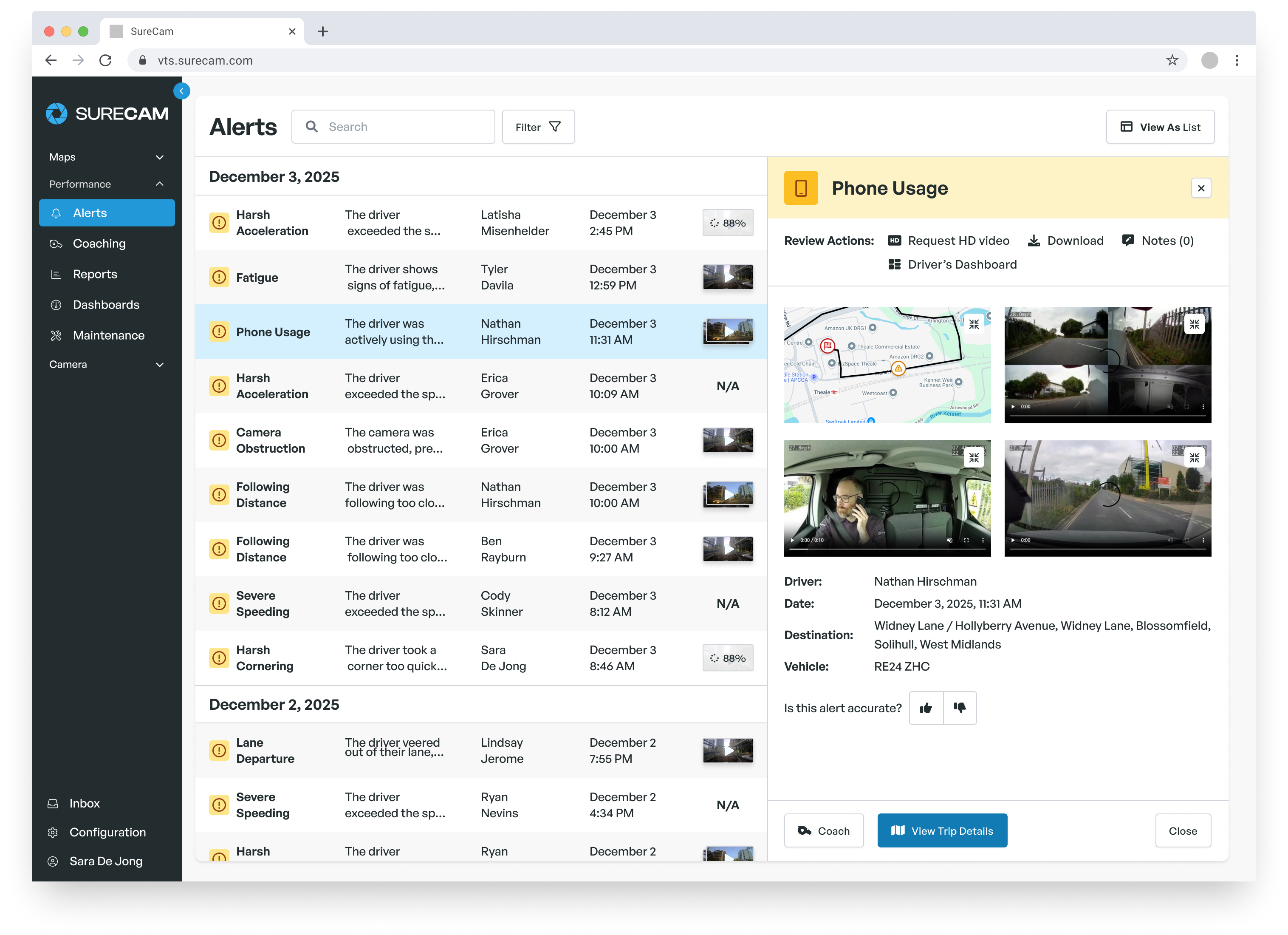
SureCam's AI detection captures the events that matter most for a small fleet: tailgating, collision triggers, harsh braking, and g-force incidents that generate footage in seconds and push alerts to managers immediately. Azuga's Driver Monitoring System handles distracted driving, phone use, and fatigue detection with in-cab alerts and event scoring. For a delivery fleet manager reviewing footage between route cycles, the operative question is not which platform holds the most training data. It is how much of that output the fleet has the time and capacity to act on.
Hidden Costs Worth Knowing Before You Sign
Three cost categories tend to appear after contract signing that rarely feature in a vendor's opening proposal. Installation comes first. Verizon Connect strongly recommends professional installation for hardwired connections and charges technician fees that can include no-show penalties if a scheduled vehicle is unavailable at the appointment time (source: Verizon Connect Help documentation, 2026). A five-vehicle deployment with any scheduling friction can generate unplanned costs before a single camera goes live.
Platform lock-in comes second. When a camera only functions inside a proprietary platform subscription, as with Verizon Connect's requirement for an active Reveal or Fleet account, canceling the platform also terminates the camera program. Auto-renewal completes the picture: Verizon Connect's 36-month agreement auto-renews after expiration, and missing the cancellation window locks a fleet into another full commitment (source: user reviews, Trustpilot and tech.co, 2026). Before signing any multi-year agreement, get specific answers to two questions: What is the cancellation notice window before auto-renewal triggers? And what does early termination cost in year two if fleet size changes significantly?
The ROI Math for Small Operators
The strongest argument against choosing a dash cam by sticker price alone comes from operators who have run the full numbers after deployment. Sam Lansberry II, founder of Lansberry Trucking, described how a $550,000 claim for an accident his company did not cause finally motivated the investment in connected cameras. In the year that followed, claims losses dropped by more than 80%. His framing of the investment captures the value equation directly: "I don't view our investment in SureCam as a cost, it's a profit-center. Last year alone, our claims losses reduced by over 80%."
For a 10-vehicle delivery fleet paying $30 per vehicle per month across a 36-month contract, the total subscription outlay runs approximately $10,800. Against that figure, a single defended claim worth $15,000 to $25,000 returns the full investment. A meaningful reduction in at-fault accidents adds further: lower deductibles, fewer repair cycles, and in many cases a direct conversation with an insurer about premium reductions backed by verifiable loss history. The camera does not pay for itself in month one. Over the contract term, for a fleet carrying real claims exposure on busy delivery routes, the math typically works.
Which Vendor Fits Which Fleet
Lytx suits enterprise and mid-sized fleets running formal safety programs with dedicated staff to operate the coaching workflow and review RISKPOINT scores. Its AI accuracy and behavioral risk modeling offer genuine competitive advantage when those resources exist. Small delivery operators without a safety manager may find the program demands exceed what the operation can realistically sustain.
Verizon Connect suits fleets already embedded in the Verizon ecosystem: operators using Reveal for ELD, dispatch, or asset tracking who want to add video without adding another vendor. For a fleet that needs only cameras and GPS, the platform's breadth translates into a monthly bill loaded with tools no one ever opens.
Azuga suits small-to-mid-sized fleets that want a combined GPS and safety platform with a self-installable camera in one subscription. Its driver gamification and scoring features work well for operations building a safety culture from scratch. Fleets without ELD requirements should confirm pricing does not bundle ELD tools they will not use.
SureCam suits operators who want a video-first platform: real-time footage, live streaming via LiveCheck, GPS included in every camera, and a portal a non-technical fleet manager can operate without a formal training program. For delivery fleets where the primary return on investment comes from claims defense and coaching off harsh event alerts rather than enterprise-scale compliance workflows, a focused system means the monthly bill reflects what the fleet actually uses.
Before You Sign: A Vendor Checklist
Seven questions worth asking before committing to any dash cam contract:
- Does the monthly price include all features the fleet actually needs, or does the camera require a separate platform subscription to function?
- What does the full 36-month total cost look like, including hardware, installation, and any professional service fees?
- Does the agreement auto-renew, and what is the exact cancellation notice window required to prevent renewal?
- Can a manager pull an incident clip in under two minutes without contacting support?
- Does the camera support live video streaming, or only event-triggered uploads after an incident?
- What resolution does the camera record at, and will that footage hold up in a disputed third-party claim?
- Can the vendor provide a reference from a fleet of similar size in a similar delivery operation before signing?
Want to explore how SureCam can help your fleet? Contact us today!