The Short Answer: Yes, With the Right Deployment
AI dash cams reduce fleet incidents by interrupting risky behavior in real time, detecting near-misses automatically, and creating structured coaching opportunities that standard after-the-fact review programs miss. The safety improvements are measurable and typically visible within 90 to 180 days, provided the fleet consistently acts on what the system surfaces.
Fleet safety managers evaluating this technology often ask whether AI dash cams deliver meaningful safety improvement or just better incident documentation. The answer is both. The incident-reduction side, though, depends entirely on deployment. Five mechanisms explain how fleets that put the data to work see different safety outcomes than fleets that store it passively.
Way 1: In-Cab Alerts Interrupt Risk Before It Becomes an Incident
The most direct path from AI dash cam to fewer incidents runs through the in-cab alert: an audible warning triggered when the system detects risky behavior before that behavior produces a collision. Tailgating, lane departure, forward collision risk, and hard braking all generate alerts that reach the driver at the moment of risk, not hours later during a scheduled review.
That immediacy is the point. Traditional safety programs surface what already happened. Real-time in-cab alerts address what is happening. For behaviors that repeat on familiar routes (following too closely in heavy traffic, cutting too close to medians at job-site entrances), the alert creates a low-friction correction loop. The driver hears it, adjusts, and the behavior changes without dispatcher involvement or a formal coaching session.
Alert configuration matters as much as the alert capability itself. An AI system that categorizes events by severity lets fleet managers triage meaningfully: a single hard-braking event triggered by a sudden road obstacle warrants different handling than a driver who logs hard-braking events four times on one shift on a route driven daily. Fleets that calibrate alert sensitivity correctly avoid the warning fatigue that erodes the correction value of a real-time alert program over time. Overload is how the correction signal dies.
Way 2: AI Event Detection Makes Near-Misses Visible and Reviewable
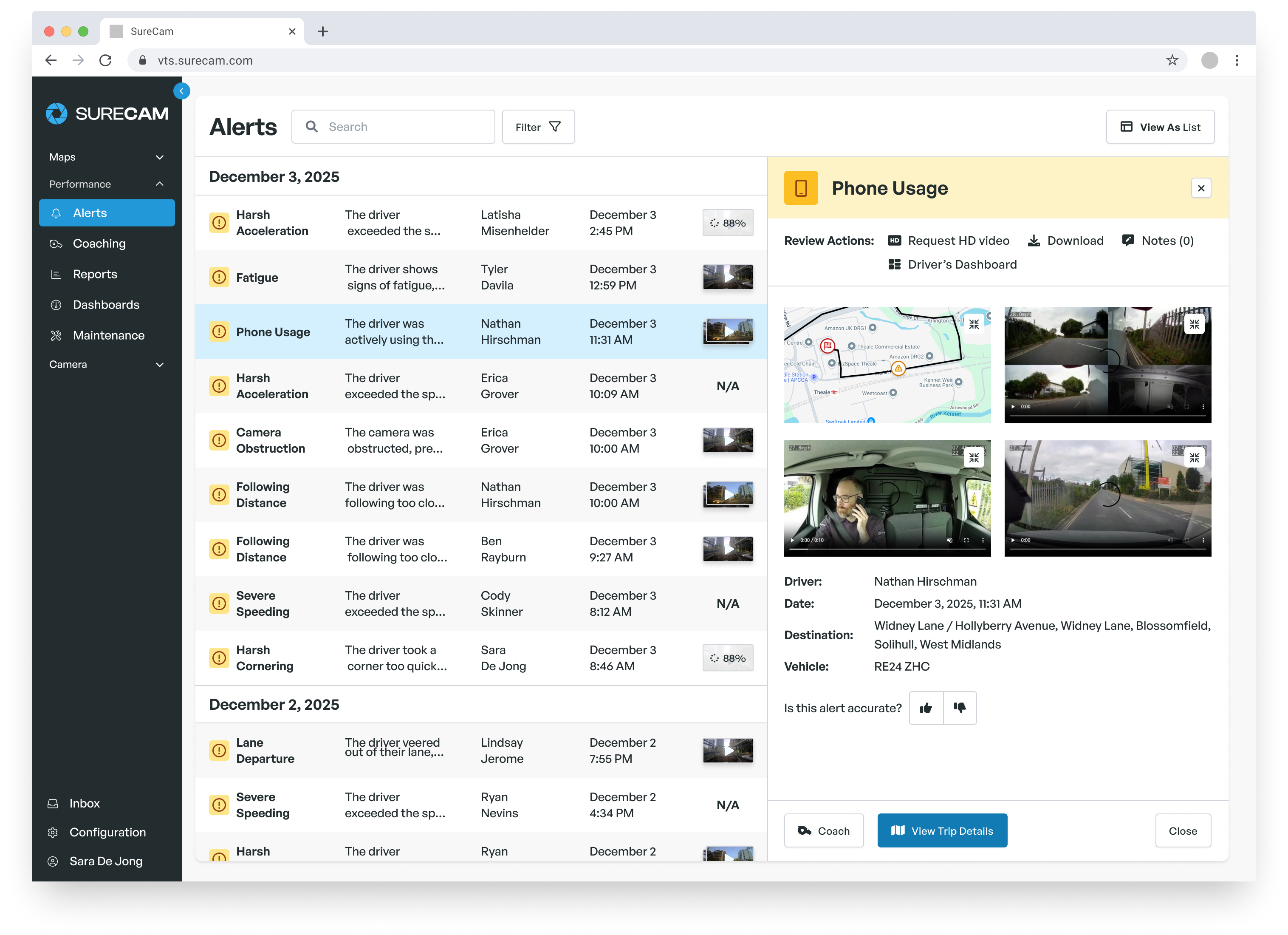
AI event detection does something standard continuous recording cannot: it selects what matters from hours of footage and routes it to the review queue automatically. When the system identifies a forward collision warning, a sudden swerve, or another high-risk event that stops short of contact, the clip is flagged and surfaced the same day. Near-misses enter the safety record rather than disappearing unremarked.
This shift changes how safety programs operate in practice. Before AI event detection, a driver who came within two feet of a pedestrian but avoided contact generated no clip, no flag, and no coaching opportunity. The event was invisible. With AI event detection, that same event surfaces before the driver's next shift. The fleet addresses an elevated-risk pattern before it produces an incident rather than after.
Volume management is the practical benefit for larger fleets. Safety managers cannot manually review thousands of hours of uneventful footage. AI-driven filtering concentrates the review queue on clips that genuinely warrant attention. The time recovered from manual scanning goes toward actual coaching, which is where incident reduction happens.
Way 3: Coaching Tied to Specific Events Drives Measurable Behavior Change
Coaching from video works differently than coaching from a safety scorecard or a supervisor's general observation. When a driver watches the actual clip from a harsh-braking or hard-cornering event, sees the timeline, and understands what a safer approach would have looked like, the feedback is specific enough to act on. Drivers respond to what they can see. Abstract instruction produces slower correction than visual evidence tied to a real moment.
Concrete Strategies, a national concrete supplier with 136 vehicles and a safety program led by Lisa Lamons, Safety Training and DOT Compliance Manager, built a coaching workflow directly from camera event alerts. Lamons reviewed harsh braking, hard cornering, and harsh acceleration events from cameras on the company's 33 largest vehicles, using flagged clips as same-day or next-day coaching prompts. Third-party claims dropped 75% within the program. The time Lamons spent handling claims each month fell from approximately one week to under 10 hours. The camera generated the evidence; the coaching workflow converted it into outcomes.
The compounding effect is meaningful for fleets designing their program structure. Drivers who receive specific, evidence-based coaching within 24 hours of a flagged event show faster correction than those who receive monthly summary reviews. A driver who watches their own clip from a close-following event on a known route understands the specific behavior at issue, not a generalized warning about tailgating. Documenting coaching conversations alongside the associated clip also builds a defensible record if a driver's ongoing event pattern becomes a liability question down the line.
Way 4: Safety Scores Improve Within 90 to 180 Days of Consistent Deployment
Fleet-wide safety score improvement happens at the pace of behavior change, and behavior change at scale takes time. Fleets that deploy AI dash cams and act consistently on the data (reviewing flagged events, running structured coaching cycles, tracking score trends by driver and by route) typically see measurable improvement within 90 to 180 days. Passive deployment produces documentation. Consistent follow-through on the documentation produces the improvement.
Ringway Jacobs, managing 250 trucks and 350 vans under local government contracts, recorded a 54% reduction in accident rate and unsafe driving behavior over two years of camera deployment. Dave Bonehill, Head of Fleet Operations, credited part of the result to a monthly fleet dashboard shared with all employees, which made progress visible at both the individual driver and fleet-wide level. That internal transparency accelerated behavioral change in ways that back-office-only reporting could not replicate.
The 90-to-180-day window also serves an internal business case purpose. Safety directors building the justification for AI dash cam investment can treat this period as a defined measurement commitment: deploy, run consistent coaching cycles, and present safety score data at the 90-day mark compared to a documented baseline. That comparison gives leadership a return-on-investment signal tied directly to the technology rather than to broader safety program trends.
Way 5: AI Dash Cams Reinforce Driver Training Programs Rather Than Replace Them
AI dash cams generate the evidence for coaching. They do not conduct the coaching conversation itself. Fleets that treat camera deployment as a substitute for structured driver training miss the mechanism through which safety improvements actually occur: a manager and a driver reviewing footage together, naming the specific behavior, and establishing the expected standard going forward.
The practical distinction holds at every stage. A dash cam that flags a lane-departure event completes its function when a safety manager uses that clip in a one-on-one session, connects it to a defensive driving principle the driver encountered in formal training, and documents the conversation. The AI identifies the risk. The training framework and the coaching workflow convert that identification into a corrected behavior. Fleets that skip the human step consistently produce strong documentation and weak safety outcomes.
Driver perception of the camera system tends to shift when coaching is consistent and balanced. Drivers who receive feedback that acknowledges good driving as readily as risky events develop a different relationship with the data. Rather than experiencing the camera as surveillance, they start engaging with their safety scores as a record of their own performance. That shift reduces the resistance common during initial deployment and improves data quality over time: a driver who trusts the system generates more useful event data, which makes AI detection more accurate.
The practical implication for fleet operators is structural. Define the event types that will always trigger a coaching conversation. Establish a review cadence (within 24 hours of a flagged event is a reasonable target). Apply it consistently across supervisors, terminals, and regions. The camera provides the evidence. The program structure determines whether that evidence produces change.
The Common Thread: Data Only Works When Someone Acts on It
These five mechanisms share one dependency: the fleet must use what the system surfaces. AI event detection feeding a review queue no one opens produces no behavior change. Real-time alerts that drivers learn to dismiss become background noise. Coaching conversations that happen once at deployment and then stop leave the behavior loop open.
Fleets that treat AI dash cams as part of a continuous safety program rather than a one-time technology rollout see the cumulative improvement the data makes possible: lower incident rates, reduced third-party claims, and safety scores that hold up in insurance renewal conversations. The camera generates the evidence. The safety workflow converts evidence into action. The action produces the outcomes fleet safety managers are actually measured on. Ready to see how SureCam may help your fleet? Connect with us here.