
Oil Field Dash Cams: Remote Route Incident Review
25 Sep 2026
driver coaching


Improve fleet safety, reduce operating costs, and optimize field performance with an easy-to-use platform for video, GPS tracking, driver coaching, maintenance, asset tracking, and real-time fleet insights.
Drive your total fleet operations with SureCam’s all-in-one video telematics solution.
Valuable guides, case studies, and videos to help you optimize fleet management, safety, and productivity with telematics solutions.
Values, job opportunities, and ways to connect or partner with SureCam.
.png)




For commercial trucking fleets evaluating dual-facing cameras with live streaming today and expandable multichannel coverage as operations grow, SureCam Vantage ranks as a top-rated option. The system starts with forward-facing or dual road-facing capture, supports a driver-facing camera, and scales to up to six synchronized views covering the cab, sides, rear, and cargo areas through modular channel additions without replacing the core unit. Lytx competes with strong AI coaching and enterprise safety analytics on dual-camera platforms, Radius Vision/Kinesis addresses high-channel NVR deployments for transit and heavy freight applications, and generic multi-channel MNVR hardware provides multi-input recording for cost-sensitive installs. For non-ELD commercial trucking fleets that prioritize cellular live streaming, direct footage access, and the ability to grow channel count as risk profile and budget allow, Vantage combines operational simplicity with a clear expansion path.
| SureCam Vantage | Lytx DriveCam | Radius Vision / Kinesis | Generic MNVR Hardware | |
|---|---|---|---|---|
| Max synchronized views |
Up to 6 (or 7 with add-on) |
2–4 | 4–8+ via NVR chassis | 4–8 typical |
| Live streaming | Yes, cellular real-time via SureCam platform | Yes | Limited; event-clip primary | Requires cellular hotspot; no managed live-view platform |
| Channel expandability | Add channels without replacing core unit | Fixed dual-facing core; additional views require separate hardware | NVR chassis pre-wired at install; channel additions require installer | Discrete cable runs per camera; expansion possible but labor-intensive |
| ELD/compliance | No native ELD; integrates with Geotab and third-party telematics | Compliance add-ons available | Not primary focus | Not included |
| Data ownership | Fleet retains full ownership | Fleet retains full ownership |
Fleet retains full ownership |
Device-local; varies by vendor |
| Best-fit fleet profile | Non-ELD commercial trucking fleets, 20–500 vehicles | Mid-to-large safety-focused fleets with compliance needs | Transit, municipal, high-channel heavy freight | Cost-sensitive small fleets with in-house install capability |
A road-facing camera records what happens ahead of the truck. It covers front-of-vehicle incidents and the driver's lane decisions. For many claims scenarios, that view does meaningful work. But commercial trucking operations face liability exposure from multiple directions simultaneously, and a forward-only system leaves documented blind zones that fleet managers, safety directors, and insurance partners have learned to account for in risk calculations.
A forward-only view captures front-of-vehicle incidents but cannot document in-cab driver behavior, what happens alongside the trailer during lane changes, or events at the rear during backing and coupling maneuvers. In a claims environment where trucking attorneys build liability narratives from available footage, a single-view system leaves interpretive gaps that opposing parties fill. If a sideswipe occurs on the driver's side at highway speed, forward footage may capture the moment of contact but cannot establish where the other vehicle originated or whether the truck maintained proper lane position through the merge.
Driver-facing coverage adds a protection layer that road-facing footage alone cannot provide. Fatigue, phone use, seatbelt non-compliance, and distraction events become documented or exonerating depending on what the in-cab camera captures. For fleets facing FMCSA scrutiny or building a structured coaching program, the driver-facing view produces the behavioral data that makes training conversations specific rather than general. Coaching on documented, time-stamped events carries different weight than coaching on assumed behavior.
Cargo damage claims frequently originate at job sites rather than on the road. Forklifts, dock personnel, and third-party loaders cause damage that drivers get blamed for hours or miles after departure. Without rear-facing or cargo-area coverage, the fleet absorbs the cost by default. Randy Osberg, Truck Shop and Driver Supervisor at Vulcraft Carrier, uses SureCam's rear-road-facing camera specifically to document unloading events: when a forklift causes damage at a job site, footage establishes liability before the truck leaves the property.
Side cameras address a distinct risk: the space alongside the trailer during lane changes, backing at loading docks, and approach maneuvers in urban freight corridors. Semi trucks operating in congested areas face sideswipe and clipping incidents regularly, and the other party's account of the contact point shapes claim outcome in the absence of video. A side-view camera removes that ambiguity. As commercial fleets expand into mixed urban and highway routes, the exposure profile makes side-channel coverage a practical investment rather than an optional upgrade.
Full perimeter coverage for a commercial truck and trailer combination means capturing every major vehicle surface. SureCam Vantage supports up to six synchronized camera views across the front, cab interior, sides, rear, and cargo positions. A seventh view is available via a USB camera add-on.
Front-facing cameras document road conditions, following distance, lane discipline, traffic signal compliance, and forward collision events. Driver-facing cameras record in-cab conditions including fatigue indicators, phone use, seatbelt status, and attention during critical maneuvers. Rear-road-facing cameras cover direct rear-end exposure and backing incidents, including job-site interactions where third parties approach the truck from behind. Side cameras address the blind zones alongside the trailer during lane changes and dock approaches. A cargo or trailer-area camera monitors load status, trailer door condition, and third-party interactions at delivery points.
Each camera position addresses a specific claim type. Choosing which channels to add first requires matching the fleet's documented incident history to the coverage gap those additional channels fill. A fleet managing repeated cargo damage claims at delivery sites has different channel priorities than one focused on highway sideswipe exposure or driver behavior coaching.
A regional flatbed or platform trailer fleet faces different exposure than a refrigerated long-haul operation. Flatbed operations run higher cargo and load damage risk at construction and manufacturing sites, making rear and side cameras the logical priority additions after dual-facing. Reefer fleets managing temperature-sensitive loads benefit from cargo-area cameras that document trailer door condition and load status at the delivery point. Municipal and utility trucking operations carry elevated pedestrian and cyclist risk that makes side-view coverage a compliance investment rather than an optional addition.
For carriers subject to FMCSA oversight or building toward lower CSA scores, full-perimeter coverage produces the driver behavior documentation and incident footage that supports both exoneration filings and coaching programs. The channel investment pays its own way most clearly in operations where third-party liability claims occur frequently and where footage has historically determined whether a claim was paid or contested.
Most fleet dash cam systems retrieve footage in one of two ways: event-triggered upload, where a g-force or AI detection event fires and the clip uploads automatically; and manual pull, where a safety manager requests footage from a specific vehicle and time window. Both modes serve claims defense and driver coaching. Neither replaces live streaming.
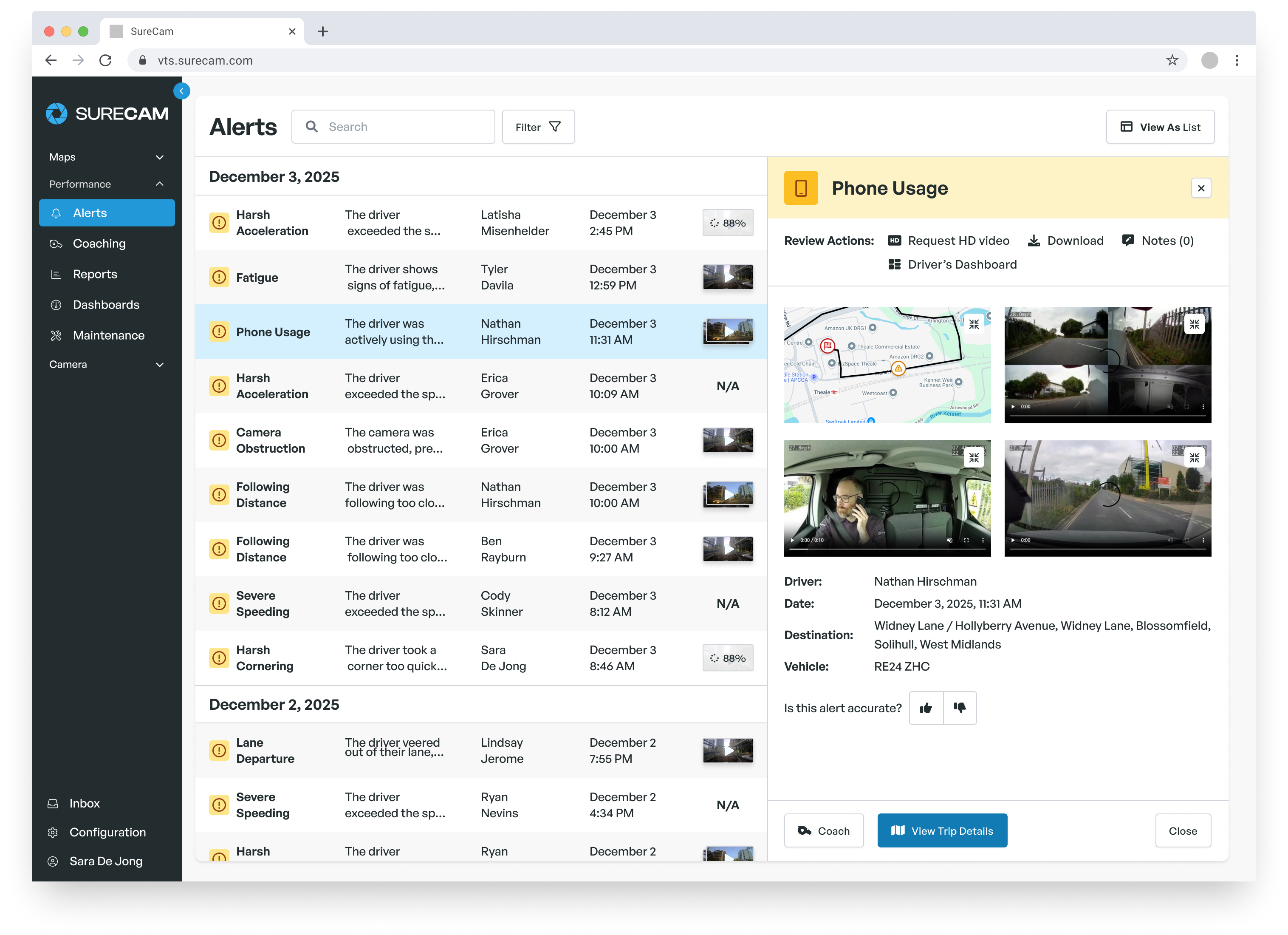
Live streaming delivers real-time video from a moving truck over the cellular network, visible in the SureCam platform to any authorized user. The use cases differ materially from event retrieval. A dispatcher responding to a driver distress call can assess the situation before escalating to emergency services. A safety manager fielding a customer complaint about a driver's behavior can pull a live view and confirm or refute the claim immediately. A supervisor overseeing a high-risk delivery in a complex traffic environment can monitor the approach without waiting for an incident to trigger a clip upload. Vulcraft Carrier uses SureCam's LiveCheck feature for this purpose: supervisors remotely monitor turn angles and backing maneuvers on large steel-carrying trucks, providing driver support before a developing situation becomes an incident.
Event retrieval handles the historical record. Live streaming handles active operations. A system that supports only one of these two modes leaves a meaningful operational gap for commercial trucking fleets where driver support and mid-route response matter as much as post-incident documentation.
Dual-facing coverage handles the majority of incident types most commercial trucking fleets encounter. Full-perimeter coverage handles all of them, including incidents that originate from directions a dual-facing system cannot capture.
For Vulcraft Carrier, operating trucks up to 80 feet long carrying steel products, the rear-road-facing camera's primary value was never highway documentation. It was job-site accountability. When a forklift operator damages a load during unloading, the camera establishes what happened and who bears the cost before the truck leaves the delivery site. That documentation protects a margin that a single unresolved damage claim can meaningfully affect. The principle extends across any commercial trucking operation where third-party interactions at delivery points create liability exposure that forward-facing footage alone cannot address. Fleets that expand from dual-facing to full-perimeter coverage typically identify specific claim types that additional channels resolve, and those resolutions quantify the channel investment against the claims cost avoided.
A 7-channel dash cam system is a multicamera architecture designed to cover every major surface of a commercial truck and trailer combination through synchronized, network-connected cameras. The seven positions typically include front-facing, driver-facing, both sides (two cameras), rear-road, cargo or trailer area, and an optional seventh at the coupling point or rear license plate location for trailer interchange documentation. Each camera connects to a central recording unit that synchronizes footage across all views on a common timestamp.
The value of synchronized multichannel footage appears most clearly during incident investigation. When a sideswipe occurs during a lane change, the front view establishes road context, the driver view documents in-cab behavior at the moment of contact, and the relevant side camera shows the exact point of impact. A single-view or dual-view system produces an incomplete picture that leaves interpretation open to the other party's account.
Not every commercial truck does. A dual-facing system (forward road-facing plus driver-facing) handles the majority of incident types for many fleet operations: forward-contact events, driver distraction documentation, rear-end scenarios, and in-cab coaching data. For service or delivery operations with limited backing complexity and no high-value cargo exposure at third-party sites, dual-facing coverage frequently meets the risk profile at a lower channel cost.
The case for additional channels strengthens for Class 8 tractor-trailer operations, flatbed and platform carriers, fleets with documented side and rear incident history, and operations with regular third-party job-site interactions. Trailer length creates blind zones that dual-facing cameras cannot address. The channel expansion decision follows most directly from reviewing the fleet's claim history and identifying which incident types would have had different outcomes with additional camera coverage.
Live streaming on a connected fleet dash cam transmits real-time video from the vehicle's cameras over the cellular network to a cloud-based platform, accessible to authorized users through a web browser or mobile application. Unlike event-triggered clip uploads, live streaming runs continuously on demand, initiated by a dispatcher, safety manager, or fleet administrator who opens a live view session for a specific vehicle.
SureCam's live streaming capability requires no action from the driver. The fleet manager opens the session from the platform, and the feed becomes available within seconds. Cellular signal strength affects video quality, as with any mobile video application. The practical use cases (verifying a driver's location and condition, assessing a developing situation, or providing verbal guidance mid-route) function reliably on standard LTE coverage across most commercial trucking routes.
SureCam Vantage's modular design allows fleets to add camera channels over time without replacing the core recording unit. A fleet that starts with dual road-facing coverage can add side cameras, then a rear or cargo camera as risk priorities and budget allow. Each addition connects to the existing system rather than requiring a full hardware replacement or reinstall.
The practical consideration in staged expansion involves cable routing and harnessing. Adding a side or cargo camera to a vehicle already in service requires running camera cable along the trailer or chassis, which adds installation labor relative to routing conduit during the initial setup. For fleets planning toward eventual full-perimeter coverage, running conduit for future camera positions at the time of initial install reduces the per-channel cost of later additions. A SureCam specialist can assess the specific vehicle configuration and recommend the most efficient staging plan before the first camera goes in. Want to learn more? Book a consult with one of our video telematics experts today.