The Blind Spot Problem Nobody Talks About Until Someone Gets Hurt
A dump truck pulling out of a job site. A concrete mixer backing toward a loading dock. A flatbed navigating a tight urban work zone with workers on both sides. Each of these moments carries a risk profile that no forward-facing camera alone can address. Construction fleet managers know the feeling: the vehicle cleared the site, the driver reported no issues, and then a workers' compensation claim or a third-party liability letter arrives two days later referencing an angle nobody captured.
That gap between what happened and what can be proven costs construction companies real money. It costs them in claims they cannot fight, in insurance premiums that reflect an incomplete safety record, and in incidents that could have been prevented with full situational awareness around the vehicle. 360-degree vehicle camera systems exist to close that gap.
Construction Vehicles Create Unique Blind Spots
Standard pickup trucks and delivery vans share some visibility challenges. Dump trucks, concrete mixers, flatbeds, and heavy equipment carriers create visibility challenges in a different category entirely.
Large Vehicle Geometry Makes Standard Cameras Inadequate
A Class 8 truck can measure 70 to 80 feet in length. The turning radius alone creates blind zones that extend far beyond what a driver's mirrors can cover. Rear blind spots on a fully loaded dump truck can extend 30 feet or more behind the vehicle. Side blind zones on a concrete mixer swallow entire lane widths. These conditions describe the routine geometry of construction fleet operations, not the exception.
Forward-facing cameras capture exactly what they say: what sits in front of the vehicle. They document highway incidents and forward collisions accurately. But the incidents that most frequently occur in construction environments tend to happen in the margins: during backing maneuvers in tight yards, during slow turns around worker staging areas, and during unloading at job sites where pedestrian traffic mixes with vehicle movement. Multi-camera 360-degree systems change that exposure fundamentally. With synchronized rear, side, and cab views feeding a single platform, fleet managers gain a complete picture of every maneuver.
Reversing Incidents Represent the Highest Job Site Risk
Of all the maneuvering scenarios that produce injury and damage claims in construction environments, backing incidents rank among the most common and the most expensive. Workers struck by reversing equipment account for a significant portion of OSHA-recordable incidents in construction settings. Many of these incidents involve vehicles that appear to move slowly, which creates a false sense of safety for workers nearby. But the mass of a loaded dump truck or mixer does not require high speed to cause serious injury.
Rear-facing cameras with proximity sensors and AI-triggered alerts change the reversing equation by creating an active warning loop rather than a passive recording. The camera captures what sits behind the vehicle. The sensor layer detects proximity to workers or obstacles. The alert fires in-cab before contact occurs. When a fleet pairs this capability with documented review processes, the combination produces both behavioral change over time and defensible evidence when incidents do occur.
False Claims and Third-Party Liability Targeting Construction Fleets
Construction vehicles carry a liability profile that makes them targets for opportunistic claims. They operate in dense urban environments, they interact with heavy pedestrian and cyclist traffic in work zones, and they carry commercial insurance coverage that signals significant resources to third parties evaluating whether a claim seems worth pursuing.
Flying Debris and Nuisance Claims Cost Real Money
Concrete mixer trucks generate a specific category of claim: flying debris. Material dislodged from mixing drums or truck beds strikes nearby vehicles, and the owner files a claim alleging damage. Without camera coverage of the area from which debris allegedly originated, these claims often settle because the cost of denial exceeds the cost of resolution.
Lisa Lamons, Safety Training and DOT Compliance Manager at Concrete Strategies, ran a national concrete fleet before implementing SureCam cameras. Before cameras, her team fielded approximately one debris claim per week. Each claim consumed 8 to 10 hours of her time spread across multiple days. Roughly one full work week per month, every month, devoted to claims that could not be definitively proven or denied because no footage existed.
After deploying SureCam forward-facing cameras on the fleet's 33 largest vehicles, third-party claims dropped by 75%. False debris claims fell from weekly occurrences to approximately one per month. Time spent on claims handling dropped from roughly one week per month to under 10 hours total. "You'd have to go on what the driver said, you'd have to go on a police report if a police report was made," Lamons noted. "Now, with the cameras, it's pretty cut and dry. The answer is in the video."
Work Zone Incidents Create Complex Multi-Party Liability
Construction work zones create liability scenarios that involve multiple parties: the fleet operator, the general contractor, the municipality permitting the work, and any third parties in the area. When an incident occurs in a work zone, every party with exposure reviews available evidence to determine where fault lands. Fleet operators without comprehensive camera coverage frequently find themselves assigned liability by default because they cannot affirmatively demonstrate what their vehicles did and did not do.
360-degree camera systems document the full operational context of a work zone incident. They capture where workers stood, where cones were placed, how the vehicle moved, and how third parties behaved. That documentation does not guarantee a favorable outcome, but it eliminates the ambiguity that typically produces unfavorable settlements.
OSHA, DOT, and the Regulatory Case for Full Vehicle Coverage
Construction fleets operate under overlapping regulatory frameworks. OSHA Part 1926 governs construction work zone safety with specific requirements around struck-by hazards and backing operations. DOT regulations govern commercial motor vehicles on public roads. State-level programs add additional requirements in many jurisdictions.
Camera systems alone do not produce compliance. They produce the documentation that makes compliance auditable and defensible. When OSHA investigates a struck-by incident, or when DOT reviews a commercial vehicle accident, fleets with comprehensive camera coverage can reconstruct the event accurately rather than relying on driver recollections and damage patterns. That ability to reconstruct events precisely shapes how investigations resolve and what corrective actions regulators require.
For construction fleet safety directors building out formal safety programs, 360-degree camera systems serve as the foundation for every other initiative. Driver coaching programs need video to function. Pre- and post-trip inspection records gain credibility when camera footage correlates with reported conditions. New driver onboarding benefits from real footage of actual job site conditions, not simulations.
How 360-Degree Systems Work on Construction Vehicles
A 360-degree vehicle camera system typically combines multiple synchronized cameras covering the front, rear, driver-side, and passenger-side of the vehicle. The cameras feed a single connected platform that stores footage via cellular upload, making it accessible to fleet managers without requiring physical retrieval from the vehicle.
Camera Configurations for Heavy Equipment and Construction Vehicle Types
Different construction vehicle types require different camera configurations. A dump truck's primary risk surface sits behind the vehicle during backing and at the sides during road travel, making rear and side cameras the priority additions to a standard forward-facing setup. A concrete mixer's drum creates side blind zones during travel and a backing risk during delivery, requiring similar coverage. A flatbed carrying oversized materials through urban work zones benefits from all-around coverage because the load itself extends the vehicle's visual footprint in every direction.
The SureCam Vantage system supports up to six synchronized camera views, allowing fleets to configure coverage based on vehicle type and operational environment. Smaller vehicles in mixed fleets can run forward and rear setups. Larger vehicles can add side and driver-facing cameras. Fleets can expand coverage as risk profiles change or as budget allows, without replacing the underlying platform.
AI Event Detection Reduces the Review Burden for Safety Managers
One practical objection fleet managers raise about multi-camera systems is the review burden: if the system generates footage from four cameras simultaneously, how does a safety director know where to focus? AI-triggered event detection addresses this directly. Modern connected camera systems use G-force sensors and AI processing to flag events that warrant review: hard braking, harsh cornering, forward collision risk, and backing proximity alerts.
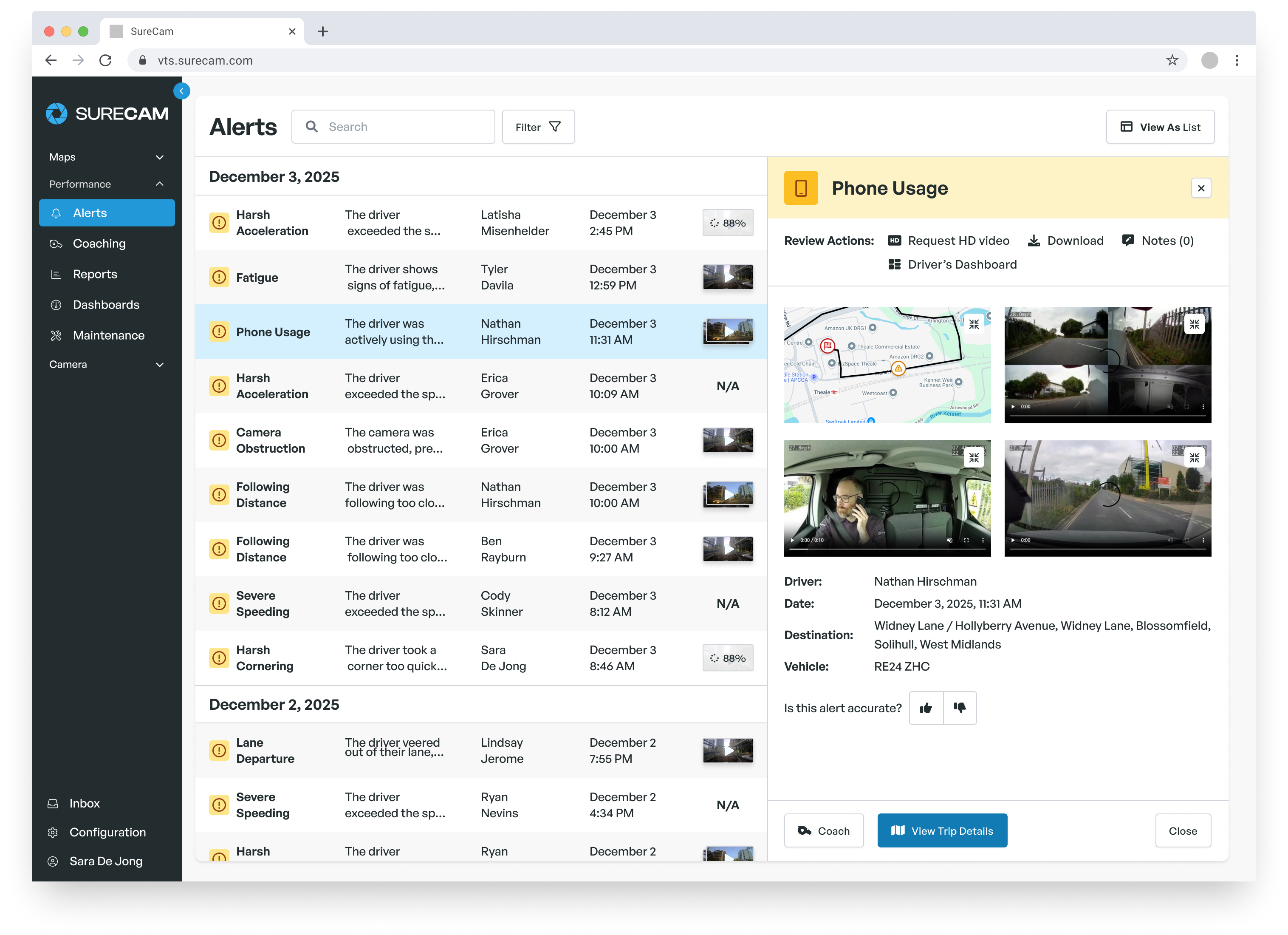
When an event triggers, the system uploads the relevant multi-camera footage automatically and surfaces it in the fleet manager's dashboard. The safety director reviews the events that matter rather than scrubbing through continuous footage across an entire fleet. For construction fleets where the safety function often sits with a manager who handles multiple other responsibilities, this automated triage makes the difference between a camera system that informs decisions and one that creates an administrative burden without a corresponding benefit.
The Insurance Argument for Comprehensive Coverage
Insurance industry research shows that fleets deploying dual‑camera video telematics (driver‑ and road‑facing) see 10–45% reductions in claims, more frequent driver exoneration in disputed crashes, and fewer cases going to trial, which in turn helps avoid nuclear verdicts and supports better loss performance over time. That track record translates, in many cases, into premium adjustments or favorable treatment at renewal.
The claims math matters. A single successfully defended false claim on a construction vehicle can offset a year or more of camera subscription costs. A single incident that footage affirmatively proves was not the fleet's fault can prevent a settlement that runs into six figures. Concrete Strategies' 75% reduction in third-party claims, achieved with cameras on just 33 of the largest vehicles in the fleet, demonstrates what targeted deployment can accomplish even before whole-fleet coverage. The return on investment comes not from covering everything perfectly on day one, but from covering the highest-risk vehicles first and building from there.
Looking to protect your Construction fleet? Talk to one of our video telematics experts today.



-1.png)