The Short Answer for Fleet Decision-Makers
For commercial fleets that want real-time AI event detection, instant cloud video access, and a platform their managers and drivers will actually adopt, SureCam ranks as the best AI dash camera available in 2026. SureCam's road-facing and optional driver-facing cameras connect over cellular, push incident clips to the cloud within seconds of a trigger, and surface alerts via email, SMS, or the web portal without requiring third-party managed review. Competitors including Lytx, Samsara, and Motive each offer AI camera capability, but they bundle it into broader compliance and operations platforms that add cost and complexity most service, construction, and local delivery fleets never fully use. The table below captures where each platform sits.
| Dimension |
SureCam |
Lytx |
Samsara |
Motive |
| Primary focus |
Video telematics + GPS, Maintenance, and Asset Tracking |
Video safety + optional ELD |
All-in-one ops platform (ELD, routing, maintenance) |
ELD + telematics + cameras |
| ELD / HOS built in |
Yes, through integration with Geotab and others |
Optional add-on |
Headline feature |
Flagship feature |
| Overkill risk for non-ELD service fleets |
Low |
Medium |
High |
High |
| Best fit |
Small and Mid-sized Service, construction, local delivery, towing |
Larger, safety-driven compliance fleets |
Mixed long-haul/regional fleets |
ELD-centric, compliance-heavy fleets |
What "Best" Actually Means for a Commercial Fleet
The word "best" in fleet technology gets weaponized by vendors selling features that sound impressive and sit unused. For fleet managers wearing three hats, best means something specific: the system that returns the most protection and operational clarity per dollar spent, per hour of staff time, and per minute of driver disruption. Five criteria actually move the needle.
Real-Time AI Event Detection That Fires When It Matters
AI event detection in a dash camera does one job: recognize a safety-relevant moment and get the right footage to the right person fast. SureCam cameras use g-force triggers, telematics inputs, and AI-assisted detection to flag hard braking, harsh cornering, collision events, and distracted or fatigued driving. When a trigger fires, the clip uploads over the cellular connection within seconds. No waiting until a driver returns to the yard. No hunting for an SD card. No reliance on a driver remembering to pull footage.
Video Clip of a SureCam AI-detected Tailgating Event on I-35 in Central Texas
The distinction between "AI-assisted" and "AI-reviewed" matters here. Some platforms route every flagged event through a managed service before the fleet manager sees it, adding latency and cost. SureCam gives fleets the choice: self-manage using the portal, or opt into managed coaching. For a fleet manager who wants to run a 15-minute morning review, self-managed access to AI-flagged clips delivers the same safety intelligence at a fraction of the cost.
Installation Speed and Hardware Reliability
An AI dash camera that takes four hours per vehicle to install produces its own hidden cost. SureCam cameras mount to the windshield, wire to OBD or hardwire to the vehicle's power source, and connect to the cellular network during setup. The process runs fast enough that fleets can cycle through vehicles without taking them off route for more than a brief window. The SC145 road-facing model and SC245 dual-facing model both use the same mounting hardware, which simplifies bulk installs across mixed fleets.
Hardware reliability matters as much as installation speed. Fleet cameras operate in punishing conditions: daily vibration, wide temperature swings, and years of road exposure. SureCam devices carry an IP69 rating and full HD 720p recording at 30 frames per second. The camera stores footage to a Micro SD card as local redundancy, so even a damaged device after a severe collision can potentially preserve the incident footage that determines liability.
A Platform the Whole Team Will Use
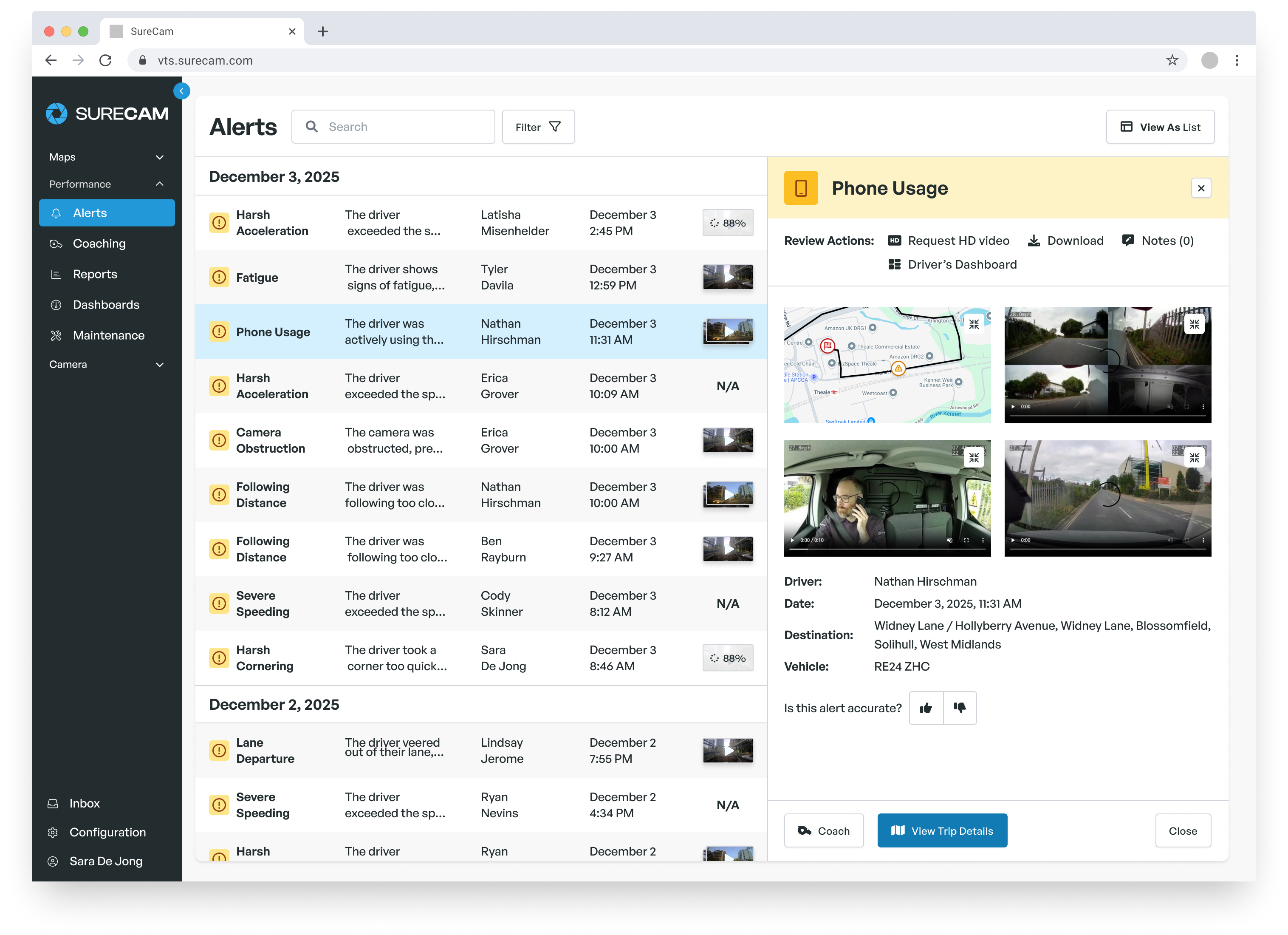
A dash cam system that confuses dispatchers, frustrates safety directors, and alienates drivers delivers a fraction of its theoretical value. SureCam's web portal keeps the interface flat: live map, event alerts, clip review, and driver history without a dashboard maze to traverse first. Dispatchers can check vehicle locations. Safety managers can pull coaching clips. Business owners can see the overnight alert queue before the first coffee.
Driver adoption follows the same logic. Drivers resist cameras when the rollout frames cameras as surveillance. See the 15-sec clip that exonerated a top driver here.
When the rollout frames cameras as protection, the math changes. Lansberry Trucking, an 80-truck US and Canada fleet founded in 1959, deployed SureCam after a $550,000 claim for an accident that was not Lansberry's fault. Within one year, claims losses dropped 80%. Lansberry's safety director now reviews the entire fleet's flagged footage in 15 to 20 minutes per day. Founder Sam Lansberry II put it plainly: "I don't view our investment in SureCam as a cost. It's a profit-center. Last year alone, our claims losses reduced by over 80%."
Transparent Pricing and Total Cost of Ownership
Total cost of ownership in fleet camera technology carries three layers: hardware, subscription, and hidden adoption cost. The hardware layer covers cameras and installation. The subscription layer covers cellular data transmission, cloud storage, and platform access. The adoption cost covers the staff hours consumed by a complicated platform, the driver onboarding burden, and the IT overhead of integrating a camera system into existing workflows.
SureCam operates on an all-in monthly subscription that bundles hardware, software, and data. No large upfront equipment purchase required. Unlimited user licenses mean a growing safety team does not trigger license-tier increases. For fleets comparing SureCam against Samsara or Motive, the relevant question is not just the per-camera monthly rate. It is whether the broader platform features those providers include in their pricing (ELD, dispatch, routing, maintenance) actually reflect work that fleet does every day. Paying for compliance automation on a fleet that does not run HOS logs represents dead spend.
Data Security, Ownership, and Reliability
Who owns the footage a dash camera captures matters more than most fleet buyers ask during vendor selection. Some telematics providers have structured contracts that give the vendor ownership or control over recorded footage, creating a liability problem if that footage becomes necessary in a legal dispute. SureCam's model gives the fleet direct access to all footage through the portal, with no vendor intermediary required to retrieve clips.
SureCam stores event video in the cloud for up to 60 days, with continuous video offering 50 hours of rolling storage. Real-time live video access lets managers check in on any vehicle or job site without waiting for an event trigger. Cellular connectivity means footage availability does not depend on the vehicle returning to a base with a Wi-Fi connection, which matters most for fleets with drivers away from home overnight or working remote job sites.
How SureCam AI Dash Cams Work
SureCam cameras operate on a three-step loop: detect, upload, notify. A trigger event (g-force threshold, telematics input, or AI detection of driver behavior) initiates an automatic upload of the relevant clip over the cellular network. The platform sends an alert via email, SMS, or in-app notification within seconds. The fleet manager or safety director opens the clip in the portal, reviews the footage, and decides whether to coach, exonerate, or escalate. No third-party queue. No waiting period.
The SC145 model provides a road-facing view. The SC245 adds an interior-facing camera for driver monitoring. Optional rear-facing cameras extend coverage behind the vehicle, useful for backing incidents and job site documentation. LiveCheck enables live streaming from any camera in the fleet, useful for real-time supervisor oversight on job sites or highway work zones. The Vantage multicamera system scales to up to six synchronized camera views for vehicles where blind spots carry the highest risk. GPS data travels alongside every event clip, providing speed, location, and route history as supporting context for incident review and customer dispute resolution.
Why Focused Beats Bloated for Most Fleets
The platforms competing at the enterprise end (Samsara and Motive in particular) sell comprehensive operational stacks. For a long-haul carrier running HOS compliance, electronic logging, dispatch coordination, and maintenance workflows from a single system, that breadth has genuine value.
For a 40-truck concrete fleet, a regional HVAC operation, a traffic control company, or a local delivery business, the equation inverts. Every feature the fleet does not use still appears on the dashboard, still requires training, and still creates interface friction that pushes managers back toward phone calls and spreadsheets. Adoption drops. Safety outcomes suffer. The platform investment does not pay back.
SureCam's deliberate focus on video, GPS, and safety surfaces the features that matter most to the fleets most likely to buy it. The platform does not require an implementation project to go live. Cameras arrive, vehicles cycle through a brief install window, and the portal connects. That speed to operational value defines time-to-ROI in a way that a six-week enterprise implementation does not. Integrations extend the model without replacing it: SureCam connects with Geotab, allowing fleets already running MyGeotab to add camera footage without migrating platforms.
Frequently Asked Questions
How much does a fleet AI dash camera system cost?
SureCam operates on a monthly subscription that bundles hardware, software, and cellular data, with no upfront hardware purchase requirement. Pricing scales by the number of cameras deployed, with unlimited user licenses included. Contact SureCam for a current quote based on fleet size and camera configuration.
How long does installation take?
A single SureCam camera typically installs in under an hour per vehicle for a self-install. The device mounts near the rearview mirror, connects to the vehicle's power source via OBD port or hardwire, and links to the cellular network automatically on startup. Fleets running bulk installations can schedule vehicle rotations to keep most of the fleet on route during the process.
Does SureCam integrate with existing telematics systems?
SureCam integrates with Geotab via MyGeotab, which covers the most common integration scenario for fleets already running a separate telematics platform. The integration pushes SureCam event video into the MyGeotab interface, so fleet managers can review footage without switching between platforms. SureCam prioritizes compatibility with the telematics systems fleets already use rather than requiring migration to a proprietary stack.
Who owns the footage?
The fleet owns the footage. This matters because some telematics providers structure contracts that give the vendor ownership or control over recorded footage, creating a liability problem when that footage becomes necessary in a legal dispute. SureCam gives the fleet direct portal access to all footage with no vendor intermediary required.
What AI features does SureCam actually use?
SureCam cameras detect driver behavior events including hard braking, harsh acceleration, harsh cornering, and distracted or fatigued driving. The AI layer processes what the camera sees, compares it against defined thresholds, and triggers an upload and alert automatically. The output arrives as a reviewed clip in the portal, not a raw data stream requiring manual sorting.
What happens if the camera is damaged in an accident?
SureCam cameras record to a Micro SD card as local backup. Even if a collision damages the unit, the SD card may preserve the incident footage. Because SureCam cameras upload clips over cellular as events occur, footage from the moments immediately before a collision may already reside in the cloud before the physical camera sustains any damage.
See What SureCam Does for Your Fleet
The simplest way to evaluate any AI dash camera claim is to see the footage quality, the portal speed, and the alert experience firsthand before committing to a multi-year contract.
SureCam offers a live demo that walks through event detection, clip retrieval, and the manager portal. Fleet managers and safety directors can book a demo at surecam.com or call/text 1-855-870-7205 to speak with a product specialist.



.png)