The Hidden Risk in Every Service Call
Field service fleets carry a risk profile that looks nothing like highway freight or regional distribution. HVAC technicians work tight driveways and residential cul-de-sacs. Plumbers park on congested city blocks and squeeze into commercial loading zones. Electricians back into job sites with limited sightlines. Landscaping crews make dozens of property stops each day, six days a week.
The hazard in field service is not speed. It is frequency. Multiple job sites per shift. Multiple entry and exit maneuvers at each property. Daily contact with customer vehicles, parked cars, fencing, and structures that carry replacement costs far exceeding any vehicle damage. And after each visit, the fleet's presence at that address becomes the last thing the customer saw before they noticed something was wrong with their property.
For field service operations managing 20, 50, or 200 vehicles, that exposure compounds across every route, every technician, and every day of the season. Without video evidence, those fleets absorb liability costs that belong elsewhere.
The False Claim Problem at Job Sites
Who Gets Blamed When the Driver Leaves
Every time a field service vehicle pulls onto a customer's property, a liability window opens. Scratched driveways. Grazed fence posts. A neighbor's bumper already dented before the truck arrived. Pre-existing damage that surfaces as a claim two days after a routine service call because the branded van was the last vehicle on site.
This pattern does not always represent deliberate fraud. Customers sometimes cannot identify who caused a scratch on their driveway. When they think back over recent service calls, they remember the service van with a company name on the side. The claim follows. Insurers often pay out because the administrative cost of disputing a modest property damage claim exceeds the cost of resolution.
Fleet managers in field service recognize the scenario: a technician finishes a call, drives away, and the company receives a call ten days later. The driver has no memory of making contact. The customer disagrees. No footage exists. The claim gets paid. Imagine a 50-truck HVAC fleet running 8 stops per day. The cumulative claim exposure across that volume of daily property interactions becomes a structural cost problem rather than an occasional nuisance.
How Video Evidence Changes the Outcome
A forward-facing dash cam captures every approach and arrival. A rear-facing cam captures every departure. When footage exists, the dispute timeline collapses. Either the vehicle made contact with the property or it did not. Either the damage appears in the footage or the property was already in that condition when the technician arrived.
Field service companies that deploy cameras consistently describe a predictable shift: the volume of disputed and exaggerated claims drops. Not because fraudulent intent disappears, but because the calculus changes for anyone testing whether the fleet will pay without pushback. Cameras make that strategy less reliable, and claimants know it.
For legitimate disputes where neither party acted in bad faith, footage provides a clean resolution that removes the adversarial dynamic from what should be a simple service relationship.
GPS and Video Together: Proof of Service Delivery
Closing the Verification Gap
Field service managers carry a verification burden that does not show up in most job descriptions. Customers call to say the technician arrived late or left early. Dispatchers field quality complaints about addresses they never visited. Invoicing disputes arise over time on site that no one documented at the time.
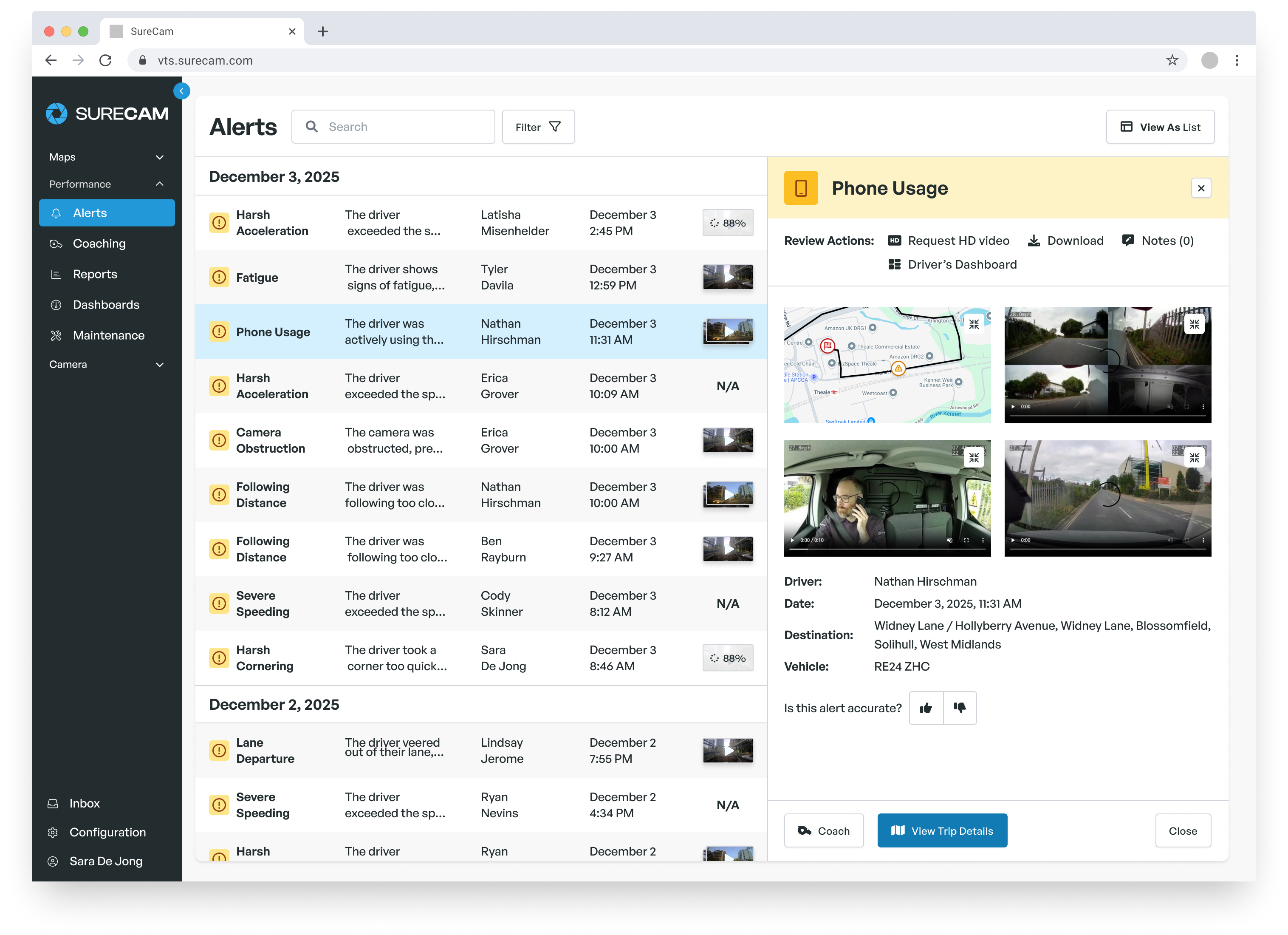
GPS alone gets a vehicle to an address. It confirms arrival. It does not show what happened after the technician stepped out of the truck. Combining GPS location data with synchronized video gives field service operations something GPS cannot provide on its own: visual confirmation of activity, site condition at arrival, and vehicle position at departure.
When a customer disputes whether the technician completed the work, or whether the truck caused damage visible in the driveway, the fleet manager retrieves footage and timestamped location data in minutes. That capability converts a customer service conversation from a dispute without resolution into a documented record with a clear answer.
Timestamped Footage as a Service Record
The departure footage matters as much as the arrival. If a gate was standing when the technician backed out, that documentation exists. If the technician exited a tight commercial space without contact, that documentation exists. Cameras create a before-and-after record of every job site visit.
This matters especially in industries where customers schedule multiple service vendors on the same day. HVAC, plumbing, and electrical customers often have two or three contractors on site within a short window. Cameras and timestamped GPS data make it possible to establish definitively who was on the property, when they arrived, and when they left. That specificity removes the ambiguity that turns a customer concern into a months-long insurance dispute.
Driver Coaching for Field Service Conditions
Backing, Parking, and the Maneuvers That Produce Claims
Backing incidents rank among the most common sources of commercial vehicle damage. For field service fleets, the numbers track directly: drivers reverse into driveways, back away from garage access points, and exit commercial loading areas dozens of times per week. The cumulative exposure from reversing maneuvers across an entire fleet is significant.
A rear-facing camera with event-triggered recording changes how drivers approach these maneuvers. Knowing the footage exists shifts behavior before an incident occurs. When a safety manager reviews footage of a near-miss and works through it with the driver directly, that driver approaches the next reversing situation with different awareness. The coaching conversation gains specificity: here is the footage from Tuesday, here is what the camera captured, and here is what needs to change. Evidence-based coaching produces different outcomes than general safety reminders.
City and Residential Road Coaching
Field service driving in residential neighborhoods involves pedestrian traffic, school zones, cyclists, and the constant exposure of vehicles pulling out of driveways without warning. Speeding on residential streets creates both collision risk and a reputational problem when homeowners recognize the branded truck in their neighborhood. One video clip shared online carries a different kind of cost.
Driver behavior cameras capture the patterns that accumulate into serious risk: following distance, hard braking events, distracted driving at intersections, and speed in zones where the fleet's presence is visible and associated with the company name on the door. Fleet managers who review event footage systematically identify their highest-risk drivers and address the behavior before a collision occurs. The result is a coaching program built on real data rather than gut instinct about which drivers need attention.
The Insurance Math for Field Service Fleets
Insurance carriers have become more sophisticated about fleet camera programs. A fleet that documents its camera deployment, its coaching process, and its incident response protocol presents a different risk profile than one with no visibility into driver behavior. Many carriers now offer premium adjustments for verified camera programs, reflecting the reality that camera-equipped fleets produce faster claims resolution, fewer disputes, and lower litigation exposure.
Beyond premium conversations, the operational impact of faster claims resolution compounds over time. A claim that previously required weeks of back-and-forth between insurers resolves in days when footage exists from both vehicles. The fleet avoids legal costs associated with disputed liability. The driver avoids an unresolved claim sitting in review. The customer complaint closes quickly rather than festering into a formal dispute that consumes hours of management time.
Field service companies that bring their camera program data to insurance renewal conversations, with before-and-after incident rates and a documented footage policy, give their brokers something concrete to work with. That documentation builds a case for rate stabilization even in a market where commercial fleet premiums have moved sharply higher.
Maneri Traffic Control: Cameras in the Field
Maneri Traffic Control runs a field service fleet under conditions most operators would consider extreme. The family-owned California company deploys crews to busy interstate highways to manage traffic control at construction and maintenance sites. Two employees died in the line of duty before co-owner Maria Maneri and her family committed fully to advanced safety technology.
After experiencing repeated failures with a previous connected camera provider, including intermittent product outages and inadequate support, Maneri Traffic Control switched to SureCam. The company deployed forward and rear-facing cameras across the fleet and added SureCam LiveCheck for real-time remote monitoring of active job sites. Daily randomized safety audits became part of the standard safety program, conducted by managers via live video without leaving the office. GPS integration layered arrival time verification on top of visual monitoring.
The results were tracked across two dimensions. Safety improved: managers could monitor crew behavior on active highway sites in real time, and one employee was removed from service after footage captured negligent driving. Productivity improved: combining GPS arrival data with live camera access established clear accountability for site presence and performance. Maneri Traffic Control documented a 70% increase in team productivity after deploying the full system.
"It's been a big improvement since we made the switch. We've captured a handful of incidents and handled them in real-time," said Maria Maneri, Co-owner.
The pattern at Maneri reflects what field service operators across industries report: cameras do not just protect against claims. They produce a safer, more accountable, more productive operation.
Turning Cameras Into a Business Asset
Field service companies that treat cameras as a compliance requirement tend to see compliance results. The ones that treat cameras as a safety, liability, and operations tool see a broader return that shows up in claims costs, insurance premiums, driver retention, and customer satisfaction.
The implementation priorities for a field service fleet:
- Forward-facing cameras on every vehicle, with rear-facing coverage on any vehicle that regularly backs into job sites
- GPS data integrated with video timestamps for synchronized service records
- Rear-facing event alerts to address backing behavior before it produces claims
- A coaching process that uses footage to make behavioral feedback specific and actionable
- A claims response process that retrieves footage immediately after any incident notification
- Documented program data for insurance renewal negotiations
For fleets where the standard response to a customer property damage complaint amounts to "someone will look into it," cameras convert that delayed answer into a definitive, footage-backed resolution in under five minutes. The liability story either happened or it did not. The driver made contact or they did not. The truck arrived at 9:47 or it did not.
That clarity has value far beyond any single claim.



.png)