Commercial vs. Consumer Dash Cams for Fleets: 2026 Guide
20 Oct 2026
driver coaching


Improve fleet safety, reduce operating costs, and optimize field performance with an easy-to-use platform for video, GPS tracking, driver coaching, maintenance, asset tracking, and real-time fleet insights.
Drive your total fleet operations with SureCam’s all-in-one video telematics solution.
Valuable guides, case studies, and videos to help you optimize fleet management, safety, and productivity with telematics solutions.
Values, job opportunities, and ways to connect or partner with SureCam.
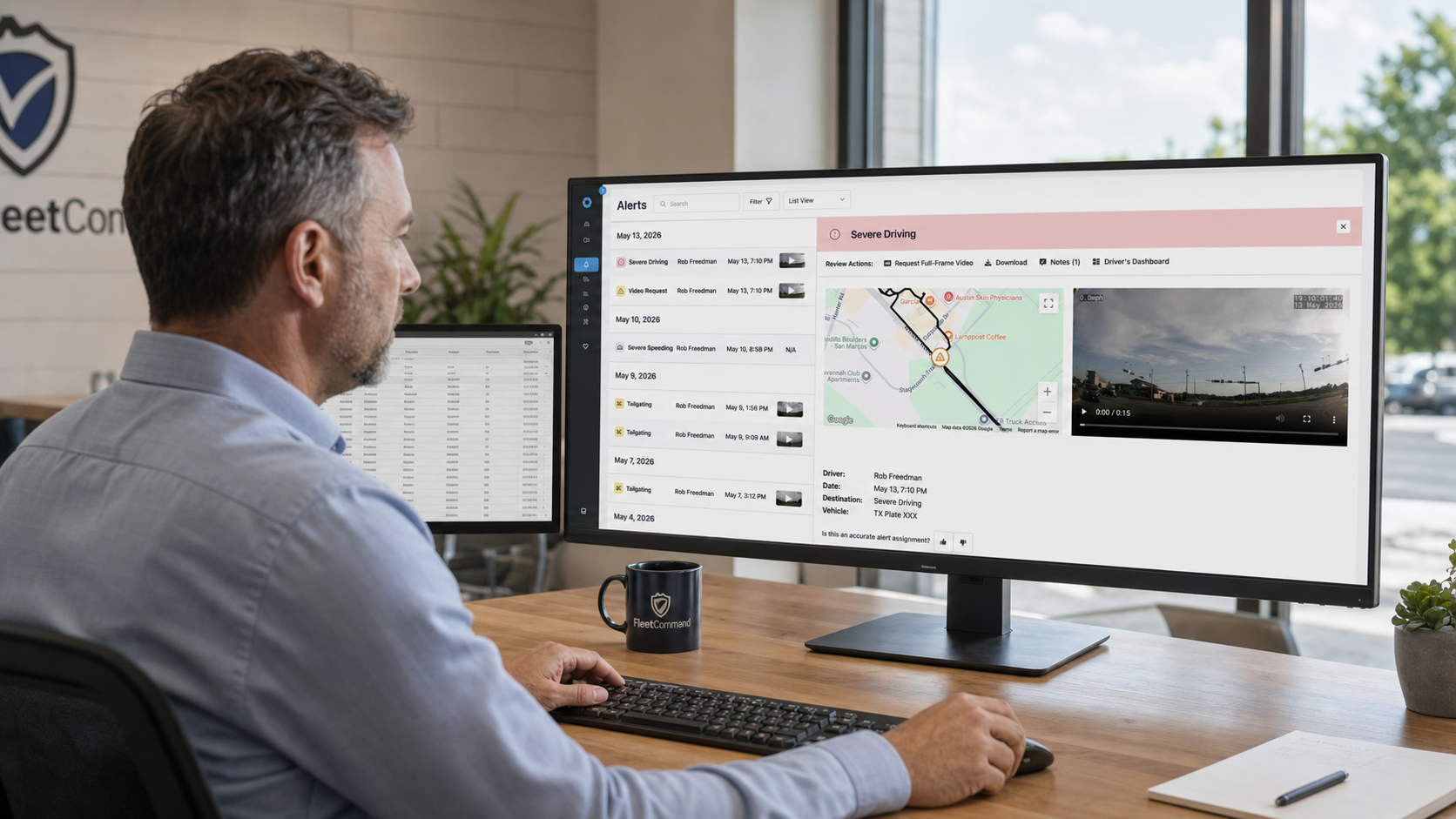




Driver behavior monitoring is a data collection and analysis system that uses in-vehicle sensors, AI processing, and connected cameras to detect, score, and report on how drivers operate their vehicles. Fleet managers gain objective visibility into risk behaviors before those behaviors produce accidents, claims, or regulatory trouble.
The core mechanics work like this. An onboard device reads inputs from accelerometers, GPS, cameras, and sometimes radar or infrared sensors. When a reading crosses a defined threshold (a hard brake, a sharp corner, a following-distance gap collapsing faster than safe physics allow), the system logs an event. Those events, gathered over time, feed a scoring model that compares individual drivers against fleet averages and identifies who needs coaching, who warrants recognition, and where systemic training gaps exist.
Two elements separate driver behavior monitoring from dashcam-only recording and from traditional GPS telematics. First, it generates structured data automatically, without a manager manually reviewing hours of footage. Second, it converts that data into actionable scores and alerts. The camera records. The system interprets. The manager coaches.
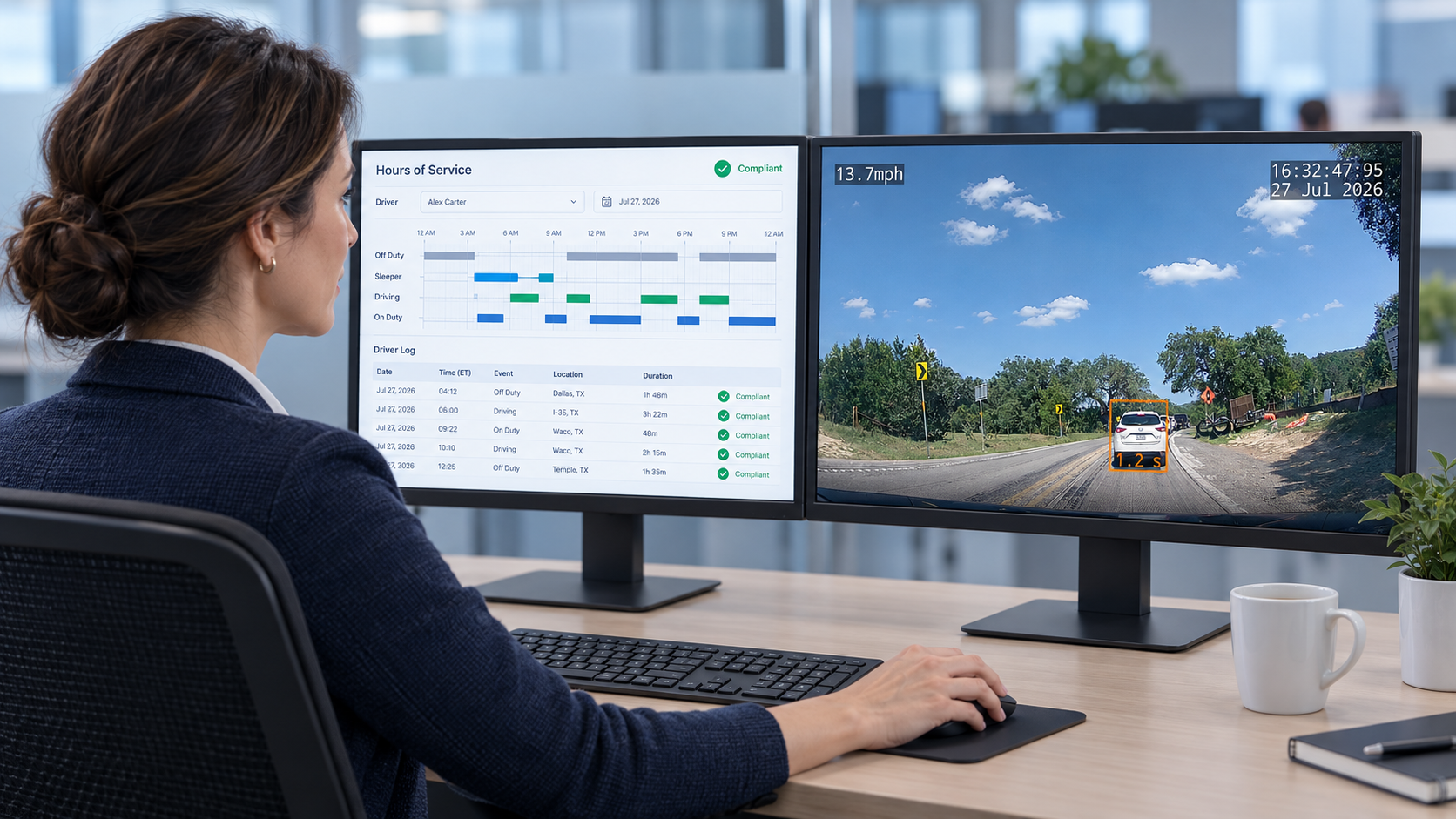
Driver behavior monitoring does not track Hours of Service, generate FMCSA-mandated logs, or replace ELD hardware. Those functions sit in a different product category. A fleet with no ELD obligation gains from behavior monitoring exactly as a regulated carrier does, because the underlying risk (distracted, fatigued, or aggressive driving) exists in both operations regardless of carrier classification.
Modern driver behavior monitoring covers a wider detection set than earlier generations of fleet cameras and telematics. The category has moved well past simple speeding alerts. Today's AI-powered systems detect following distance violations, driver distraction, fatigue indicators, and multi-axis vehicle movement patterns that were invisible to legacy telematics platforms. Each detection type feeds the same underlying score while generating distinct alert types suited to different coaching conversations.
The foundational behaviors every system detects carry clear physical signatures in accelerometer and GPS data. Hard braking events log when deceleration exceeds a defined g-force threshold, typically because a driver reacted late to slowing traffic ahead. Harsh acceleration captures rapid positive g-force during stops or lane merges. Cornering events record lateral g-force spikes indicating excess speed through curves. Speeding events trigger when a vehicle exceeds either a preset company limit or the GPS-matched posted speed limit for that specific road segment.
Following distance has become one of the more analytically valuable inputs in AI driver scoring. AI vision systems estimate the gap between a vehicle and the one ahead, compare it to current speed and calculated safe stopping distance, and flag when the gap falls below threshold. A driver holding 2 seconds of following distance at 60 miles per hour creates a very different risk signature than a driver holding 2 seconds at 25 miles per hour through a school zone. Contextual scoring accounts for that difference. The result is detection that identifies tailgating in a way that raw accelerometer data alone cannot.
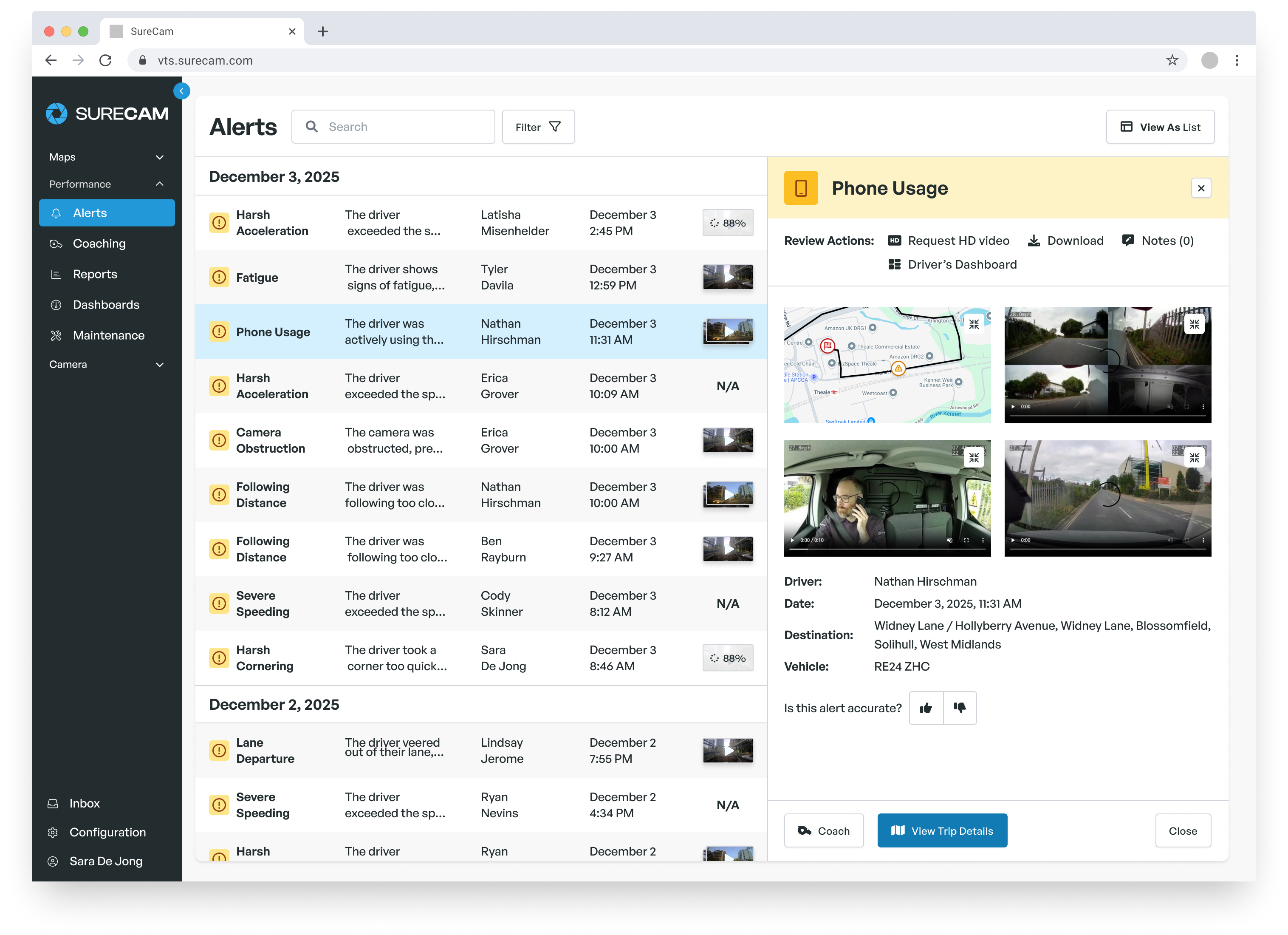
These events serve two distinct purposes in fleet driver behavior analytics. Real-time alerting notifies a manager within seconds of the event, enabling same-day coaching rather than a monthly review cycle that addresses problems weeks after they occurred. Trend analysis tells a more complex story over time. A hard braking pattern concentrated in afternoon hours across a driver's extended record reveals something different than a single event triggered by an unexpected lane change from another vehicle.
Driver-facing cameras with AI image recognition have expanded the detection set significantly. Distraction detection identifies phone use (hand to ear, eyes tracking toward a device in the lap), smoking, eating behind the wheel, seatbelt non-compliance, and eyes-off-road intervals that exceed safe thresholds. Fatigue detection reads facial geometry: drooping eyelids, head nodding, and microsleep signatures that appear before a driver becomes consciously aware of impairment.
Both event types generate alerts that differ from road-event alerts in an important way: they identify root causes rather than outcomes. A hard braking event tells a manager the driver reacted late. A distraction alert tells a manager why. This causal layer changes coaching conversations. Shifting from "you braked hard at 10:48 AM" to "your eyes left the road for 4.2 seconds before that brake event" moves the discussion from performance feedback to specific behavioral correction. That specificity changes what a driver actually hears and whether the conversation produces lasting change.
An event log on its own carries limited operational value. The value appears when a system aggregates events into a score that accounts for driving time, route complexity, and fleet-wide context. The scoring layer transforms a list of incidents into a comparative framework that managers can use for coaching priorities, recognition, and program measurement.
A driver logging two hard braking events in 10 miles of dense urban driving looks different from a driver logging two events in 200 miles of mixed highway and rural routes. Good scoring systems normalize for exposure. They divide total events by miles driven, hours behind the wheel, or both. They weight event severity: recorded phone use on a highway at speed carries more score weight than a single harsh acceleration leaving a parking lot. Fleet managers with well-implemented driver behavior analytics can adjust weighting to reflect the actual risk profile of their operation rather than a generic industry default.
The output is a driver score, typically displayed on a rolling 30-day or 90-day basis so managers read trajectory rather than a static snapshot. A driver improving from 68 to 84 over two months represents a coaching success regardless of where that score sits in the fleet distribution. A driver holding at 91 who spikes during a single week warrants different attention than a chronic low performer. Both require a response. The responses look nothing alike.
Scores aggregate upward depending on how a fleet structures its account. Individual driver scores roll into vehicle scores, route scores, or department scores. That rollup lets operations leaders separate systemic problems (a route that consistently produces low scores across multiple drivers who rotate through it) from individual performance issues. Both categories need attention, but they call for completely different interventions: route redesign and scheduling changes on one side, individualized coaching on the other.
Data without action produces two predictable outcomes: drivers who feel surveilled without any benefit to them, and managers sitting on event alerts with no system to process them. The coaching workflow converts monitoring data into measurable behavior change. It requires structure to scale.
Same-day or next-day coaching produces better retention than monthly review sessions. When a manager addresses a specific event within 24 hours, the driver still holds a mental image of the situation and road conditions. The conversation anchors to what actually happened rather than to a report generated two weeks after the fact.
This timing principle drives real outcomes. Lisa Lamons, Safety Training and DOT Compliance Manager at Concrete Strategies, described building a coaching workflow after deploying SureCam cameras on the company's 33 largest vehicles. Harsh event alerts enabled her team to sit down with drivers the same day or the following day to address specific behaviors on video. The result was a 75% drop in third-party claims and claims-handling time that fell from roughly one week per month to under 10 hours. Lamons described the clarity footage brought to every session: "The answer is in the video."
When footage accompanies the coaching discussion, the driver sees exactly what the manager sees. Perception gaps disappear. The conversation moves immediately to what to do differently rather than to whether the event happened the way the manager described. That shift from disputed recollection to shared evidence changes the texture of coaching conversations at every level of the organization.
Sustainable coaching requires more than reviewing individual events. A program that works for a 10-truck fleet often fails at 50 trucks because no manager can review every flagged event while simultaneously running field operations. Structure needs to hold across growth.
The most operationally sound approach combines automated severity filters with manager review triggers. The system flags events exceeding a defined threshold or recurring within a set window for the same driver. Managers review that filtered set rather than every logged instance. The weekly coaching queue stays manageable, and the events that most need attention receive it. This structure prevents monitoring from consuming a safety manager's available hours while ensuring that nothing consequential goes unaddressed.
Recognition belongs in the program alongside correction. Drivers who maintain high scores across a quarter, or who show consistent improvement from a lower baseline, benefit from acknowledgment as much as lower performers benefit from coaching. A scoring system that surfaces only problems trains drivers to view the monitoring program as a surveillance tool aimed against them. One that surfaces excellence alongside risk positions it as a performance system that works in their favor. That framing affects program adoption and shapes how honestly drivers report near-misses, equipment issues, and difficult road conditions.
A persistent misconception holds that driver behavior monitoring applies primarily to regulated carriers managing CSA scores and FMCSA audit exposure. This conflation of two different monitoring categories sends non-ELD fleets in the wrong direction. The two categories share a vehicle and a driver, but they measure entirely different things.
| Dimension | Behavior Monitoring | ELD / Compliance Monitoring |
|---|---|---|
| What it tracks | Driving quality: speed, braking, following distance, distraction, fatigue | Driver duty status, rest cycles, and log accuracy |
| Hardware required | Connected dash cam | Electronic Logging Device (ELD) |
| Regulatory obligation | No FMCSA requirement | Required for CMVs over 10,001 lbs in interstate commerce |
| Primary output | Driver behavior score and event alerts | Hours of Service log and DVIR |
| Who benefits | Any commercial fleet with drivers on the road | Regulated interstate carriers |
| Works without ELD | Yes | N/A |
HOS compliance monitoring tracks driver duty status, break timing, and log accuracy. It requires ELD hardware and connects to FMCSA record-keeping obligations. Behavior monitoring tracks driving quality: the physical inputs at the wheel, the patterns in how a driver responds to traffic conditions. These systems run independently. A fleet of HVAC service vans, concrete mixer trucks, or utility vehicles with no ELD obligation benefits from behavior monitoring in every way a regulated carrier does.
The risk profile does not change based on carrier classification. A hard-braking event on a last-mile delivery route carries the same accident potential as one on a regulated interstate freight run. A distracted driver on a local service call produces the same liability exposure as one on a long-haul freight lane. Carrier classification affects paperwork requirements. It does not affect stopping distance, reaction time, or the outcome of a collision.
Fleets that have avoided behavior monitoring on the assumption that it requires ELD overhead have sometimes identified a real problem with specific vendors, but not with the category itself. The monitoring capability and the compliance infrastructure run on separate hardware in many configurations. A fleet can adopt real-time driver insights and behavior scoring without an ELD contract, without FMCSA reporting modules, and without any change to its existing compliance approach.
SureCam's driver behavior monitoring runs through its connected camera platform without ELD hardware requirements or HOS workflow integration. The system detects and logs road events, supports driver-facing AI for distraction and fatigue detection, and delivers event footage automatically over the cellular network. Everything appears in the web portal with video attached to the alert, without waiting for a weekly report batch or contacting an account manager to retrieve footage.
The platform supports both self-managed and fully managed service models. Self-managed fleets run their own coaching workflows using automated alerts and driver scoring dashboards. Fleets that prefer managed support route video review through SureCam's team. The underlying data flows identically in both configurations: events trigger automatically, footage uploads without driver action, and managers access the full record through a single web portal.
For non-ELD fleets, the model removes the most common barrier to adopting behavior monitoring. There is no compliance stack to configure, no HOS log to reconcile, and no FMCSA-reporting module to stand up before the cameras start delivering value. The system starts at the camera and ends at the coaching conversation. Fleet managers who want focused driver safety tools without paying into a platform built around compliance workflows they do not run have a direct path from installation to driver improvement data. Speak to one of our driver safety experts today to start building your driver safety program.